

The man called “Mountain Goat”
John Clarke is considered by many as Canada’s most accomplished mountaineer with 600 first ascents; some argue he is the world’s most accomplished solo mountaineer.
September 23rd, 2026
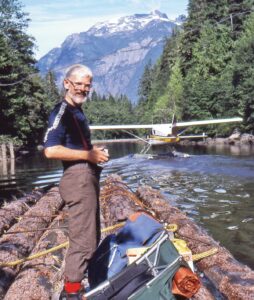
A float plane drops off John Clarke on a log boom at Cumsack Creek, Bute Inlet, BC.
“I had to know what was beyond the next horizon.”—John Clarke
Review by Mark Forsythe
When you read what John Clarke accomplished in his lifetime, the proverbial comet blazing across a night sky comes to mind. In his 58 years he achieved legendary mountaineer status, became an acclaimed wilderness educator and dedicated conservationist. Clarke lived for BC’s Coastal Mountains and spent up to six months each year traversing vast wilderness areas by foot or on skis, crossing icefields or skirting around deadly crevasses to reach the next peak. Credited with more than 600 first ascents, many of these were on solo expeditions, which broke a cardinal rule for many in the mountaineering community. (The pilot who dropped him off on glaciers and lakes later remarked, “By agreeing to fly him where he wanted to go, I became his accomplice.”)
Clarke never felt lonely in the mountains and revelled in “absolute isolation.” During his first major solo expedition into the Misty Icefields, he climbed 12 different peaks. In 1972 he spent eight months in the wilderness, marking 50 first ascents. He bushwhacked up steep slopes, forded icy creeks, dodged grizzly bears, camped atop glaciers (often waiting out storms) and existed on granola, lentils and butter. He built stone cairns atop these peaks and tucked a hand-scribbled note inside reading: “Greetings from the 20th century.” If he missed a peak, he would return—even many years later. The level of plotting, skill and sheer determination is hard to fathom. Clarke is considered by many as Canada’s most accomplished mountaineer during a career that began in the 1960s and continued until his death from a brain tumour in 2003. Some argue he is the world’s most accomplished solo mountaineer.
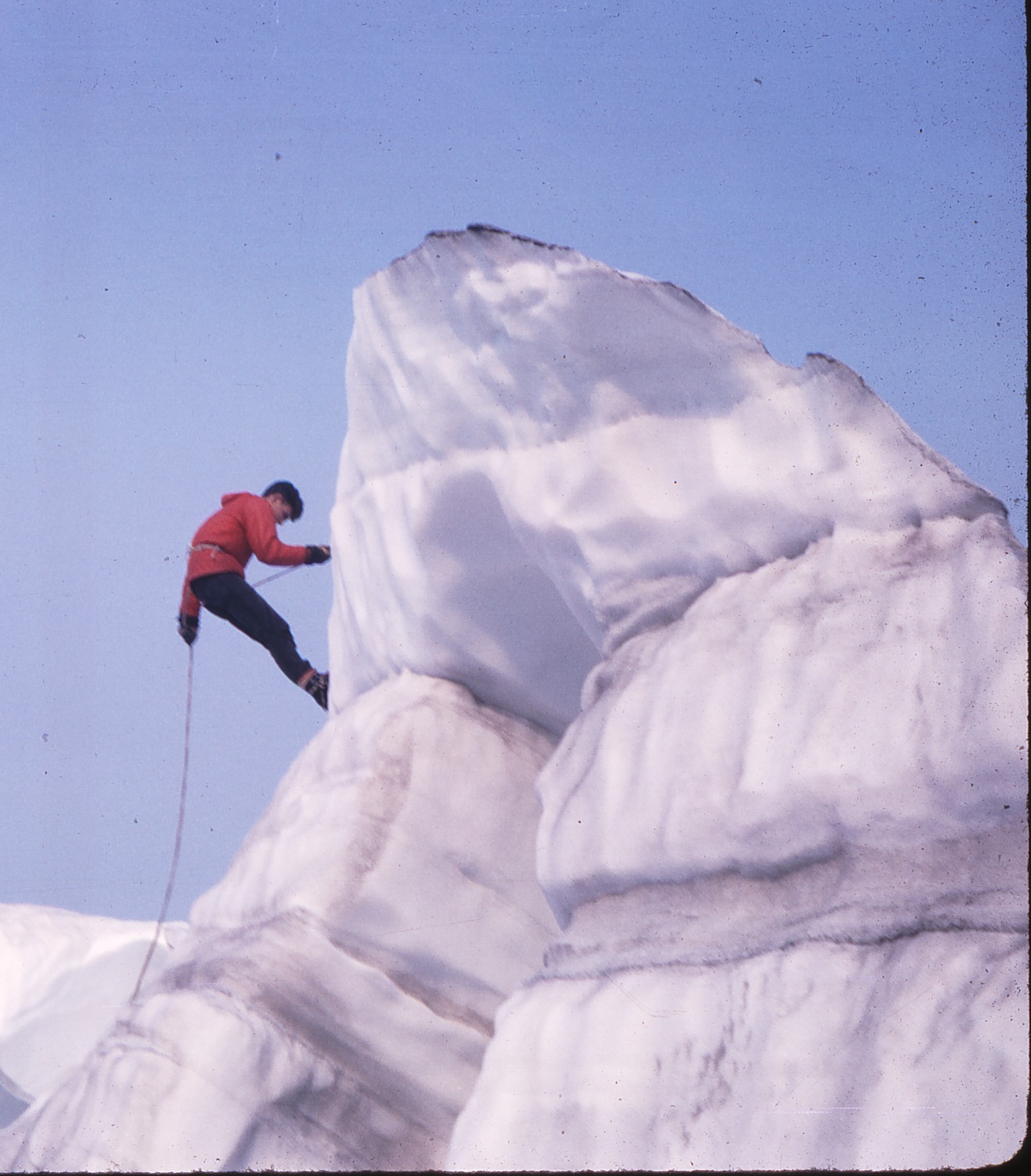
John Clarke rappels off Castle Towers Mountain, Garibaldi Park, 1965.
Friend and mountaineer Lisa Baile traces his remarkable story in John Clarke: Explorer of the Coast Mountains (originally published in 2012 and recently reissued by Harbour Publishing). Drawing from his diaries, columns for the Canadian Alpine Journal and interviews with friends, a nuanced portrait emerges revealing how and why he inspired so many people. That includes another famous BC mountaineer, John Baldwin. Their first 29-day trip together included 10 days tent-bound by weather—yet they still managed to make 24 first ascents and reached the conclusion they were kindred spirits. “We got along instantly,” said Baldwin. “We were totally on the same wavelength and wanted to do the same things. It was fantastic.” A young climber and conservationist named Randy Stoltmann was another mountaineering companion; Clarke watched helplessly as Stoltmann was struck by an avalanche, falling 1,000 feet to his death. (A wilderness area north of Squamish is named in his memory.) This experience became a catalyst for Clarke to dedicate himself to wilderness preservation through public education.
There are ample photos and maps, along with Baile’s eloquent descriptions of wild spaces that most will never experience, such as this one: “…peaks floating above the clouds like lost continents; dark, horn-shaped summits rearing out of glistening icefalls; a glimpse into the narrow gorge of Headwall Creek where a falling rock takes twelve seconds to hit anything; thousands of feet of polished rock; frigid pools connected by warm granite slabs; snoozing goats; and far below, the sun-struck braid of the Tahumming River snaking its way toward the infinite blue of Toba Inlet.” You can almost hear the wind in the trees.
Even with decades of first ascents behind him, Baile says Clarke was a man of humility with a rare ability to make everyone he met feel special. He could be laugh-out-loud funny—known to climb in long johns and a white cotton shirt, he would pin on a tie while summiting. Children loved him and he spent more time playing with them than visiting with their parents. He wasn’t interested in acquiring “trophy climbs” of the highest peaks; it was about exploring unknown territory, where he was happiest, “in a kind of a dream state.”
Baile stitches Clarke’s story together like a traverse along the peaks and valleys of his life. An Irish immigrant, as a child Clarke connected instantly with BC’s mystical mountains and was soon exploring. His mountaineering obsession also resulted in fractured relationships with women who knew the mountains were his first love. (Until much later in his life when he did marry and fathered a son.)
Baile closes with Clarke’s work as a wilderness educator (through WildEd) and collaboration with the Squamish First Nation through the Witness program, which connected urbanites with wilderness areas threatened by logging. The Squamish people named him Xwexwesélkn or “Mountain Goat” to acknowledge his deep commitment to wilderness and a mountain was named in his honour after his passing. 9781998526536
Mark Forsythe worked at CBC Radio for 30 years, 18 as host of BC Almanac. He co-authored four books about BC with Greg Dickson, frequents the outdoors, lives in Fort Langley and is president of the Langley Heritage Society.
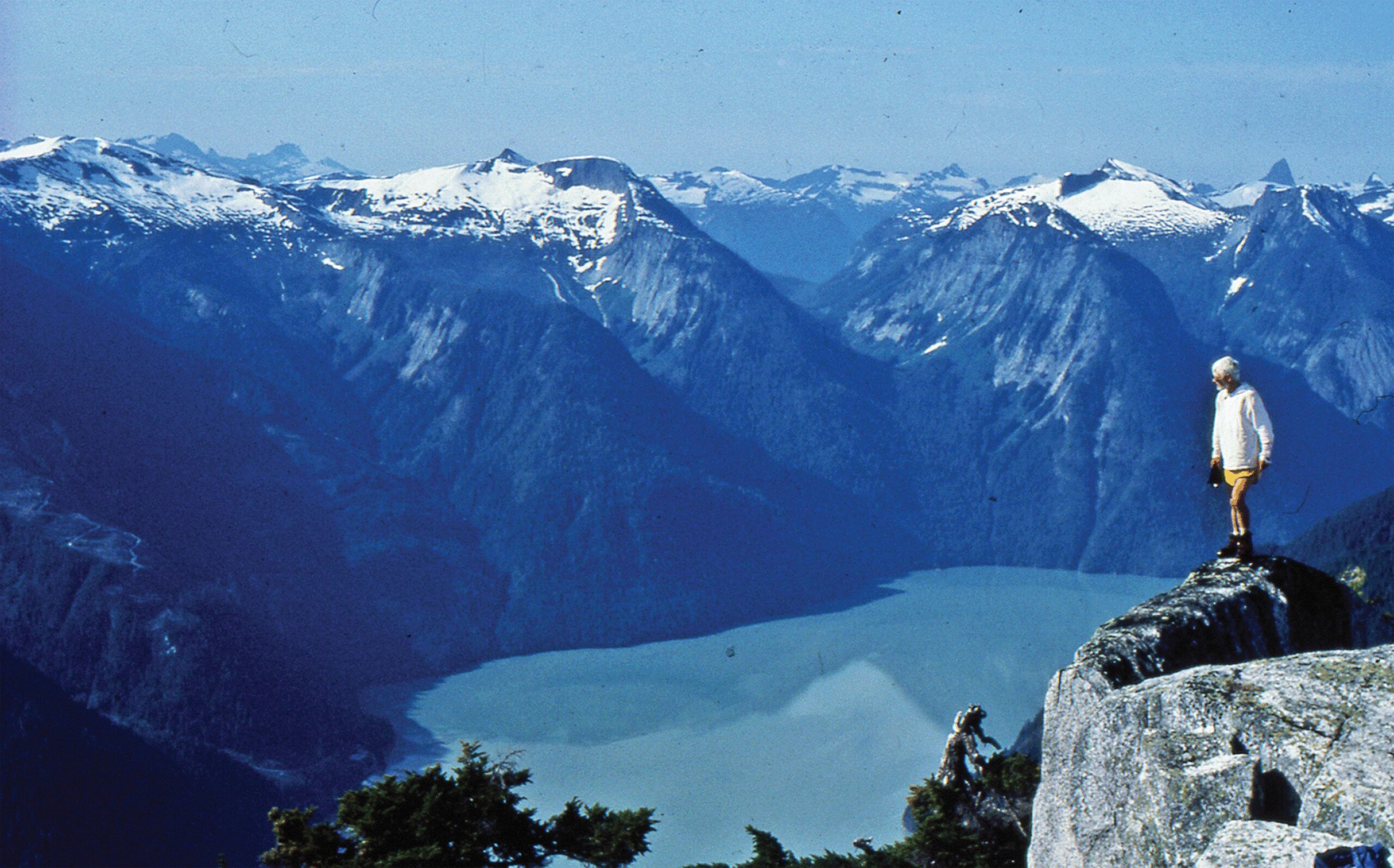
John Clarke at the head of Toba Inlet—a remote, deep fjord located 100 air miles north of Vancouver.
EXCERPT
John Clarke once took an inexperienced friend, Barbara Handford on a climb with him. He wrote about it for Canadian Alpine Journal. Several decades later, Handford verbally recounted the same climb, recorded in John Clarke: Explorer of the Coast Mountains. It “sounds as if the two of them had been on different trips,” writes author, Lisa Baile. Here we excerpt two segments about this climb; Clarke’s version and Handford’s perception of the same event. The two couldn’t be more different.
John Clarke: “Early next morning we headed for the peaks of Crerar by hiking along the crest toward the northwest peak, the lower of the two and our first objective. We were fortunate with the weather up to this point, but clouds were now boiling up from the valley to about 4,000 feet. The blocky northwest ridge of the first peak provided good class 3-4 rock, but its summit revealed that the main peak was gained by dropping south from the crest and skirting the main divide. The peak, a sharp crest at 8,000 feet, gave a great view of the mountains northwest of Squamish and those near Mount Tinniswood.
Barbara Handford: “We had to start going up to the rocky part and the ice …I’m not used to exposure and I’m a little bit scared of heights …We had to do some kind of chimney stuff and go around rocks and things [but] John figured we didn’t really need to rope up …Then we came to a really pointy kind of rock, which we had to climb over; and it was two thousand feet down that way and about a thousand feet down that way. I’m like, ‘Oh my goodness!’ John just walked across it in his boots because he had no fear and complete balance. I thought, I’m not walking across that! John said, ‘Just sit on it and inch along.’ When I got over it, John very nicely let me be the first person to stand on the first peak. We built a little cairn and that was all very exciting. Then John said, “We don’t have time to go back the way we came, so the best way for us to go is down this snow chute.” It was August and the snow was rock hard. John said, ‘You have to be really careful. You have to kick steps, and you have to turn around and traverse down this steep chute.’ We had ice axes—I’d used one a couple of times but I’d never had to save myself. So we started down. All of a sudden I slipped. I thought, Okay, this is it! I’m going to die on this frigging mountain! I went screaming down the snow chute. I knew there was a big boulder sticking out of the ice partway down because I’d seen it. My glasses hit the side of the boulder and went flying off into a crevice—not a crevasse, thank god! As I went down, I thought, I guess I’m going to go over the edge! But then I thought this being a chute, there are probably stones at the bottom. By then, I was starting to get the axe in as John kept yelling, “Get your axe in!” I had no strength—I was a skinny thing—but I finally got the axe into the snow and that slowed me down a bit. I’m on my stomach, and all of a sudden I felt the bottom of my boots bank into the rocks. I flipped into the air and did a complete three-sixty and landed sitting up. And all I’ve got is this cut on my hand. I held my bleeding hand over my head and I started screaming, ‘God is in the mountains, God is in the mountains!’ And I’m not even religious! I was just so happy to be alive!
John was so relieved because he was visualizing rescues and all sorts of crap, but then my body went into complete catatonia. I was terrified. ‘I just can’t move,’ I told him.
‘Well, we’ve got to go,’ he said. ‘We need to get down to the timber.’
Finally I was able to get and up and follow him. I was just in shock.”





Leave a Reply