


A life of wonder
For the past 40 years, Vancouver-based Bill Pechet’s art, architectural and design works have been driven by his wit and whimsy.
September 23rd, 2026
“[A list of Pechet’s motifs and materials includes:] mustard bottles, picnic tables, honey bears, salmon, high school chemistry beakers, marshmallows, folded paper dolls, music boxes, suitcases, watering cans, keyholes, bongs, cigar rings, spoons, barns, bunnies, a hand with painted nails. One of Pechet’s enduringly effective strategies is the immense and surreal enlargement of often banal objects.”
Review by Robin Laurence
Most days, it is just too challenging to discuss Bill Pechet’s interdisciplinary career without compiling list after list after long-and-varied list. The most bare bones description of his Vancouver-based practice would include art, architecture and design. Now cue a list—the first of many—per the inside front cover of updn: 88 Spins with Bill Pechet (ORO Editions $51.99), a multilayered survey of his multivalent work by architectural scholar Leslie Van Duzer. Here, Pechet’s professional accomplishments are given as “illustrated children’s books, street furniture, urban lighting systems, set and costume designs for dance and theatre, cemetery designs, residences and many public art pieces both monumental and intimate.” To this, add a raft of creations both practical and unlikely—everything from retail and office interiors, reconfigured parks and plazas, a sensitive memorial garden and a private residence built into a challenging natural environment to a space-defining grid of 388 security mirrors, immense cast concrete chairs situated on a suburban beach, functioning waterworks shaped like an enormous watering can, a mist- and light-emitting public art piece in the form of a gigantic beaker, vent stacks evoking an upraised hand with artificial fingernails and circles of soft white light hovering like smoke rings above a downtown street. Oh, and don’t forget a bong-inspired bridge for children, a drinking fountain in the form of a giant spoon, light fixtures resembling upside-down garbage cans, an art installation comprising two large glass vessels and a “bajillion” miniature marshmallows, another installation featuring concrete sponges, cast-resin honey bears and a hairy floor lamp with skinny bird feet—and, with his then architectural partner Stephanie Robb, a Brobdingnagian orange fleece sweater that entirely filled the Canadian pavilion at the 2006 Venice Biennale of Architecture.
“In Bill’s wonderland, delight comes from having your expectations upended, from finding your sense of agency compromised, from being ensnared in thick webs of references and puns,” Van Duzer tells us. The upending of expectations is first signalled by the book’s title. On architectural plans, “updn” indicates stairs; it can also be, as seen on the cleverly designed cover, an ambigram, a visual palindrome that invites you to totally reorient yourself. And while an architectural definition of “spin” might indicate rotational movement or spinning elements, here it suggests a lighthearted ride or romp around an undertaking or a playful interpretation of a subject.
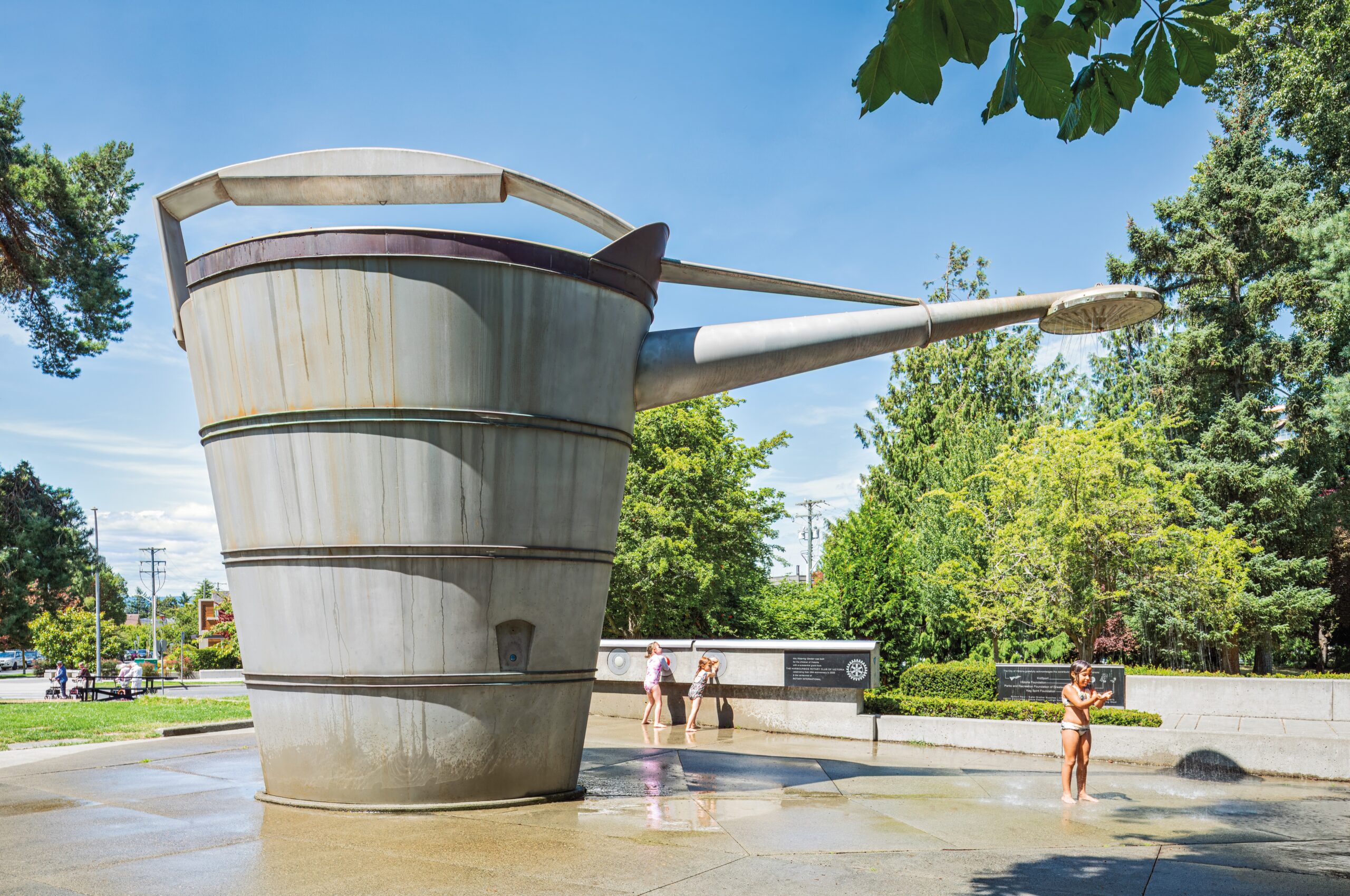
Watering Garden, Beacon Hill Park, Victoria. Desgin by Pechet and Robb Art & Architecture.
A long-time friend and colleague of Pechet’s, Van Duzer studied architecture at the University of California Berkeley, taught widely and moved to Vancouver in 2010 to take up the directorship of the School of Architecture and Landscape Architecture at the University of British Columbia. Now a professor who divides her time between Vancouver and the Sunshine Coast, she is the prize-winning author, co-author or co-editor of a number of architectural books and also initiated the series of monographs, West Coast Modern Houses. In updn, she writes in terms that are responsive to architectural and design concepts while also being highly accessible to the layperson.
Van Duzer explains why the 88 spins are arranged alphabetically and discusses each one individually while also giving us an overview of Pechet’s approaches to his varied and various projects and commissions. She illuminates the “multiple overlapping threads” in his practice and his work’s openness to different interpretations. “No matter what the scale of a project, a thick network of relationships…provides alternate pathways into the work without creating closed narratives,” she writes. Pechet responds, “Because I see myself between disciplines, most projects are in dialogue with multiple audiences; each of whom have different worldviews, aspirations, histories and belief systems…” Meaning, he continues, “arises from a continuous loop of references, relationships, reflections.”
Throughout the book, Van Duzer expresses a fond appreciation of the wit, whimsy and sense of wonder that Pechet brings to so many of his projects. She also gives us another list, this one of Pechet’s forms and motifs and materials: “mustard bottles, picnic tables, honey bears, salmon, high school chemistry beakers, marshmallows, folded paper dolls, music boxes, suitcases, watering cans, keyholes, bongs, cigar rings, spoons, barns, bunnies, a hand with painted nails.” One of Pechet’s enduringly effective strategies is the immense and surreal enlargement of often banal objects.
Yet another list that could attach itself to Pechet’s practice would be that of the many places in which his architectural, landscaping, public art and public amenities projects are situated. Based in Vancouver for decades, working with Robb and then out of his own studio, he has won commissions all over Metro Vancouver as well as on southern Vancouver Island and the Sunshine Coast—and in Ontario, Manitoba, Alberta, California and Nevada. His graduate thesis project was staged in Japan, a country in which he has lived and worked for extended periods, drawn to both its culture and urbanism. (He credits his time in Japan with the discovery of his creative voice. Part of his soul, he says, “lives there.”)
Updn includes not only Van Duzer’s essay and commentaries along with extensive photographs, drawings and sketches, but also Pechet’s interviews with Lőrinc Vass and Thena Jean-hee Tak. The former explores the personal and professional significance of time Pechet spent living and working in Asia and the latter gives us an appreciation of his enlightened and often humorous approach to teaching and pedagogy. Important contributions also include a photographic essay by Greg Girard and a biography by Bill Richardson, delivered with his characteristic warmth, gently nudging humour and sensitivity to the myriad ways in which individual lives unspool themselves across place and time.
And now for a personal note: updn has reawakened my appreciation of Pechet’s public art and public amenities in my own neighbourhood. I am looking again at GRANtable, his enormously enlarged and throne-like chairs and 66-foot-long table situated in a small park near me. I’m also looking at the vertical light bars and modular seating on Granville Street in Vancouver’s designated “entertainment district.” Most of all, I’m enjoying the strings of coloured lights on Davie Street, their sequential on-and-off-ness running along overhead wires like shivers of delight.
Another personal note and full and final disclosure: my Georgia Straight review of Pechet’s 2007 exhibition, “finding sudoku,” is reproduced alongside one of his 88 spins. And I can’t lie: I’m immensely proud to have been given a wee place in this wonderfully engaging book. 9781961856530
Robin Laurence is an award-winning writer and critic based in Vancouver.





Leave a Reply