

These walls can talk
How a well-loved old apartment building in Vancouver’s West End attracted and nourished decades of writers and creative individuals.
September 30th, 2026
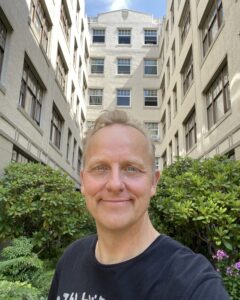
Poet and author, Kevin Spenst did a deep dive into the remarkable people who have lived in the apartment building he calls home—the historical Stanley Park Manor, completed in 1931. BC BookWorld conducted the following interview with him about his new book, Stanley Park Manor: A Collective History (Anvil $26) on the subject.
BC BookWorld: When and how did you come to live in Stanley Park Manor?
Kevin Spenst: The short answer is that I was in a pandemic breakup and my ex had once lived in the Manor and she recommended me to the building manager, Lyn Guy, who, in December of 2020, showed me a suite, which I loved on first sight.
BCBW: What was it like at the Manor during your first few years there?
KS: During the pandemic it felt like a safe haven—a sentiment that comes up a lot in the interviews I did with different Manor residents, the majority of whom moved in way before COVID. Early Manor resident, Simma Holt, one of the first female reporters in Vancouver to have a crime beat, told Lyn Guy that this was one of the few buildings that would rent to Jewish people in the 1940s. For me, I felt safe to follow an odd impulse or two. After I moved in, I bought wool at a local thrift store at Denman Mall and started wrapping things in wool and hanging other things from webs of wool I strung around my very tiny bedroom (some would call it a large closet). That initial phase of soft sculpture lasted a year and then I took it all down. I still have one videotape wrapped in wool (which also became the title of a small book of poetry). The building was my creative bower, buzzing with all kinds of colours. Looking back through my journals at the time, I see many instances of going out to swim or wander through Stanley Park, both adventures that led to conversations with strangers. Moving into this building, helped me move deeper into myself both in terms of solitude and a shared solace in nature with others.
BCBW: Did you already know people in the building when you moved in?
KS: I knew the artist, Shannon Pawliw. In fact, well before I’d moved in, I was over at her top floor corner unit a couple of times with my partner to play cards or Settlers of Catan. Shannon calls her place the “Beyoncé Suite” because it combines one of the regular studios with a former sun-room for the people in the 1930s who paid top dollar to live on the 6th floor (a whopping 65 bucks). Today, this is where Shannon dreams big. In fact, she opened an art gallery in East Vancouver not too many years ago, THIS gallery, which is a hive of community art with two openings a month. I organized a “Jane’s Walk” [community-led walks inspired by the late Jane Jacobs] this year that started at THIS with our city poet laureate, Elee Kraljii Gardiner, opening an afternoon of poetry readings in various locations in the Mount Pleasant neighbourhood. Shannon does so much to support the arts at THIS and she does it with a flair for fun. Many years ago, she curated informal art exhibits inside Stanley Park Manor. I like to think of my home as a creative incubator and I’m sure that’s the case for many others in the Manor.
BCBW: When did you realize the Manor was more than “just” a building—that it was more like a community?
KS: After I moved into the Manor, I went through an emotionally turbulent time. One of the first people I met had a dog, who everyone adored. One afternoon as we were both leaving through the back door exit of the building, we fell into conversation. I explained how I’d moved into the building after a break up. “Me too,” he said. “This is a halfway house for the broken hearted,” he laughed. I must add that there are many who’ve moved in to secure their freedom from unhappy relationships, so the building maintains an emotional balance. The front entrance of the building is where people stop and chat and in my first few months living here, Lyn’s friendly smile as I came or went meant the world to me.
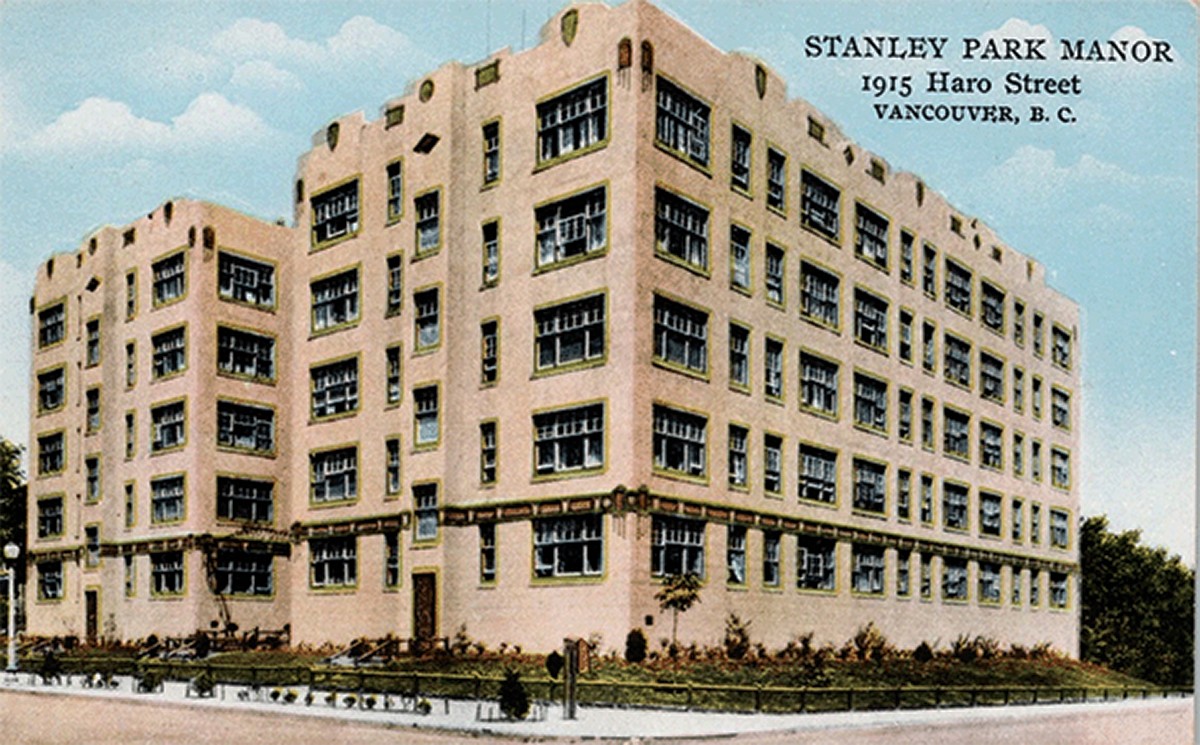
Postcard of Stanley Park Manor, date unknown.
BCBW: Describe some of the historical writers and interesting people that lived at the Manor before your time.
KS: One of the most interesting throughlines I found while researching the book was the long lineage of journalists in the building. In the early 1930s, Bob Bouchette took up residence in #601. Through the 30s, he was Vancouver’s most popular journalist. In his book The Great Depression: 1929-1939 (M&S, 1990/Anchor Canada, 2001), Pierre Berton wrote that Bouchette was “an iconoclast, who, when covering heavyweight boxing matches, made it his business to interview the loser while his colleagues were crowding round the champion.” Berton segues from here into Bouchette’s coverage of government relief camps, revealing the horrible conditions under which men worked for 20 cents a day. Bouchette’s articles helped sway public opinion against this “solution” to the poverty brought about by the depression. The next most important journalist resident of the Manor was Pierre Berton. Berton writes about living here in his memoir Starting Out 1920-1947 (M&S, 1987). This was brought to my attention by Greg Dickson, who I interviewed for the book. Greg, who just lives down the hall from me, has been a broadcaster, journalist, CBC producer and author. He was the perfect person to talk to about the many journalists living in our building from Simma Holt to Kiran Singh and others.
BCBW: What is the architectural significance of Stanley Park Manor?
KS: The issuing of a permit for a 122-unit apartment building at 1915 Haro was in the Vancouver Province in 1929 and its completion was advertised with a full-page spread in the Vancouver Sun in 1931. Given the fact that the Great Depression hit in late 1929, I think it’s remarkable that the Manor was completed. The Hotel Vancouver stood unfinished through much of the 1930s because of the drastic slowdown of the economy. The Manor is a remarkable exception perhaps due to the clout of W.A. Lightheart, whose family built many houses and apartments in the city. This was the last Lightheart build. Originally, there were 139 studio apartments (“flats” is the term used in the 1931 Vancouver Sun ad for the building). According to W.A. Lightheart’s granddaughter, who Lyn Guy has gotten to know over the years, Stanley Park Manor was built as a place for single women living in the city. In the early 1970s, the vast majority of the units were occupied by women.
H.H. Simmonds was the architect and he also designed a series of movie theaters, starting in the 1920s, throughout the Lower Mainland (including one in Cloverdale.) Perhaps our building is an expression of cinematic grandeur with a mix of the old (castellated heights) with modern interiors. Each unit feels like a house in miniature: with a small entranceway, a mantel (that originally had electric lights on either side shaped like candles), and French doors (few of which remain) to the dining nook and kitchen. In such small spaces, H.H. Simmonds designed so much detail.
BCBW: Anything else you would like to add?
KS: I’d like to thank all the people who trusted me with their words. It’s a remarkable honour to be the one who gets to help bring Stanley Park Manor, the building, into book form and this book is a compilation of so many voices and forms. I hope this book stands as a testament to the importance of affordable rent, an ethos of care and the power of creative living.
9781772142617





Leave a Reply