

Drawing as a tool of resistance
How Michael Nicoll Yahgulanaas created a distinct visual and narrative form that blends Haida design with Japanese manga and graphic novels—and made it famous.
September 30th, 2026
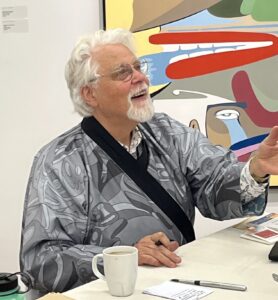
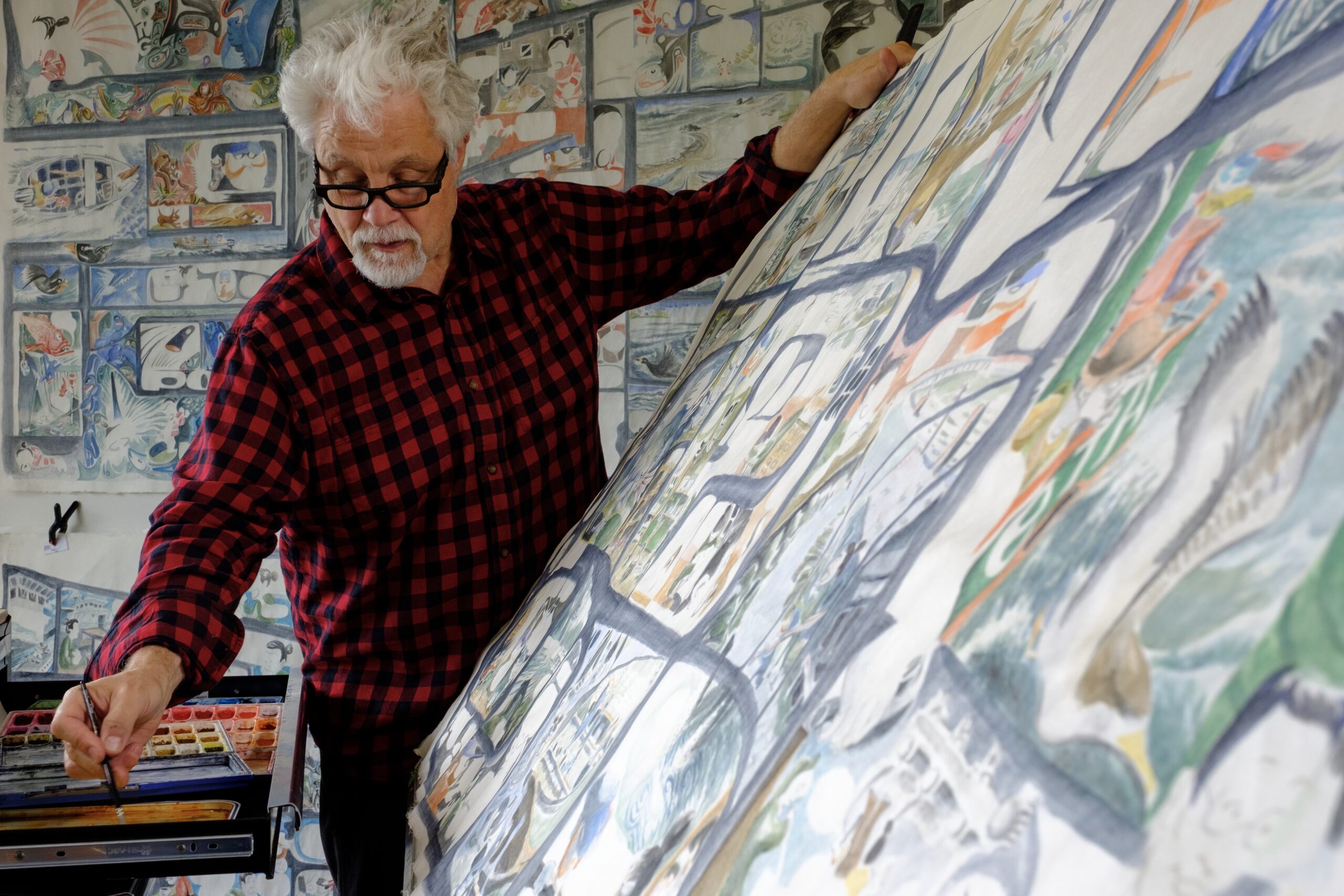
Michael Nicoll Yahgulanaas signing books at his launch for The Lost Haida Manga at Gallery Jones in Vancouver, May 20, 2026.
“Yahgulanaas understood something fundamental: if you want to influence people and inspire change, you must first meet them where they are.”
BY ROBIN LAURENCE
At the launch of Michael Nicoll Yahgulanaas’s newest book, The Lost Haida Manga: A Compendium (D&M $34.95), it was striking how much time the artist spent with everyone who stood in line to meet him and have their copy signed. In addition to speaking with each person at length and then fully inscribing the half-title page of their book, he presented every individual with a small ink or watercolour drawing. Eventually, he was interrupted by the organizers so that he could address the large audience that had gathered for the event and answer their questions. Once done that public task, however, he returned to personal interactions with his fans.
“The work I do is at some point quite solitary,” Yahgulanaas says. “I burrow myself into my studio.” He goes on to explain that because much of the art he creates is spontaneous rather than premeditated, he has to retreat into himself to allow the imagery to flow through him. “When I get a chance to talk to people who have taken time out of their lives to buy a book and express an interest, it’s good for me. It calibrates my relationship with others.” The process is exhausting, he admits, but also gratifying.
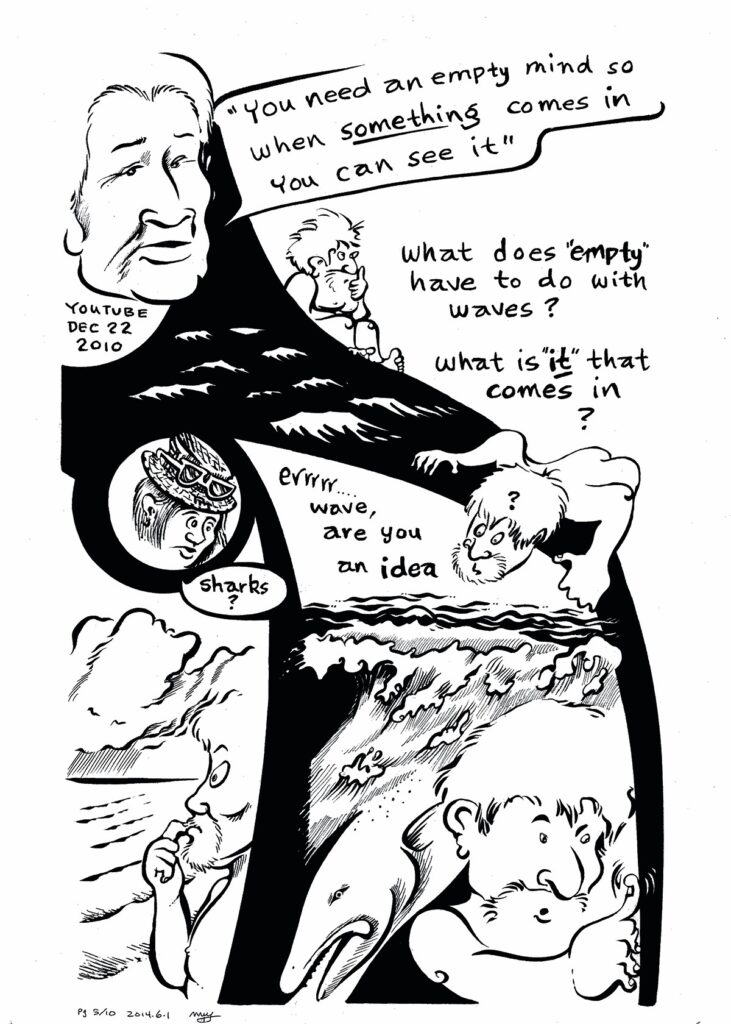 With a foreword by anthropologist Wade Davis, The Lost Haida Manga brings together 15 previously unpublished, black-and-white works Yahgulanaas created between 1981 and 2025. Their subjects range from personal anecdotes to cultural narratives, from a story of time he spent with his grandmother as she gathered medicinal plants in the forest to a rhyming poem about “Rockin’ Raven” fishing, and from an account of Haida management of culturally modified trees to Yahgulanaas’s existential thoughts about diving through ocean waves and making art.
As the stories unfold over time, we see the evolution of Haida manga, the graphic style that Yahgulanaas invented and made famous. Davis describes it as “a distinct visual and narrative form that blends Haida design principles with the dynamic of Japanese manga and graphic novels.” He then goes on to characterize Yahgulanaas, who also paints and sculpts and is currently developing an interdisciplinary performance and video work, as “an artist-activist, a philosopher with a brush, a mischief maker who has reimagined all the possibilities of the Haida aesthetic ….”
*
Born in Prince Rupert in 1954, Yahgulanaas grew up near Masset on Haida Gwaii, folded into his mother’s family, clan and moiety. From an early age, he drew and painted prolifically; as a young adult, he committed himself to environmental and land rights causes. His art and his activism first came together in the 1970s, when he created the comic book No Tankers, T’anks for the Island Protection Society. Widely distributed, it was part of a successful campaign to block tankers from transporting Alaskan crude oil through the Hecate Strait, the perilously stormy body of water that lies between Haida Gwaii and mainland British Columbia. “The bafflegab advancing the theory that the economy must trump ecology needed surgery,” he says.
Throughout the 1970s and 80s, Yahgulanaas continued to marry his graphic art to his environmental and political activism as a highly effective form of outreach. He discovered, Davis writes, “the power of drawing as a tool of resistance,” and produced thousands of comic strips, cartoons and visual essays of both protest and advocacy. “Long before Haida manga had a name,” Davis continues, “Yahgulanaas understood something fundamental: if you want to influence people and inspire change, you must first meet them where they are.”
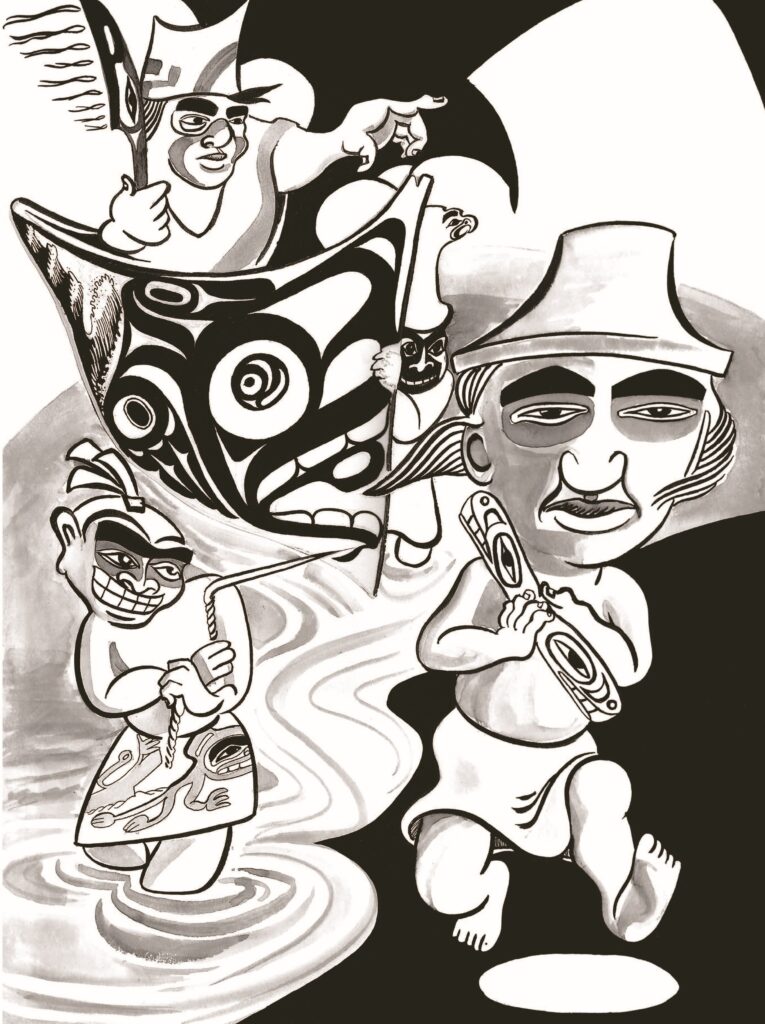 At the same time that his graphic art reached out to non-Indigenous audiences, Yahgulanaas was an active member of the Council of the Haida Nation. He is especially proud of his part in the anti-logging blockade on Lyell Island in 1985 and the wide support the Haida generated locally, nationally and internationally, resulting in the creation of the Gwaii Haanas National Park Reserve and Haida Heritage Site. “The degree of public support was such that I decided, at that time, I was going to try to do art that spoke across these cultural-ethnic divides,” he says.
Yahgulanaas has fully embraced the idea of “cultural hybridity” in his expanded art practice as well as in his actions. In fact, hybridity was a state of being he was born into. In his thirties, he added his Haida mother’s clan name (Yahgulanaas translates as “those from the middle of the village”) to his Scottish-Canadian father’s surname. His art studies, too, reflected cross-cultural currents: a brief stint at what was then the Vancouver School of Art, where he picked up instruction in cartooning and perspective drawing, and apprenticeships with renowned Haida carvers, Robert Davidson and James Hart, where he learned, he says, “the power of the line, that classic Haida characteristic.” He also studied ink brush painting in Victoria with a Chinese master who spoke no English. “Most of the conversation was not by sound,” Yahgulanaas recounts. “It was by his grabbing hold of my hand and pushing the brush when he wanted to show me this brush has this particular power.” The expressive power and fluidity of working ink and watercolour with an Asian brush have become hallmarks of Yahgulanaas’s style.
He also forged links, both personal and historical, to Japan. Japanese university students he was guiding into “the deep forest” noticed his sketching and described it as “manga,” Yahgulanaas says. “I then developed a notion that there was a merger possible between Asian and Haida graphic techniques.” In his foreword, Davis writes that Haida manga emerged organically and stands as a “response to a long history of imposed binaries: traditional versus modern, Indigenous versus non-Indigenous, white versus brown, local versus urban.” Yahgulanaas’s art, which is not bound by such binaries or defined by outdated notions of tradition and authenticity, “insists that cultures are not museum pieces.”
“We live in a contemporary petri dish and I think there’s some danger in governing our lives according to standards established in different times for different reasons,” Yahgulanaas says. “I am more interested in the living moment.” Still, he says, it is a moment informed by where he comes from–“a small fishing village off the West Coast of Canada with a really interesting cultural foundation.”
A lot of that foundation is evident in The Lost Haida Manga, in tales of shamans and sickness and supernatural creatures. Also evident is the condition of cultural hybridity, especially as expressed in Yahgulanaas’s 2014 tale, “The Wave.” Here, the artist muses on something a Haida elder, Kwii7aans, once said to him: “If I decide to dive into the ocean I must resurface outside the wave.” As he muses on what that koan-like saying meant and how it might apply to his own artmaking, he considers a spooky Japanese story about immersing oneself in a stream; a couple of lines from a Leonard Cohen song; and a Zen-like piece of advice about creatively emptying one’s mind, spoken by the Canadian-American artist Agnes Martin. Ultimately, Yahgulanaas depicts himself diving into his art as if it were a wave and becoming the instrument of his own creativity. Amid sinuous Haida lines and drawings of himself, his friends, his wife and his studio, he writes – exultantly — “I am a brush.”
Robin Laurence is an award-winning writer and critic based in Vancouver.




Leave a Reply