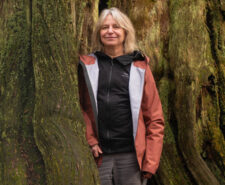


Gladys Maria Hindmarch (1940-2026)
April 14th, 2026
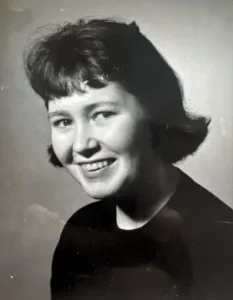
Vancouver experimental-feminist poet, writer and college professor of English, Gladys Maria Hindmarch died at home on March 18, 2026 after a short battle with cancer. She was known as a core member of the TISH community in its first phase (1961-63) and an editor in its second phase.
Born in Ladysmith on January 1, 1940 to parents Taimi (Aho) and Robert Hindmarch, Gladys Maria Hindmarch attended UBC in Vancouver, where she was a central figure in the writing community, and fondly known as “Glad-Eyes” amongst her friends. There, she obtained both bachelor’s and master’s degrees in the Faculty of Arts. She began teaching at Vancouver City College in 1965 (later to become Langara College) before teaching at Capilano College from 1974 to 2002.
While studying at UBC, Hindmarch was a rare female presence within the TISH community as well as the Vancouver literary scene in the 1960s and 1970s. She attended the influential 1963 Vancouver Poetry Conference during this period that helped her establish productive connections with Black Mountain poets among many others.
As an editor, Hindmarch was involved in the magazine Motion (a prose companion to TISH); the second editorial phase of TISH, which she co-edited with Peter Auxier, David Cull, David Dawson, Daphne Marlatt and Dan McLeod; and issues 7 to 9 of The Capilano Review.
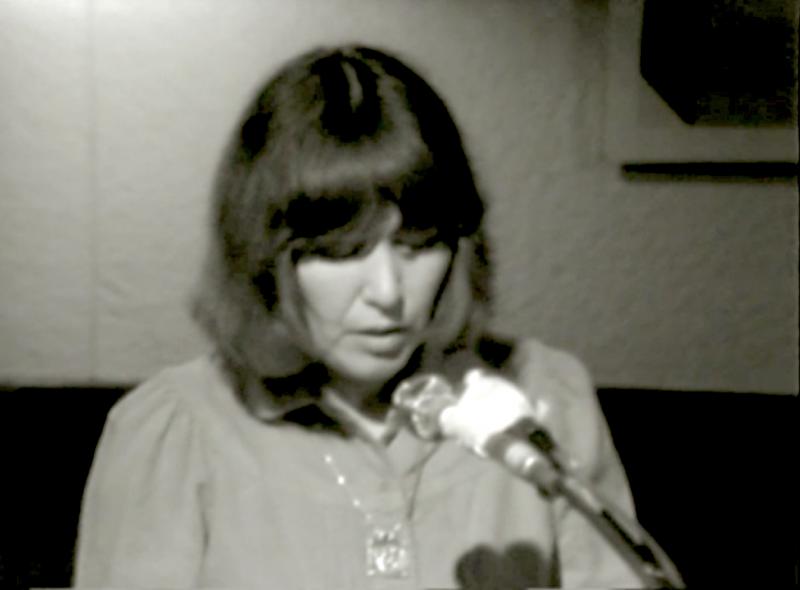
Gladys Maria Hindmarch, from a still while being filmed at a 1975 reading at The Western Front.
Hindmarch’s books had long gestation periods. She began writing her first two books, both published in 1976, back in 1961 (Peter Stories) and 1970 (Birth Account, about two pregnancies but one birth in 1971). Her stories that became The Watery Part of the World (1988) were begun in 1967 and not finished until 1986, with more editing done in 1987—a 20-year production. In that book she examines crew life through a female narrator’s eyes as an ocean-going freighter makes 24 stops delivering mail and goods (beer, pop, toilet paper, logging camp supplies, even motorboats) to Vancouver Island places that had little or no access by road in the 1960s: Ucluelet, Bamfield, Hot Springs Cove, Gold River, Tahsis, Winter Harbour, Fair Harbour, Zeballos, Friendly Cove, etc.
“We often picked up whale meal in Coal Harbour where there was a whaling station and sometimes fish meal on our return trip at Ucluelet,” she wrote in 2004. “When there was a storm, we sometimes were able to ride it out. I recall our 165-foot ship, the Tahsis Prince, drifting backwards for ten hours while the engineers had the engines going full steam ahead: we were that small and the storm that strong. Other times, we just hid behind an island or in a fiord and waited for as many as three days for the storm to subside enough. The only reason I got to cook on the boat (which I did more than I ‘mess-girled’) is that no one who had a cook’s discharge in her sailing book wanted to. I was a relief worker only and sailed as a cook or messgirl on almost all the Northland Navigation boats on both the outer and inner coasts up to almost Alaska.”
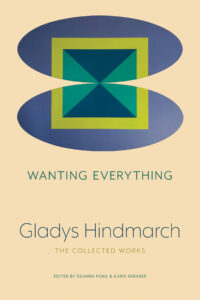 Hindmarch’s last published book, Wanting Everything: The Collected Works (Talonbooks, 2020) was edited by Deanna Fong and Karis Shearer. In addition to reproducing newly revised editions of her book-length works (The Peter Stories, A Birth Account, and The Watery Part of the World), the volume collects unpublished works of prose as well as correspondence, criticism, oral history interviews and occasional writing. Publicity for the book says: “Spanning over five decades, this diverse work challenges the conception of what constitutes a prolific literary career, extending the notion of writerly activity to include work that is social, collaborative, and dialogic.”
“Hindmarch’s work embraced the experimental and avant-garde with an eye trained to the concerns, lives and practices of women,” notes Talonbook on their website. “With a feminist slant, Hindmarch delved into pregnancy, birth, how the labour of working-class women lives in the body … her writing was firmly grounded in the earth and neighbourhoods of the West Coast.”
Hindmarch’s writing appeared in various publications including Iron, Imago, Periodics, boundary 2, Writing and The Capilano Review; and anthologies Cradle and All: Women Writers on Pregnancy and Birth (1989), Words We Call Home (1990), and Islands West: Stories From the Coast (2001).
Until the late 1990s she wrote under the name Gladys Hindmarch, but later preferred to use her middle name, Maria, pronounced the Finnish way, she said, with emphasis on the first syllable. In 1999, Hindmarch was diagnosed with inflammatory breast cancer, a relatively rare type of breast cancer, leading to a work-in-progress called Swimming with Cancer. “I am healthy right now. I swim. I dragon boat race. I love. I enjoy my life,” she wrote. Hindmarch was to suffer two more bouts of cancer before succumbing to the disease.
Her literary archives are housed at Simon Fraser University Special Collections.
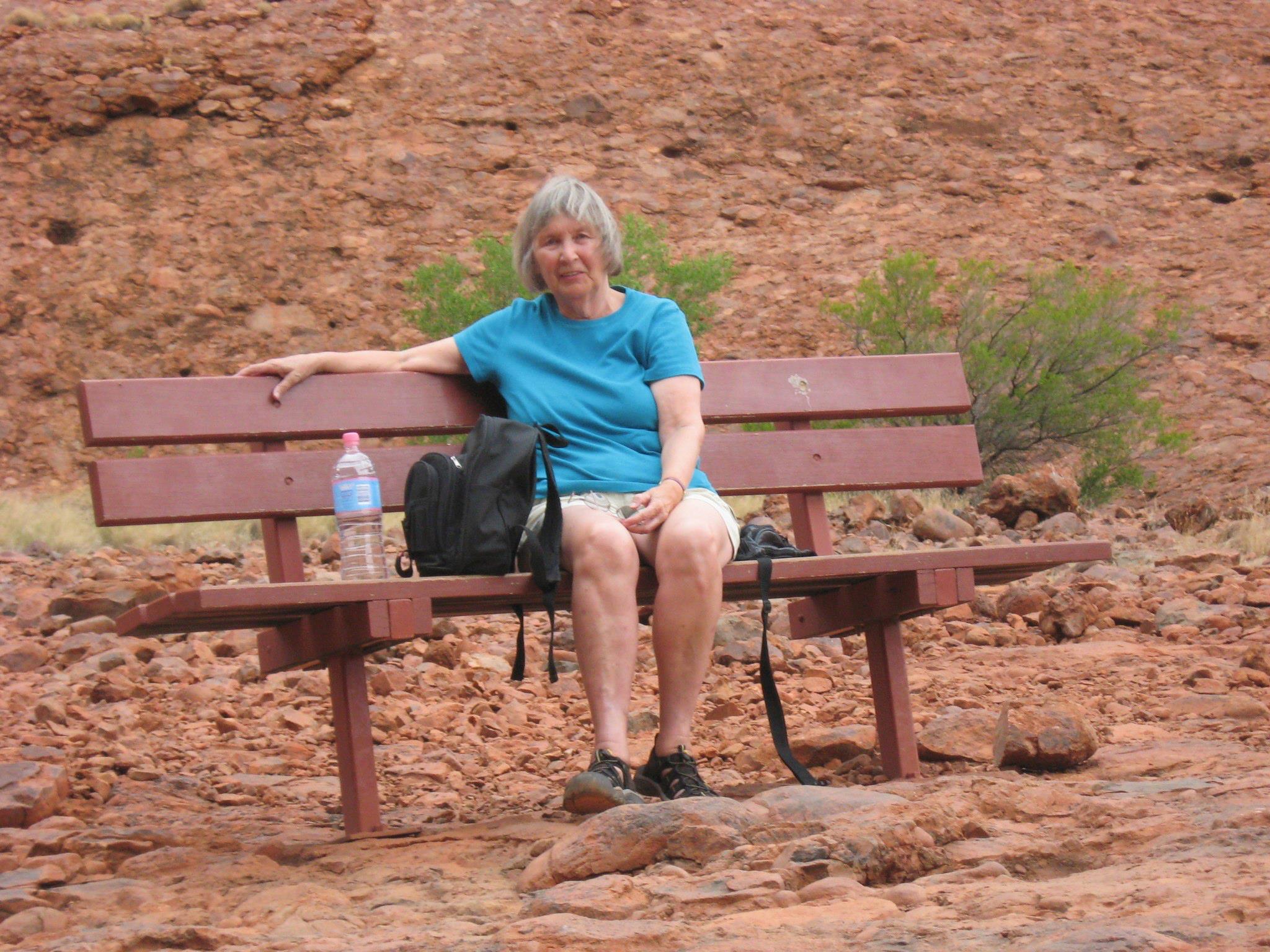
Gladys Maria Hindmarch in Australia, 2013.
BOOKS:
The Peter Stories (1976)
A Birth Account (1976)
The Watery Part of the World (1988)
Wanting Everything: The Collected Works (Talonbooks, 2020) $29.95 9781772012484. Edited by Deanna Fong and Karis Shearer.




I am sad finding out that Gladys has passed away. She was a great caring teacher that I had the pleasure of learning from in 1989 Capilano College while I was a mature returning student.
She knew I was working full time, shift work, and attending 3 classes at Cap College. I got off my third graveyard shift (2400 – 0800 hrs) and attending my English class at 1000 hrs with Gladys. I was exhausted, fell asleep in class, and apparently snoring while Gladys was giving a lecture.
She stopped apparently looked at me with my head down on the desk and commented “I didn’t know my lectures were that boring.” Everyone laughed in class, which woke me up at which time I apologized.
She understood my situation and when I approached her after class to apologize again she said it was alright just try not to snore so loud…we laughed. She was a great person with kindness and showing the type of humanity we are missing in today’s world…