

The narrowing of the light
Facing a future of diminishing returns, Kathy Page’s beautiful memoir depicts her rage, despair and levity as she struggles with Parkinsons.
March 30th, 2026
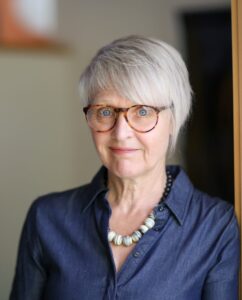
Kathy Page is the author of eleven acclaimed works of fiction. Photo source: And Other Stories.
“… this memoir has a much wider audience—all of us. It is a truism that, as we age, our lives will change, our capacities diminish, our abilities become less sure. In Page’s telling, however, we find an undiminished beauty in all that we are still able to see ….”
Review by Carellin Brooks
The first time I laughed out loud when reading Kathy Page’s memoir of Parkinson’s disease was less than forty pages in. If it seems strange that I should have found a story of being taken hostage by a disease amusing, I can only credit Page’s mordant wit.
The Salt Spring Island novelist’s eleven previous books have received high honours: nominations for the Scotiabank Giller and Orange prizes and the ReLit and Governor General’s awards. All this to say that in Page’s capable hands, readers are in for not only a moving but also occasionally hilarious memoir of sudden illness and what it means in a life.
Page’s first intimations that something was not right came with a seemingly insignificant accident—a fall and injury to her hand. Always active, the novelist sought medical attention. Waitlists, COVID complications and potential alternate medical explanations finally resolved into the unwelcome news. Parkinson’s disease is progressive and incurable. Upon diagnosis, Page faced a future of diminishing returns: medication that would work to restore some of her limb function, until it didn’t, increasingly bothersome side effects and a guarantee of steadily reduced capacity. How can a novelist, one who was used to functioning at the highest levels to construct stories and commit them to the page, ever cope?
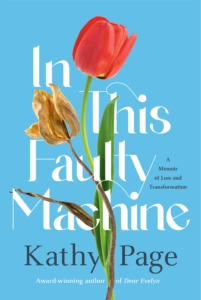 Page’s memoir, In This Faulty Machine: A Memoir of Loss and Transformation (Viking $34.95), does not sugarcoat these realities, nor does it gloss over her own rage and despair at the changes she sees, as well as the ones she knows are coming. The amusing parts come not as gimmicks in an otherwise tragic story but as natural points of levity. There is the PWP (people with Parkinson’s, the acronym Page uses for herself and her fellow sufferers) “bitter joke:” a wish to remove oneself from this mortal coil before things get even worse but, with the diminishing dopamine brought on by the disease, a lack of will to carry through this intent. Suicide rates are, she notes wryly, hardly different in PWP versus the general population, perhaps due to this neat little paradox.
There’s the time her doctor asks if she has vivid dreams. “Of course not,” Page replies instantly over Zoom, only to have her husband butt in to correct her. When she subsequently asks him to note down what she says in her sleep, the resulting exchange goes like this:
“You yelled ‘You bastard! You’ve always been like this!’ I hope it wasn’t me.”
… “You said no thanks it wasn’t really your thing.”
(Bondage? Country music? Fermented seal meat?)
… “You asked, ‘Do you want to join us?’”
(In the swimming pool? In bed? A trip to Argentina?)
Of course, Page can remember none of it despite her fanciful interpolations. But what’s most charming about the voyage this writer takes us on is her undimmed sense of self. “I’m hoping my undiminished ability to judge and criticize others [means I’m not losing my facilities],” Page remarks wryly at one point. This before embarking on an extended rant about the use of the word “journey,” uttered by a luckless acquaintance to describe her cancer and remission. As someone who’s railed against this sanctimonious terminology myself, I could only smile in recognition as Page argues against baggy and unexamined metaphors, words that strip the specificity out of tormented experience.
If Hilary Mantel, quoted in Page’s book, describes writing about illness as a “devil’s dictionary of anguish,” Page spares us the worst of it. This is a book that allows for some privacy; while her husband and friends and acquaintances from the PWP world and elsewhere are sketched, she barely mentions her adult children, an omission she later explains as being at their request. Still, the novelist doesn’t spare herself, writing about an accidental glimpse in the mirror where she realizes she’s losing so much weight that her breasts are “withered; deep creases ran like rays to the nipples.” Worse yet, Page says her eyes have “an angry, terrified glare that I found repellent yet could only alter briefly by vigorously feigning mirth.” Despite the fact that I don’t have Parkinson’s, I winced and grinned in recognition. As I’ve aged, my own increasingly bleak and forbidding expression, like a hawk disdainful of its dinner, can only fleetingly be altered by a determined expression of pleased cheer.
If Page spares others, but not herself, she also lets us in on some of the concerns that we all have. What happens to a relationship of decades when one of the partners can no longer, even figuratively, pull equal weight? In Page’s telling, it can go a number of ways. The hulking husband of one tiny wife in the PWP support group, for example, refuses to use mobility aids, repeatedly falls and then will not let her help him up (not that, given his weight, she could). The wife must then hover beside her prostrate husband, explaining to anyone who comes to their aid that he will not accept assistance. Other couples grow closer. Some accept the sad reality of impairment and an inability for caregivers to bear the strain and begin to look for care homes.
There’s an elegiac tone to the last part of this memoir. Page details her struggles with typing, correcting and preparing her manuscript for publication. She briefly mentions the helpers she recruited to bring this book to press when she could no longer accomplish such tasks herself. While the need for aid came quickly to Page, it will come sooner or later to us all; the only thing we can control is the grace with which we necessarily relinquish the agency that we’ve spent the previous lifetime acquiring.
This is, as I hope I’ve already made clear, a beautiful book. I wouldn’t necessarily recommend it to someone with Parkinson’s: Page’s own discoveries about the condition are interesting to those of us to whom such hard-won knowledge is unnecessary. But details about effects, drugs, potential treatments and the disease’s trajectory are probably already well known to those treading the same path as Page.
Perhaps a newly diagnosed person could be handed this book as a sort of touchstone, a way finder … here is someone who has been where you are, let her show you the path to follow. (As long as you promise not to utter the word “journey”). But I think this memoir has a much wider audience—all of us. It is a truism that, as we age, our lives will change, our capacities diminish, our abilities become less sure. In Page’s telling, however, we find an undiminished beauty in all that we are still able to see, even in the inevitable narrowing of the light. 9781037800887
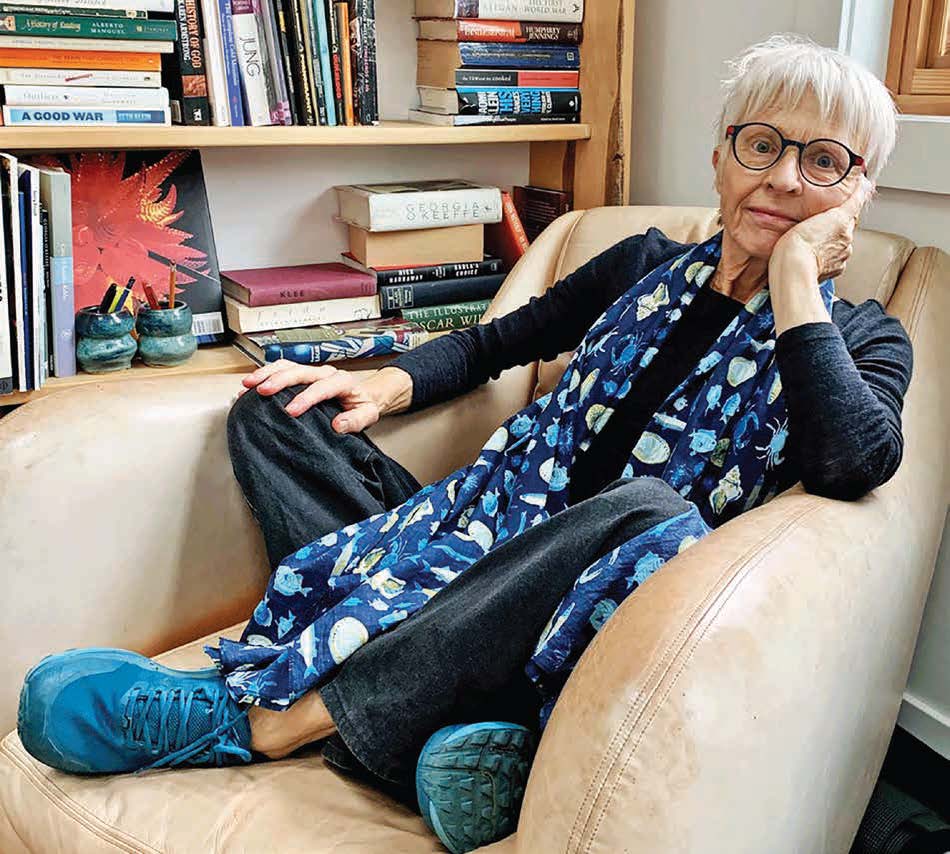
Kathy Page at home on Salt Spring Island.
Carellin Brooks is the author of five books, including her most recent, a poetry collection titled Learned (Book*hug, 2022). She lives in Vancouver.





Leave a Reply