

Welcome to downtown Antarctica
The highest, driest, windiest and coldest place on earth with overpowering landscapes inspired BC scientist, Louise K. Blight to think of nature meditation as “a form of worship.”
October 13th, 2026
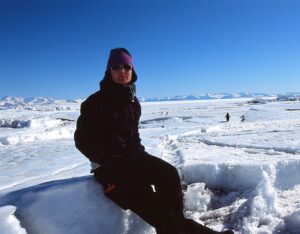
Louise K. Blight and penguins, Cape Royds, at the edge of the Ross Sea, Antarctica.
“McMurdo [research station], with its landing strip and emergency evacuation units, is a US facility housing hundreds of researchers and support staff … a prefabricated, circa 1980s Arctic village with basic amenities: dorms; a cafeteria; storage space for every sort of winter, field, food and fuel supplies; lab and communications units; a ‘wine cellar’ hut for relaxing, even a bowling alley.”
Where the Earth Meets the Sky: A Story of Penguins, People, and Place in Antarctica by Louise K. Blight (Penguin Random House $38.00)
Review by Trevor Carolan
Despite recent virus outbreaks aboard polar-bound cruise boats, Antarctica is now an on-trend destination for extreme travellers. Yet, as Louise K. Blight intimates in this journal-like account of a three-month research season there earlier in her career, the strange can be merely normal in this southernmost continent that otherwise exists politically as a model of international cooperation, without borders or passports.
Blight begins with reports from 2023 and 2024 of breeding failures among Antarctica’s huge penguin populations that reinforce her concern with global climate change. Although once untouchably remote, its collapsing ice shelves and record-high temperatures are “emblematic of a changing planet,” she says. Her story, she explains, is of Antarctica “on the cusp of change.”
In 2003, after previous visits as a cruise ship tour guide, Blight was offered a research sojourn on remote Ross Island. The launch-pad for the earliest successful overland voyages to the magnetic South Pole, she describes it as a mesmerizing world of ice and ancient lava-rock—landscapes so overpowering that they inspire her to meditate on BC painter E.J. Hughes’ remark that he painted from nature as “a form of worship.” The only continent never to have had Indigenous inhabitants, this “highest, driest, windiest and coldest place on earth,” we’re told makes “human suffering [feel] insignificant.”
 Blight’s role is to assist her new boss, a taciturn marine ornithologist, in biological studies and the banding of Ross Island’s Adélie penguins. Their two-person post at remote Cape Royds, 35 km by heli-jet or tracked vehicle from the larger McMurdo research base, is home to an expansive colony of the flightless, marathon-swimming penguins born without fear of humans. McMurdo, with its landing strip and emergency evacuation units, is a US facility housing hundreds of researchers and support staff. Blight describes it as a prefabricated, circa 1980s Arctic village with basic amenities: dorms; a cafeteria; storage space for every sort of winter, field, food and fuel supplies; lab and communications units; a “wine cellar” hut for relaxing, even a bowling alley. Welcome to downtown Antarctica. Run on military-style discipline, its “isolation, extreme weather, and monochromatic landscape draw an odd mix of adventurers, iconoclasts, and loners,” she records. The next closest station, Scott Base, is a New Zealand facility of 85 souls; life is friendlier and there’s a “rugby field” where the Kiwis always win.
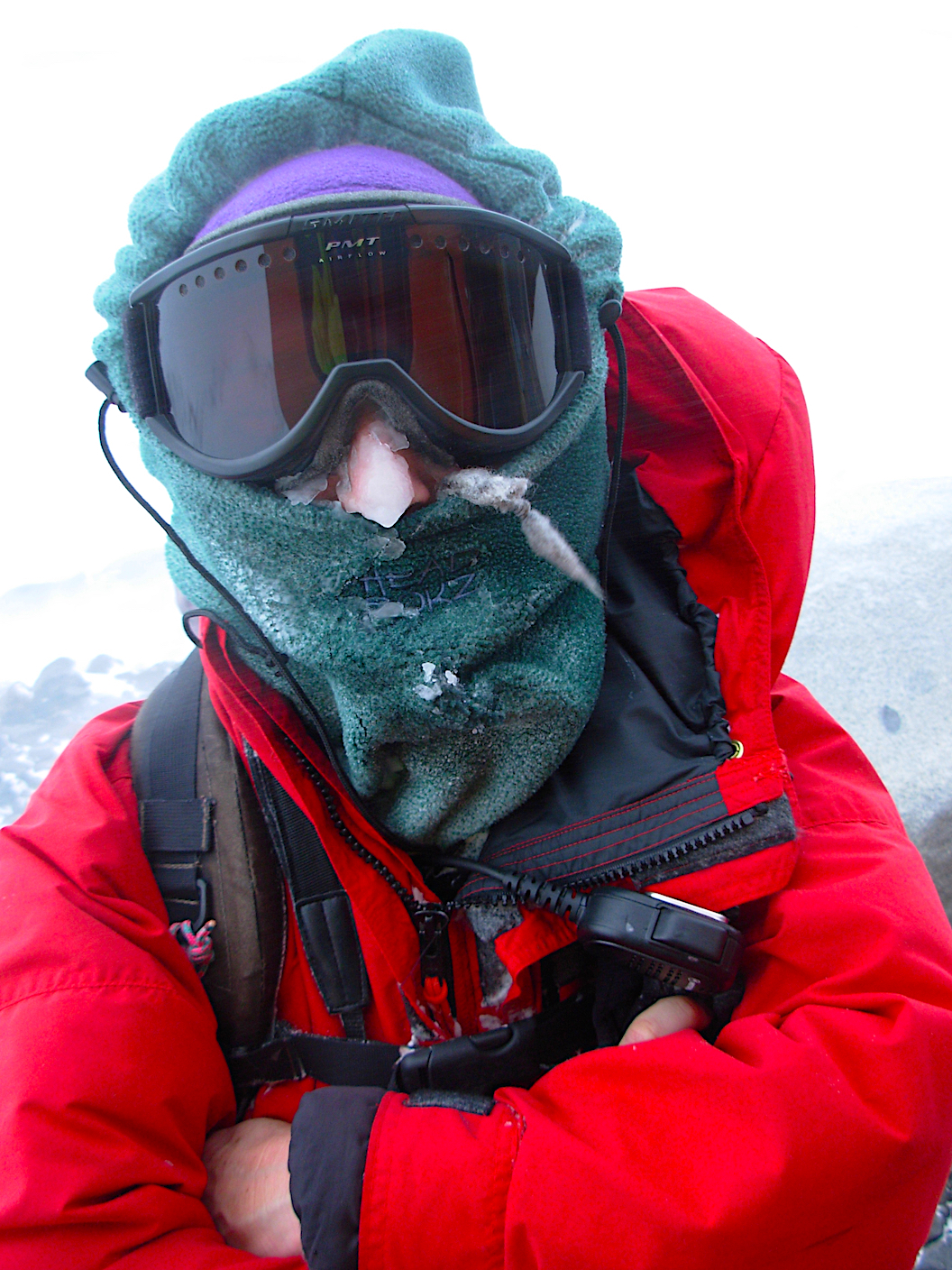
With spring temperatures at -20°C, and kitted out in parka, neck-warmer and extra layers of clothing over a couple of pairs of long-johns, Blight undergoes a mandatory boot camp of extreme weather training. It’s vital as she’ll be sleeping in a mountaineering tent in summertime zero-degree weather and continual daylight beside the Royds’ solitary canvas Quonset hut.
Beneath the gaze of Mount Erebus, a snowbound but active volcano, the author’s isolated new home—“a moonscape with penguins”—proves utterly spartan. There’s meltwater for drinking and cooking, and sanitation is an old-fashioned honey-bucket. Technology is an emergency radio, with a free-standing propane stove for heat and solar-panels to power their computers. With a long, contemplative season ahead, she self-reflects: in Canada she’s left behind unfinished career objectives, a partner whom she calls a “future ex-husband” and grief at her sister’s death. Yet, “there are few things lonelier than being at the end of the world and awakening to the fact that you are truly alone,” she confesses.
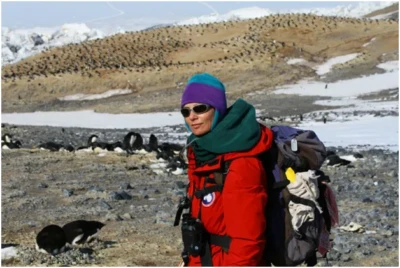 It’s the penguins that are the draw. We learn plenty about them. Less than 1% of Antarctica is ice-free, making Ross Island’s rocky summer terrain an ideal breeding environment. Males build nests of loose stones; females produce only two eggs. Their colony area reeks of guano, or penguin poop. Research days are spent carefully observing, weighing and documenting their behaviours, and attaching small transponder tags to the birds. They’ll be tracked for survival rates, migration patterns and reproductive success—data that can be analyzed over time. David, the station boss explains the reason: on a swiftly changing planet, there’s no better measurement of change than making comparisons with the Earth’s “last intact marine ecosystem.”
Once sea-ice clears with warmer days, liquid-ocean appears and fishing is easier for the Adélies as they struggle to raise their chicks. Everything is logged. Meanwhile, Blight’s frozen camp meals grow monotonous, relieved only by rare overnight stints “in town”—a chance to meet others, eat fresh, get clean, wash clothes of the stink of penguin guano and purchase goodies—chocolate, a bottle of liquor. For some, she notes there are secret relationships with “ice wives” or “ice husbands.” Even on the shiftiest edge of the world there’s room for a little hanky-panky.
There are lengthy accounts of icy weather surges, landscape details and more of the penguins’ annual saga. Echoes of Lynne Quarmby’s Arctic book Watermelon Snow (McGill-Queen’s UP, 2020) resonate when visitors from the Antarctic Artists and Writers Programme turn up, and when Blight discovers patches of unbelievably hardy lichens and moss surviving even here. Then, in an emotive interlude we see her embark totally solo into the icy vastness on cross-country skis. And amid images of Miles Davis’ Kind of Blue album or Yo-Yo Ma’s cello drifting through on headphones into the great void, moments of “peace and tranquility” so profound arise, she intuits, “Antarctica is holding its breath.” There’s merit in this Canuck’s endurance where the earth meets the sky. 9780385702102
Trevor Carolan writes from North Vancouver.





Leave a Reply