


Vancouver in high contrast
Brian Kaufman captures the fleeting, hardboiled grit of East Vancouver in Cascadia Subduction Shift, turning raw urban moments into lithe, smart art.
November 04th, 2026

Brian Kaufman has worked over 30 years in the Vancouver art scene as a playwright, editor and publisher.
“He and his father in the Econoline van—he’d sit centre on the engine cover, where it was warm—no seat belt or even a thought of seat belts back then.”
Review by Peter Babiak
Writing in the 1920s, a decade of political and technological changes that caused social ruptures in his native Germany, the cultural journalist Walter Benjamin said “true literary activity cannot aspire to take place within a literary framework.” He argued writers should not confine themselves to writing books if they wanted to adapt to a modernizing world; they should embrace the “prompt language” of writing leaflets, articles, pamphlets, even posters because this is where “significant literary work” will occur. He was wrong about books—they’re still with us, though news of the death of reading seems pervasive—but he had a point when he dubbed the literary medium of the modern world a “prompt language.”
This phrase came to me often as I read Cascadia Subduction Shift (Guernica $22.95), a smart and entertaining collection of fictionalised autobiographical vignettes by long-time Vancouver publisher, editor and writer, Brian Kaufman. These eighty-one nimble but elegantly-crafted stories, organized into three sections (childhood, adolescence, adulthood) and delivered in less than one hundred and twenty-five pages, pack a deep literary punch that’s well-suited to the prompt spirit of our distracted world. This is a book I’d recommend to my students, to anybody who believes they wouldn’t enjoy reading prose, or to any avid reader who can appreciate concise, cursory narratives. Kaufman’s stories are fast, furious, but they exemplify what lithe, smart literature is and what it can do.
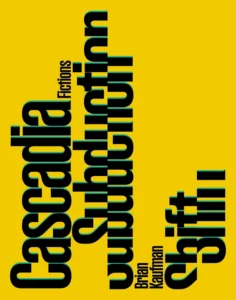 In all but one, Kaufman adopts a third-person point of view mostly centred on males experiencing the transitory dramas or just the remarkable ordinariness of their Vancouver lives. Some are unnamed, a technique that puts readers into the position of voyeurs scrolling through fragmented scenes of their lives. Others are named, a few reappear and some even work in Vancouver’s literary scene, which gives these single-sitting stories the aura of an autobiographical bildungsroman. Thankfully, Kaufman steers clear of the excessive confessional style, choosing instead to frame his recollections with a journalistic realism punctuated by flashes of poetry and those ephemeral, head-exploding moments that tell us we’re reading someone who knows that strong writing isn’t a compilation of cool experiences and ideas but depends on exacting verbal structure to give them life.
Kaufman’s prose is seductively cinematic. Reading his stories is like browsing a photo album where every picture is a shallow focus shot with only core characters and key details of their settings defined. In the first sentence of “Don’t Tell Anyone,” where Frank, one of those reappearing names, is “eleven, maybe twelve, when Ron Wolanski, a childhood pal, grabbed him by the wrist and dragged him across the road from the edge of their subdivision and into an open field sparsely populated by building materials for the new housing development that was under construction across the landscape of sod and mud.” Here’s another from “The Balcony”: “Royston Fellers awoke, awkward, discomfited, bent-backed over a fourteen-inch granite gardening stone on the floor of an unfurnished eighteen story apartment building in Vancouver’s West End.” Both read like establishing shots in a Law and Order TV episode: there’s no mess, no fuss, just sentences that compel readers with built-in indicators of tension and imminent conflict.
His Vancouver settings are a sophisticated take on urban realism. Outside the titular story where a candid Miss Simpson announces to her elementary school class, “‘Many of you will likely die in the Cascadia subduction shift of 2028,” references to trees, mountains and the ocean are kept to a minimum. Unlike the Vancouver of William Gibson or Douglas Coupland, both of whom have made the place a postmodern spectacle mediated by technology and consumer culture, Kaufman’s aesthetic is unapologetically modernist. The city is present in a web of references and street names that pinpoint most of his plots in East Vancouver. There’s always a recognitional pleasure when we read literature about familiar places, of course, but any reader will enjoy these compressed hardboiled tales
One example of Kaufman’s street-level realism is “Mad Bull,” which is nicely inflected with the poignant emotions we often attach to childhood memories. After a drive along Kingsway, Commercial and Venables, “through the rumoured ‘bad area’ of Franklin and Pandora Streets,” Frank and his dad are at a Powell Street slaughterhouse, where the boy, relishing the experience of the “killing floor,” suddenly thinks about the bull that jumped out of a second story window and ran off into the night after the executioner messed up. There’s a record of a bull that ran thirty-blocks around Vancouver until it was caught at 49th Avenue, but that story pales in comparison to Kaufman’s nostalgic, mythical rendering, which leads to some of his most graceful turns of phrase. The two-page story is also interrupted by a stunning 123-word sentence worthy of Virginia Woolf, as are a number of his other tales.
Far from pedestrian description, Kaufman’s literary urbanism is like the poetic prose of Charles Baudelaire, who said the beauty of the modern city lay in its “fleeting character,” which can be “bizarre, violent, excessive, but always poetic.” In recalling snippets of the past—or his past—Kaufman lays bare for us not only that memories usually come to us in scatter-shot images but also shows us the art that can happen when we give words and sentences to them. In “Arco Hotel,” his narrator gives us a group of drinkers who reconvene their socializing at Marty’s Pender Street SRO room in the once-dignified building at the edge of Chinatown. There’s a talkative parrot there and at one point, someone tells someone else to get their mother a beer—the confusion of who’s who nicely simulating their intoxication—but then the narrator interjects: “It was only then that Bobby realized that he didn’t know any of these people, couldn’t remember what he was doing there, where he was, or why he was there, and that he was also extremely high. The parrot stared down at him, its pebble eye jerking up, then down, and Bobby was sure it said, ‘Get outta Dodge!’.” Kaufman excels at nudging the mundane into credibly unfamiliar territory, like this.
In “Dr. Angel,” his narrator conveys in two measured sentences a fleeting encounter with metaphysical absurdity during a man’s visit to a doctor: “He was slight, smocked in white, and when he cupped Barry’s testicles in his cool palm he made him feel as if he were, for the moment, being held in the palm of God. Maybe not God in its entirety, but certainly in the grace and company of an emissary of the divine.” The impeccable architecture of Kaufman’s clauses illustrates a conscientiousness about words and their arrangement that never supersedes either the depth of characters or tempo of their stories. His adept story-telling is likely indebted to a long tenure in editing and publishing, where word count, structure and other practical considerations—like writing what people want to read—are top of mind.

Brian Kaufman at work. Photo: Dan Toulgoet.
Although his cast of Vancouverites is idiosyncratic, none of them—to quote one of E. M. Forster’s laws of characterization—“waste time running up and down ladders in their own insides.” Like us, they experience an array of emotions, from comic stupor to angst and despair, even regular Vancouver loneliness. But these characterizations illustrate how a person’s identity is the product of their changing public contexts, not just their private psychology. In “Funny Odd,” for instance, two guys driving along Broadway see a man “walking, with great purpose:” “He was naked except for a pair of brown socks … He held his head straight and erect as he headed north down the hill toward False Creek.” The one, Arnie, looks at the other, Bob, and just laughs, because, really, that’s all a person confronted with such a bizarre rupture in the visual horizon of their day probably could do.
Minor epiphanies like this, where characters doing something trivial realize something momentous, are Kaufman’s favourite structural trope. And the pattern makes for good reading—“simple shapes of stories … are beautiful shapes,” as Kurt Vonnegut famously said—because, as Arnie’s laugh illustrates, we all like witnessing strange things, if for no other reason than to unsettle the lacklustre continuity of daily life. These moments are the ones we remember and tell people about later, even if, like Arnie, words fail and we can only laugh.
These climactic moments often involve violence, danger, even death, but Kaufman renders them with tasteful compositional wizardry. There’s what Miss Simpson tells her students, which no teacher would dare say in 2026, but there are many similar occasions. A teenager “facing his fate under the boots and blows” of his adversaries escapes by telling them Friedrich Nietzsche is the kid they’re looking for. A woman grieving the death of her boy recognizes “the abyss of grief or, worse, the dark cellar of madness that she could sense, could feel, could almost see just beyond the steps that led from the kitchen down to the basement.” A man imagines himself dead—fittingly, in the last story—and recalls once seeing a soul “jettison from the short vent stack” of the crematorium at Fraser and 41st, “moving at great speed amidst a mist of black particulate, westward, toward the Pacific Ocean and the blood orange-setting sun.” This is inspired writing, plain and simple.
Cascadia Subduction Shift bristles with the subdued charge of regular characters encountering irregular junctures. The stories, barely longer than a social media post, are well-suited for deep reading in the gaps of time that mark an ordinary day: when you’re on the phone waiting to speak to a real person at Rogers, during the TV commercials Prime makes you watch when binging Slow Horses, when you’re walking your dog. I’d recommend it to any reader, and if I were still teaching, I’d assign the book to a first-year class. Not because Gen Z readers don’t read as much as they probably should. But because Kaufman’s stories are short, prompt, and they’re also set-pieces written in inviting language that glimmers with quicksilver insights that, like all good stories, open questions but will never leave readers unsatisfied or intimidated. 9781778490644





Leave a Reply