


Never take more than what is Needed
Under the guidance of Indigenous elder, Dr. Ellen White, Geraldine Manson discovered the sacredness of sustainably harvesting wild plants.
June 10th, 2026
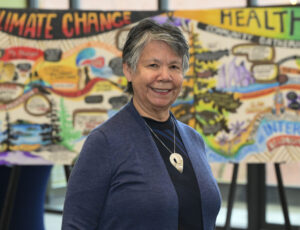
Geraldine Manson (Snuneymuxw First Nation) is an Elder-in-Residence at VIU.
In Plant Teachings from My Auntie: Gathering Coast Salish Plants for Medicine, Textiles, Nourishment, and Ceremony (New Society $24.99), Geraldine Manson (Snuneymuxw First Nation) and ethnobotanist Nancy J. Turner offer readers something deeper than a field guide. The book reads as a map of relationships—between people and plants, between teachings and land, and between generations of knowledge holders.
Review by Odette Auger
At the heart of the book are the teachings shared by Kwulasulwut, Dr. Ellen White, affectionately known as Auntie Ellen, whose mentorship shaped Geraldine Manson’s understanding of Coast Salish plant knowledge. Manson describes the early years of learning alongside her: “Hours of sitting and walking alongside my dear Auntie Ellen began in the early 1990s, with her showing me the trees and other plants, sharing the vital importance of the plant world within the mountains and forests, along the riverbanks, and in the ocean.”
That slow apprenticeship of walking, observing and listening sets the tone for the entire book. Rather than presenting plants only through their uses, the authors ground each teaching within cultural protocols and lived experience. Knowledge is not extracted; it is shared carefully, with context.
Auntie Ellen’s influence is woven throughout the work. Her teachings are described not as information, but as responsibilities. Manson writes that Auntie Ellen was “very strict and repetitive in teaching me about the sacredness of harvesting plants.”
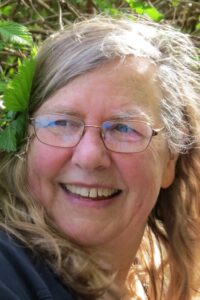
Nancy Turner
That repetition becomes a form of protection for both the plants and the knowledge itself. Readers are reminded that plant teachings are not simply technical skills but part of a cultural system shaped by Elders, language and land.
One of the most important threads running through the book is the emphasis on sustainable harvesting. Early in the text, the authors caution newcomers that gathering wild plants requires preparation and humility. Harvesters must learn to identify species properly, understand where plants grow safely and be mindful of ecological impact. “Wild plants are not the same as garden plants,” Manson writes, urging readers to research carefully and understand endangered species before harvesting.
The guiding principle is simple and profound: never take more than what is needed. In the chapter on harvesting protocols, the reminder appears again: “Good harvesting is only taking what you need, leaving the grounds clean, and filling any holes you created.”
This ethic of care reflects a broader worldview. The teachings position people not as owners of the land, but as stewards responsible for protecting plant communities so they remain healthy for future generations.
Several chapters explore the spiritual uses of plants, illustrating how Coast Salish traditions recognize plants as helpers in both ceremonial and healing practices. Snowberry, for example, is prepared into a cleansing spray used to remove negative energy before ceremonies. Devil’s club carries protective properties, with stems sometimes placed above doorways “to ward off either evil spirits or visitors who try to harm or upset the homeowner.”
These descriptions move beyond simple medicinal applications. Plants are portrayed as active participants in community wellbeing, bridging the physical and spiritual worlds.
The chapter, “Stories, Connection, and Spirituality of Plants” uses storytelling to teach. One account reveals how yarrow was used to heal a severe injury when a young man accidentally sliced off the tip of his thumb. His mother quickly gathered yarrow leaves, chewing them together with tobacco and binding the mixture over the wound. Days later, the thumb had healed.
These stories emphasize how plant knowledge lives within community memory. They are not abstract lessons but lived experiences passed from Elder to youth.
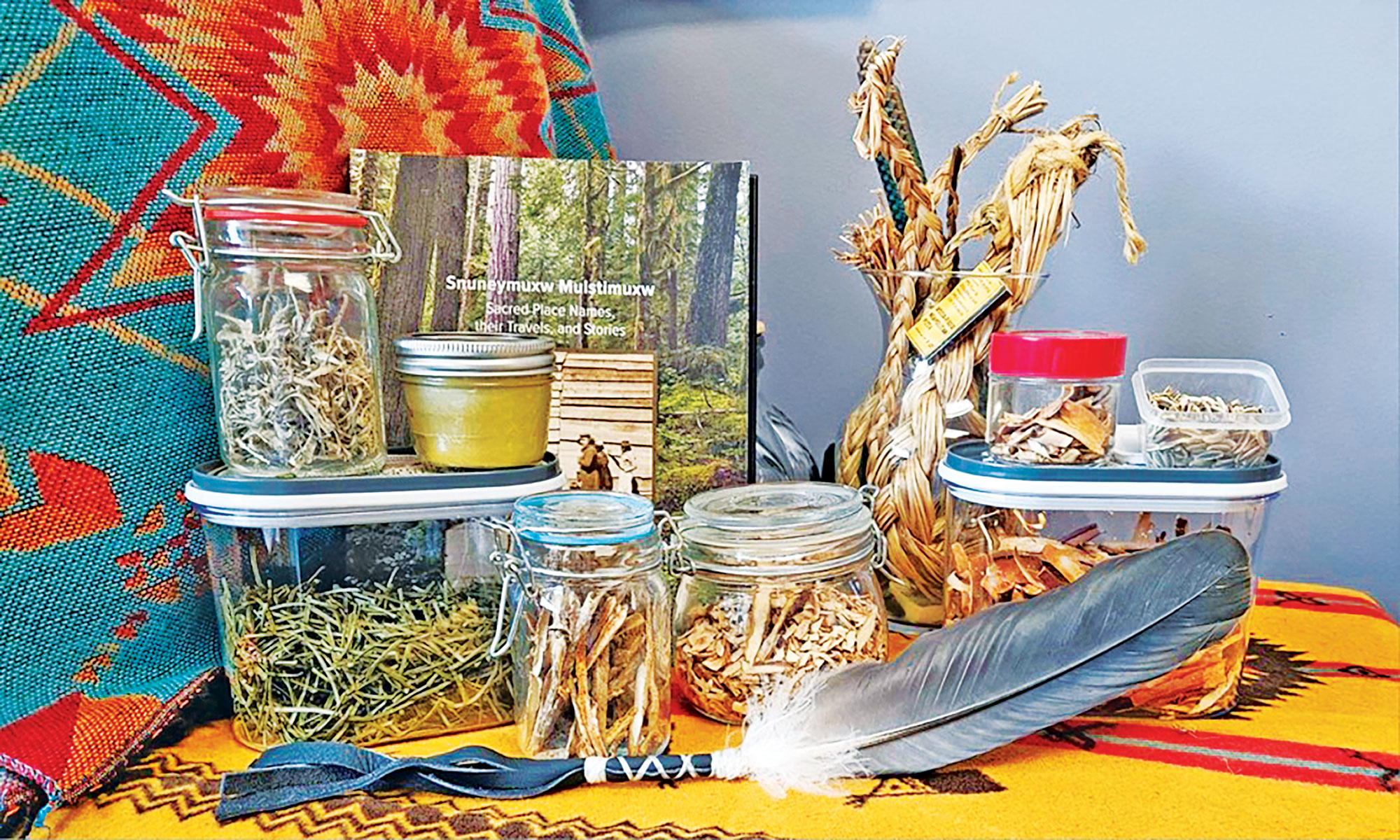
Plant Teachings from My Auntie: Coast Salish peoples harvest wild plants for medicine and food, for weaving textiles and for use in their ceremonies.
The story of “Cedar Woman,” illustrates how plant teachings can arrive through spiritual commitment and perseverance. After months of prayer and solitude in the mountains, a young widow receives guidance from the trees themselves, learning to harvest cedar bark and roots and how to transform them into tools and woven items for her community. The lesson is not simply about craftsmanship—it is about listening, sacrifice and finding one’s place within a living ecosystem.
Throughout Plant Teachings from My Auntie, Manson returns to the idea that learning from plants begins with preparing oneself. Harvesting starts long before entering the forest. One teaching advises that preparation begins “the night before, preparing body, spirit and mind as one,” with prayer and offerings acknowledging the plant communities being visited. These protocols reflect an understanding that plants are not resources to be taken, but relatives deserving respect.
For readers unfamiliar with Coast Salish plant traditions, the book offers a gentle entry point. For Indigenous readers and knowledge keepers, it stands as an affirmation of teachings that have been carried forward despite generations of disruption.
Plant Teachings from My Auntie ultimately reminds us that ethnobotany is not only about plants. It is about relationships—with Elders, with the land and with the responsibilities that come with knowledge.
Like the stories shared by Auntie Ellen, the book leaves readers with something to carry forward: an understanding that learning from plants begins with respect, patience and the willingness to listen. 9781774060322
Odette Auger, award-winning journalist and storyteller, is Sagamok Anishnawbek through her mother and lives as a guest in toq qaymɩxʷ (Klahoose), ɬəʔamɛn qaymɩxʷ (Tla’amin), ʔop qaymɩxʷ (Homalco) territories.





Leave a Reply