

Murder at the fort
Historical sleuth, Geoff Mynett unravels an 1823 double murder that threatened the relationship between Hudson’s Bay Company with the Dakehl peoples.
July 14th, 2026

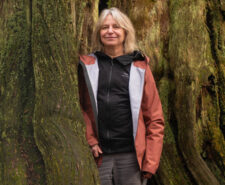
Retired barrister and historian Geoff Mynett dedicates his retirement to researching and writing about British Columbia's rich regional history.
“HBC understood that its presence in New Caledonia was largely based on bluff and that a failure to uphold its position would be seen as weakness. And if that meant it had to use violence to redress a wrong, so be it.”
Review by Mark Forsythe
“No Greater Misfortune Could Have Befallen The Department”—John Stuart, HBC Superintendent for New Caledonia.
In the 1820s, what is now British Columbia was a very different place: home to an estimated 300,000 to 500,000 First Nations peoples (some estimates reach one million), and a tiny band of newcomers who were chasing after furs. Following the 1821 merger of the North West Company and Hudson’s Bay Company, fur traders did business west of the Rockies at posts in a region they christened, New Caledonia.
The two companies were vicious competitors before the merger with deadly consequences during the 12-year long Pemmican Wars. Distrust, rivalry and disobedience lingered within the new Hudson’s Bay Company; men who had previously tried to kill each other were working for the same company. Nor’Westers had been independent small businessmen who shared profits; within HBC they became servants to the company.
The fur trade existed as a fragile relationship between the HBC and local Indigenous peoples. Men from the forts often forged “country marriages” or “mariage à la façon du pays” with local Indigenous women. Officially frowned upon, this occurred at almost all posts, which strengthened economic and cultural ties as both sides needed each other. But this could also result in deadly complications.
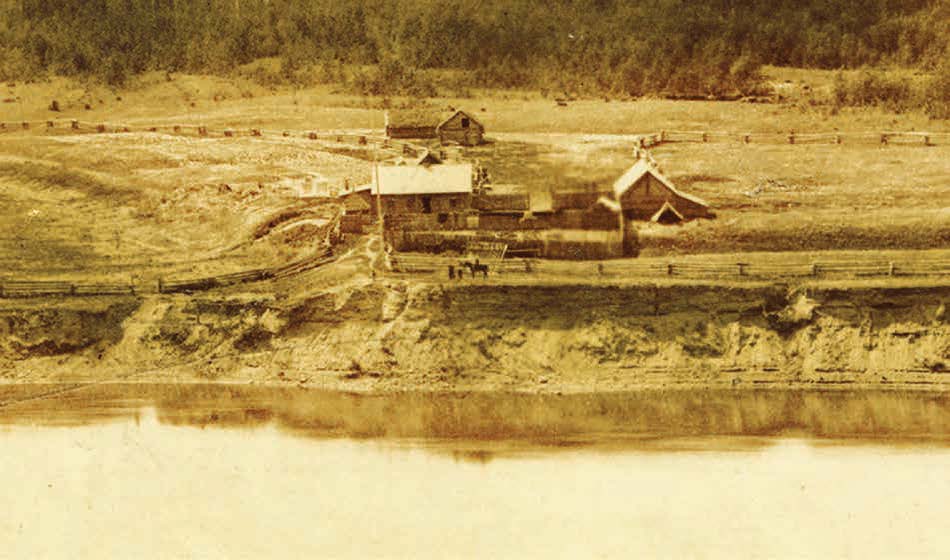
Fort George in 1891-1892 on the Fraser River. The area cleared of trees is now Lheidli T’enneh Memorial Park.
This is the backdrop to Geoff Mynett’s book, The Fort George Murders of 1823: Crisis and Coexistence in New Caledonia (Caitlin Press $26), which attempts to unravel a grisly double murder that shook the foundation of a trading relationship with the local Dakehl peoples. Two HBC employees (engagés from Lower Canada) were murdered in their beds by two Dakehl men who also worked for the fort. One of the killers had had a previous relationship with a Dakehl woman who was living with James Murray Yale, HBC trader in charge of the post. (Yale BC and Yaletown bear his name.) When Yale returned to Fort George from his travels in 1823, he came upon a horrific scene. Mynett writes: ”a drama played out with the blood seeping into the soil and dogs chewing on human flesh.” Two employees were dead, the killers were hiding in the woods, and Yale’s unnamed female companion was gone.
At the time, Fort George (today’s Prince George) was one post in a web that included Fraser Lake, Stuart Lake, Babine Lake, McLeod Lake and Fort Alexandria. HBC traders were eager to trade beaver furs and salmon—furs for gentlemen’s hats in Europe and salmon for their own survival where temperatures could dive below minus 50 degrees Fahrenheit. Indigenous peoples valued the HBC’s metal tools, guns, blankets, clothing—and sometimes liquor—traded in return. Mynett notes the, “HBC understood that its presence in New Caledonia was largely based on bluff and that a failure to uphold its position would be seen as weakness. And if that meant it had to use violence to redress a wrong, so be it.”
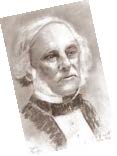
James Douglas
Stakes associated with the HBC’s response were high and had to match the Dakehl people’s expectations concerning punishment. Unnecessary violence (like wiping out the village where the murderers lived) would likely trigger a full assault from Indigenous warriors, a battle that the HBC was sure to lose as they were vastly outnumbered. No response from HBC would also show weakness. The future of trade in New Caledonia also hung in the balance.
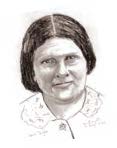
Amelia Douglas
Mynett digs for the truth of how and why these murders happened by searching HBC archives for journals, diaries and correspondence. A lawyer by profession, he weighs apparent facts while also recognizing their limitation: company records were inherently biased and prejudiced. He also draws upon Dakehl oral history, and a book written by the great-granddaughter of Chief Qua. He was a key trading figure, a principal chief near Fort St James and a cousin to one of the killers which presented another complicating factor: Chief Qua was required to display strength and courage to his own people.
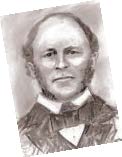
James Murray Yale
A young James Douglas, future Chief Factor of the HBC and colonial Governor, enters this story. Five years after the killings, he led a party that killed the lone surviving murderer, Zill-na-houlay. There have been numerous stories of how Douglas’s life was threatened by Chief Qua and then saved by his Métis wife, Amelia Connelly. Mynett figures much has been mythologized through many re-tellings, but suffice to say, Douglas was persona non grata in New Caledonia. He was quickly shipped to the southern Columbia Department for his own good and that of the HBC’s trading relationship.
Thirty characters appear in this story; an appendix naming each is valuable, beside short profiles of the main players. Mynett’s account goes a long way toward revealing the precarious nature of the fur trading enterprise 200 years ago and how HBC and the Dakehl negotiated this dilemma. It laid the foundation for trade to flourish, a new colony and province to evolve, and ultimately the alienation of many Indigenous peoples from their land and cultures. Much has changed in this sliver of time; much remains to be reconciled. 9781773861791
Mark Forsythe worked at CBC Radio for 30 years, 18 as host of BC Almanac. He co-authored four books about BC with Greg Dickson, lives in Fort Langley and is president of the Langley Heritage Society.





Leave a Reply