


Art in the face of fascism
In her new play, former Chilean anti-Pinochet revolutionary, Carmen Aguirre portrays her childhood heroine, the artist and revolutionary, Tina Modotti.
August 12th, 2026

Carmen Aguirre is a Chilean-Canadian author, actor and playwright and a Core Artist at Vancouver’s Electric Company Theatre.
“Intertwined in this script, are two remarkable women, writer and subject, whose fierce intelligence, artistic brilliance, great beauty and sheer hard work combined to make their contributions to humanity and to their chosen art forms an everlasting one.”
Review by Caroline Woodward
The lives of certain people and their participation in and documentation of major historical incidents can forever haunt the lives of other people. This is even more the case for fellow revolutionaries and artists of another time and place who wish to do justice to their sacrifices. So it is for Chilean-Canadian playwright, author and actor Carmen Aguirre and her nearly lifelong subject of admiration and inspiration, Italian-American revolutionary and photographer, Tina Modotti.
For over fifteen years, Aguirre wrote and workshopped and produced three versions of the Tina Modotti “project” as she called it, never satisfied with the way the play worked onstage. She put it away and, always a busy actor and writer, occupied herself with other work. During COVID, she picked up the Modotti script again and started yet another round of rewrites and workshopping. This is the “haunting” part of the process which takes over an artist’s imagination and simply will not let go until it’s banished by a successful interpretation and subsequent production/exhibit/publication.
Aguirre explains what drove her back to work, time after time, in the Playwright’s Preface: “….I probe the following questions: What is the purpose of art in the face of fascism? Can art serve the poor, and if so, how? What is the personal cost of militancy?”
She further explains in a Note On Style that as a Chilean-Canadian, she was raised in the theatrical tradition of zarzuela, a blend of Spanish, Indigenous South American and African forms where dialogue is interspersed with popular music as well as dance. It is, given the history of Chile, “often darkly comic in tone…yet embracing tragedy…and often magic realist and nonlinear in structure.”
In Fire Never Dies: The Tina Modotti Project, A Play Script (Talonbooks $19.95), there is the added visual component of large photographs (powerful black and white photography, simply stunning) by Modotti, several paintings by Mexican political activist and world-famous muralist Diego Rivera, paintings by Frida Kahlo, photographs by Edward Weston and other works by other artists projected onto the backdrop of the stage. The actors, especially in Scene One when they are introduced to the audience, each come out and interact with the projected photographs (often of themselves so they imitate their pose in the photograph) to lively music, everything from excerpts of songs by David Bowie to South American pop hits and Italian and Spanish revolutionary tunes.
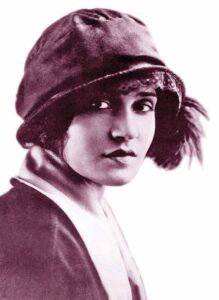
Tina Modotti, self portrait.
Tina Modotti was working at a silk factory sewing machine in Italy by the age of six. She eventually escaped the life sentence of the working poor by emigrating to San Francisco with her father and sister at the age of eighteen. In America, she became a model, actor and photographer, a protege of Edward Weston. When she travelled to Mexico, she became a political activist, following her parents’ path. She, like many others from countries who sympathized with the revolutionary forces rejecting General Franco’s fascist troops, volunteered in Spain and changed her identity, becoming Comrade Nurse Maria. After that bloody and unsuccessful debacle, World War II began. Italy was run by Mussolini so Modotti returned to Mexico. There she died in what some say are suspicious circumstances of a heart attack in a taxi, alone, at age 45. This moment is where the play begins.
Carmen Aguirre was born in Chile but left at the age of six with her parents for Canada. At the age of eleven, she returned to Chile with her mother and step-father and became involved with underground revolutionaries against the brutal Pinochet dictatorship. (Read Something Fierce: Memoirs of a Revolutionary Daughter—published by D&M in 2011—if you haven’t already). When she returned to Canada at the age of eighteen, she was accepted to the National Theatre School in Montreal where she had to cope with recurring bouts of PTSD from her dangerous life in Chile as well as studying and living, using English and French.
And so it is, in this hugely imaginative play script, a mythologizing of Tina Modotti’s life, we have her heart as a separate character, a heart only Modotti can see. (Spoiler alert for actors: Sagradx Corazón (Sacred Heart) has many of the best lines in this play as she interrogates her impulsive and sexually adventurous human framework, i.e., Modotti). She is surrounded by the kindred spirits of her brief but action-packed life: her mother and father, her lover and mentor Edward Weston, her dear friend Frida Kahlo, lover and artistic inspiration, Diego Rivera, in Mexico, and in Spain, Ernest Hemingway and the revered Canadian doctor, Comrade Norman Bethune.
In Spain, where Dr. Bethune has revolutionized medicine by successfully devising a method for blood transfusions in the battlefield trenches, Tina Modotti has changed her name (after narrowly escaping threats of assassination in Mexico) to Comrade Nurse Maria. She has decided that she wants to be of service to the revolution, to be practical and useful, a not-uncommon urge, especially for artists of working-class origins.
In some great lines for the actor playing Hemingway who is urging Modotti to resume her photography, he says: “We’re in a revolution. My words won’t be enough to chronicle it. It’s our duty to do so. We are stewards of the present moment.”
Modotti exclaims in exasperation: “Was I supposed to grab a camera and run the hospital?”
Intertwined in this script, are two remarkable women, writer and subject, whose fierce intelligence, artistic brilliance, great beauty and sheer hard work combined to make their contributions to humanity and to their chosen art forms an everlasting one.
But let’s hope Carmen Aguirre will carry on writing and performing for many more decades. 9781772017175
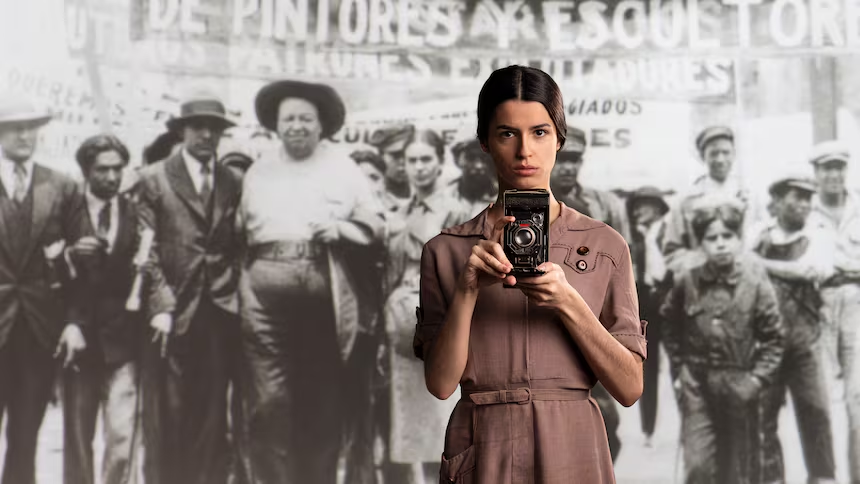
Marianna Zouzoulas as Tina Modotti in the Electric Company Theatre production of Fire Never Dies at The Cultch in Vancouver, 2025. Directed by Carmen Aguirre.
Caroline Woodward reads, writes and reviews from New Denver.




Leave a Reply