


Art, story and legacy
June 10th, 2026
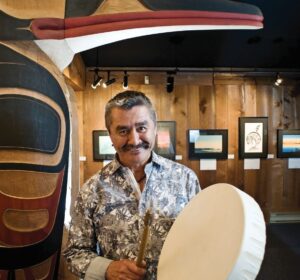
Roy Henry Vickers, Indigenous artist and storyteller, celebrates his 80th birthday this year with The Best of Roy Henry Vickers: 80 Selected Works (Harbour $24.95). This collection of eighty artworks are from the years 1974 to 2024 and include some of the artist’s most famous pieces. One of those images, Siwash Rock (1988) is his “most popular art piece,” Vickers says. He adds that it was inspired by E. Pauline Johnson’s classic, Legends of Vancouver first published by Vancouver’s George S. Forsyth & Co. in 1911 (more recently republished by Orca in 2018 and Douglas & McIntyre in 2024).
*
Question: As you celebrate your 80th birthday with this retrospective, what do you hope younger Indigenous artists and storytellers take away from your journey and your body of work?
Roy Henry Vickers: As I complete my 80th year, I hope other artists are inspired by my stories and create for the world what only they can create. I hope that others will resolve to be creative from that powerful place of inspiration. Acknowledge your ancestors and teachers, be humble and give credit to those who inspire you. What you put out will come back to you multiplied by what you give. Create from a desire to tell your story, not to make money–and your lifestyle will be rewarded beyond your expectations and needs.
We all have a unique story to tell, and only we can tell that story. I’ve found that inspiration is divine, it comes from the Creator and all of our ancestors and teachers, from their art and their stories. As I look through the images from 50 years of work, it is apparent to me that I’ve stayed true to inspiration, and this mindset continues to help me grow and evolve as a person and, therefore, as an artist.
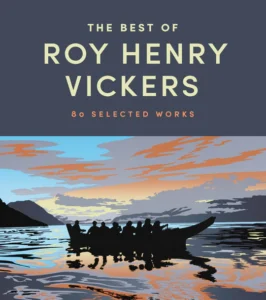 Q: The Best of Roy Henry Vickers spans more than fifty years of your artistic career. Looking back at works from 1974 to 2024, what do you notice about how your art—and perhaps your understanding of yourself as an artist—has evolved over time?
RHV: I began my artistic expression with a desire to explore my Indigenous ancestors. I grew up in a 5,000-year-old village, and as an adult, I wanted to connect with my father’s people, particularly their distinct artistic style. I began to realize that the art was created to remind storytellers of the ancient stories. As time passed, I realized I was creating art in a style that few people connected with, and I wanted to bring my European ancestors into my creative style. I began to realize a great truth: we are all one race, not different races of humanity; we are different cultures and languages, but one great family of humanity. I wanted to create as I live today, as a child of many cultures.
I found that inspiration is divine, it comes from the Creator and all of our ancestors and teachers, from their art and their stories. As I look through the images from 50 years of work, it is apparent to me that I’ve stayed true to my inspiration, and this mindset continues to help me grow and evolve as a person and, therefore, as an artist.
Q: What role has your long-standing collaboration with Lucky Budd played in the creation and success of your many books?
RHV: Lucky has been involved for a short time when you look at my 50-plus years of creativity as an artist; however, the great thing Lucky has given me is the renewed realization that books are a place where I can write down the stories I was sharing as a storyteller. When Lucky came into my life, he inspired me to illustrate and write the stories that I was sharing as books; he reminded me of my friends, Wilson Duff and Hilary Stewart, who had created books to teach us about the Indigenous cultures of the Pacific Northwest and how important books were.
Inspiration will always help collaborations last for decades.
Q: Having collaborated on numerous books connected to West Coast history and culture, what do you think makes his work so enduring?
Lucky Budd: Roy is a storyteller through and through. He grew up listening to and learning from storytellers and it really is in his DNA. Incredible stories endure for generations. The best songs tell stories. What makes Roy’s artwork so enduring, in my opinion, is the layers and layers of storytelling that are in each of his images. I have had the great pleasure of watching Roy draw and create images. There is something incredibly powerful about watching someone who is working from a place of inspiration who also happens to be a master at their craft. It is almost like Roy steps aside and these other voices are coming through his work. He has shared with me that sometimes he goes back to a particular piece days after it is complete and it is hard for him to believe that he created it. There are so many layers of stories coming through! I urge you to pick any of his prints, stare into it for a while and examine it. Look for the way the water moves, look at the birds or other creatures in the trees or in the clouds. What knowledge about the people, places and values of the people of the northwest coast are being communicated? Can you catch of little of Roy’s sense of humour coming through? Like any good story, it means something different to you depending on where you are at in your own journey… Roy’s art comes from the heart, so it connects on a heart level. He loves the stories he is sharing in each image and us viewers can really feel it!
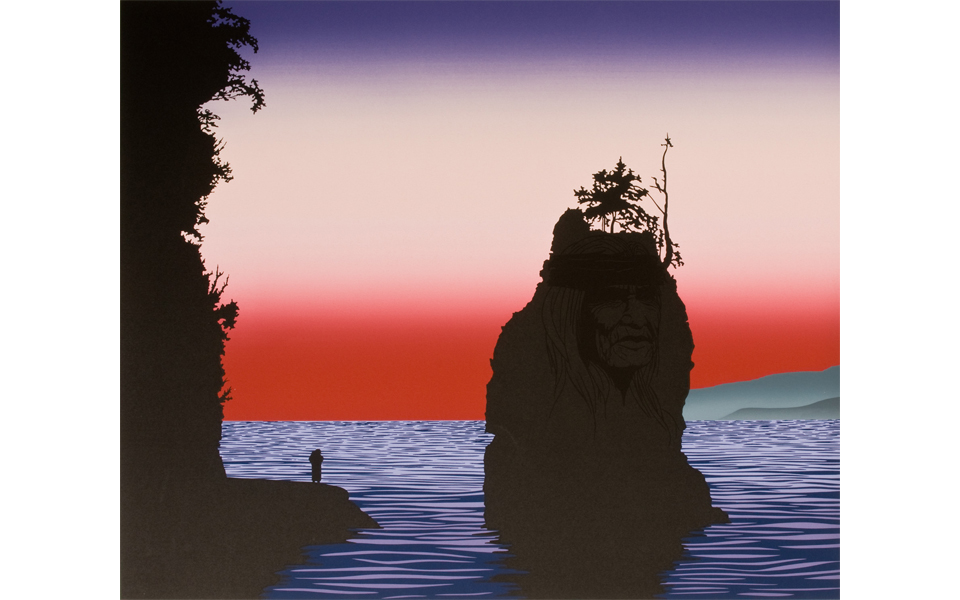
Siwash Rock (1988) by Roy Henry Vickers
Q: This collection brings together many of the images and themes that people most associate with your work—Northwest Coast legends, dramatic landscapes and scenes of coastal life. Why do you think these images continue to resonate so deeply with audiences across generations?
RHV: We are part of all our ancestors; their DNA is part of us, their personalities are part of us, and when we create from inspiration, we are influenced by them, and it’s a natural outcome to create unique works. My indigenous ancestors bring to me a natural connection to nature that feels fresh. They relied directly on the land for their survival until relatively recently. That relationship still feels vivid and present to me. Inspiration is innate and magical because it comes through our ancestors for many generations, as well as all the teachers we have. Our ancestors are part of the land, part of nature. When we feel inspired and create stories, whether with pictures or words, we are creating what only we can do because we are all unique and special. I’m an “old child,” and it’s easy for me to connect with young people. One of my children said, “Dad, you’re just like an older big kid.” And I take that as a compliment.
Create from your heart and emotions, and people will not only see but feel what you do.
Q: Looking at the eighty pieces selected for this retrospective, what themes or images do you feel have remained most constant throughout Roy’s long career?
LB: What I see more than anything, is a constant student who is always learning and evolving. Roy is never afraid to push himself to try something new, be it a perspective, a colour or a subject matter. In fact, this constant growth is what drives him! Whatever he is inspired by in his life, he jumps in with his whole heart to learn. So, when he is inspired, that learning comes through very strong! For much of Roy’s career as a professional artist, he has created a print a month, year after year. So, when we look over the breadth of his work for a book like this, we can see what he was learning, where he was, and what inspiration was driving him. The constant for Roy is learning. The constant is curiosity. The constant is using that student knowledge and becoming a teacher to share what he has learned with all of us.
Q: You’ve spent years working with Northwest Coast storytelling traditions, including digitizing many high-profile oral history collections. How did that background shape your approach to curating Roy’s artwork for this retrospective?
LB: Well, there are so many wonderful things about working with and being friends with Roy. One of them is that he is among the best storytellers I have ever heard. As someone who works in the medium of storytelling, I find chatting with Roy a joy! I ask him a question, and a flood of knowledge comes out in the form of stories. It feels like we are talking for 3 minutes, and we look and over 90 minutes have passed. All of Roy’s images convey stories and many layers of meaning. So, as we worked on this book together, a story from all the smaller stories began to unfold. As the curator of his archive, I know the majority of his works intimately. I often call him and ask for a story of this image or something I saw in another.
I believe this collection offers many brilliant stories that are slowly revealed as the book unfolds…





Leave a Reply