


Far from Home
July 20th, 2026
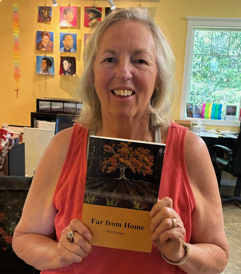
Ruth Rodgers retired from full-time college teaching and moved from Ontario to British Columbia’s Sunshine Coast in 2013, where she’s fulfilled a long-held ambition to write. Born in England but raised in Canada from a young age, she was aghast to realize, as an adult, how many critical parts of Canadian history had not been taught in her school curriculum. Exposure to the local Indigenous people of BC made her especially aware of how little she knew about their experiences and vowed to learn more and share what she learned through historical fiction novels. All of her books (except Always your Peggy, a fictionalized account of her English mother’s war experience) are set in Canada and explore the lived experiences of Canada’s marginalized people. Through these stories, she hopes to open eyes to our own history and uncover hidden prejudices and values.
By Cathalynn Labonté-Smith
Prepare yourself, reader, for heart-rending tales that will stay with you long after you close the covers. Historical fiction author, Ruth Rodgers, from the Sunshine Coast of BC, weaves an unforgettable story about a cohort of “home children” and their plight in Far From Home.
Rodgers bases her book that spans a lifetime, on the history of the nearly 80 years (1869 to 1948) when over 100,000 children, some as young as three years-old, were shipped to Canada from the UK, like so much cargo. Most would never see England, or their families again. The book starts with Sue, in her 70s, who has saved up for a trip to Ontario from the UK, to see if she can find her elder sister, Lucy McRae.
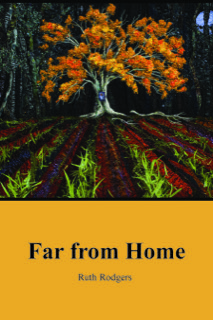 According to the Home Children Canada Research, that Rodgers lists in her resources at the end the of her book, 10% of Canadians are descended from these unfortunate waifs. The children were often swept up off the streets seen as unwanted human trash, or taken from their impoverished parents, then corralled from orphanages, such as Dr. Barando’s homes, onto trains and dumped at ports. If they survived the weeks of a grueling sea voyage, that on occasion took their lives in shipwrecks, they became indentured workers as farmhands or domestics in Canada as well as in other Commonwealth countries, like Australia.
In 1873, in England,. Lucy, Punch, and Joseph find their way to The Beehive run by kindly Annie Macpherson, who trains children to serve in homes.
Another lad, named ‘Punch,’ about ten, was discovered one night asleep in a barrel at Billingsgate Market with his little dog. Punch had made a living of sorts by doing acrobatic tricks and ventriloquism in East End gin palaces. Now he had a secure bed and three meals a day and no longer had to roam the filthy streets of the East End. Yes, she had saved all of these and many more—but how many others had she not saved? (Far From Home, Ruth Rodgers, Independently published, 2026, p. 17.)
Joseph and Punch become fast friends with Joseph becoming the smaller boy’s protector. Joseph settles in and eagerly learns how to be a cobbler. The orphans’ transition to a relatively stable life is interrupted when suddenly Mrs. MacPherson announces:
“Now, boys,” Miss Macpherson began,. . . “I want to tell you about a wonderful opportunity. You have the chance to go to a new country, to a place that has lots of space and fresh air and plenty of food. It’s called Canada and I’m looking for boys who want to go there with me!”(Rodgers, p. 31.)
Joseph is cajoled into going abroad by the adventurous Punch. They’re led to believe the trip will be short, but when a trunk of clothing appears at the foot of their bed filled to the brim with clothing fit for Canada’s harsh climate, Joseph has second thoughts.
“I think we may have signed up for more than a day out,” he said slowly, but couldn’t explain what they might expect.
. . . They found the brown wooden trunks at the end of their beds, stenciled with their names in black ink. . . There was a grey cloth overcoat,. . . a woollen hat and a flat cloth cap, and a pair of knitted gloves. There were three—three!—jacket and trouser suits of a cheap but new material, with four white shirts and matching soft collars with collar buttons, plus two ties in navy blue. There was one warm knitted jumper, also navy, a pair of serviceable brown canvas overalls, plus a set of suspenders and a belt. There was a pair of sturdy black shoes and two pairs of heavy brown boots. . .plus three pairs of new woollen socks to accompany the footwear. . .There were two sets of woollen underwear, handkerchiefs, a hair brush and comb, a small sewing kit for mending, a Bible, and even some paper and a pen. Riches indeed for an orphaned boy from the workhouse. . .There were enough things here to last a year! (Rodgers, p.33.)
The promise to follow up after the children left the receiving homes in Canada to see how the children were cared for in their new placements was not always done, as Rodgers depicts in her book. Yes, younger children were eagerly adopted into loving home, and a lucky few did have a better life in Canada, but many suffered physical, mental, and sexual assaults at the hands of their new employers. The inspector character, Mr. Doyle, explains the lack of proper supervision to Joseph, in one of his home visits:
Mr. Doyle shook his head sadly. “His employer, that wicked woman Helen Lindsay, she starved and beat them both to death. It is a tragedy that illustrates the worst problem with this program of child immigration, I am sorry to say. There is not anywhere near enough oversight or inspection of the places where these children are being sent! This should never have happened, and you can be sure I intend to make that point very strongly in my report!”
Tears rolled down Joseph’s cheeks, and he buried his face in his hands. Starved! Beaten to death! (Rodgers, p. 113.)
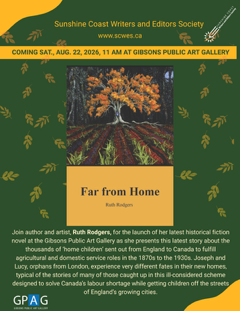
Is Sue at last reunited with her beloved, long-lost sister, Lucy? What is the fate of Joseph, Punch and his little dog, Punch?
You’ll have to attend the Far From Home book launch and get a copy at the Art & Words Festival, Gibsons Public Art Gallery, 431 Marine Dr, Gibsons, BC, Saturday, August 22nd, 11:00 a.m. to find out. Or contact Ruth Rodgers directly (ruthrodgers.com/books or rodgers.ruth@gmail.com) to nab a copy, or order a copy on Amazon, or pick it up at Talewind in Sechelt and EarthFair in Madeira Park, after the book launch, of course.
Cathalynn Cindy Labonté-Smith taught English, Journalism and other subjects at Vancouver high schools. She currently lives in Gibsons (and North Vancouver), BC, where she founded the Sunshine Coast Writers and Editors Society. She has a new book, I’m Not A Mormon (Anymore), to be released in Fall 2026 and available for preorder from Caitlin Press or Amazon.ca.





Leave a Reply