

Whistles in the forest
Indigenous poet, Jess Housty delves into ancestral knowledge and spirituality through the lens of Heiltsuk supernatural beings like Báxvbakvalan̓usiwa (the Great Cannibal at the North End of the World), which is dangerous at times, yes, but can also channel spiritual gifts.
September 01st, 2026

'Cúagilákv Jess Housty: Winner of the Dorothy Livesay Poetry Award and the Bill Duthie Booksellers’ Choice Award as well as being shortlisted for the Gerald Lampert Memorial Award and the Pat Lowther Memorial Award.
’Cúagilákv Jess Housty’s poems suggest the supernatural has never left us; rather, modern life has numbed our ability to recognize it.
Review by Odette Auger
In their second poetry collection, How to Nourish a Cannibal (Nightwood Editions $24.95), ‘Cúagilákv Jess Housty deepens and widens the lush spiritual and land-based poetics readers first encountered in their debut Crushed Wild Mint (Nightwood, 2024). Where the earlier volume often moved through prayer, medicine and kinship, this collection enters into transformation itself—asking what hunger means, what it means to feed one another and how the body becomes both feast and offering.
Drawing on Haíɫzaqv understandings of cannibals and supernatural beings, ’Cúagilákv writes toward a world where the sacred is neither distant nor metaphorical but living and immediate. The poems hold grief, longing, sensuality and abundance simultaneously. In “Taken,” the cannibal becomes less a figure of terror than a force pulling us toward surrender and belonging. ‘Cúagilákv writes: “When you hear the whistles in the forest / drawing closer, like a lover would, ask yourself: / are they coming to take you away / or to take you home?”
The collection repeatedly returns to the body as landscape, inheritance and threshold. ’Cúagilákv’s particular gift remains their ability to dissolve boundaries between land and self without flattening either. In “Indivisible,” they write, “your body is a creation story / unfolding into a motherland, / into a government, / into futurity.”
 Nourishment consistently becomes reciprocal rather than consumptive. Berries, geese, nettles, saltwater, rosehips and mint are not decorative natural imagery but part of a living system of responsibility and intimacy. In “You Nourish,” the poet stands “warmly bloodied to the elbows / with the gifts I’ve been given,” while “Twenty-Four Bundles of Mint” transforms grief into acts of preparation and care.
Time moves strangely through these poems. Ancestors surface beside children. Water becomes a portal between worlds. Ravens, robins, wolves and sparrows carry teachings forward through ordinary encounters. ’Cúagilákv’s poems suggest the supernatural has never left us; rather, modern life has numbed our ability to recognize it. In “The Year We Lost You,” the speaker reflects that, “We thought the Indian Agents / had burned those little fiends / along with our masks and treasures, / that the supernatural / had left this world ….” But the speaker realizes, “we know now / how rich we are, / having spirits we can lose.”
There is also a sharpened sensuality in this collection, a tenderness that often edges into ache. Hunger is erotic, devotional and communal all at once. How to Nourish a Cannibal reframes the body not as lacking, but as a source of abundance: “You are not made / in the shape of hunger. / You are a glut of succulence / and succour, / an invitation to generosity.”
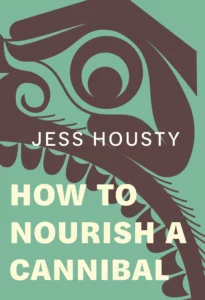
The striking cover art by Nusí, Ian Reid (Heiltsuk) evokes the circular, open-mouthed imagery running throughout the volume: transformation, consumption, invocation. The poems themselves often move similarly, circling back through repetition and accumulation until image becomes incantation.
By the end of the collection, readers begin to understand nourishment itself as ceremony—a way of holding grief, kinship and futurity together. In “What Islands Are Made Of,” ’Cúagilákv writes that islands are formed partly from “The upward swell / of all that is holy / and all that is common.” That may also describe this collection.
These poems refuse separation between body and land, sacred and ordinary, hunger and love. Like the warm loaf tossed across the water in “Leavening,” ’Cúagilákv offers readers something sustaining, handmade and carried carefully through difficult weather. 9780889715189
Odette Auger, award-winning journalist and storyteller, is Sagamok Anishnawbek through her mother and lives as a guest in toq qaymɩxʷ (Klahoose), ɬəʔamɛn qaymɩxʷ (Tla’amin), ʔop qaymɩ (Homalco) territories.





Leave a Reply