

When a sanctuary becomes a prison
Pioneer workers who spent a lifetime laying the very foundations of BC, earned little and were treated to mean conditions at the province’s first care home where they were called “inmates.”
September 02nd, 2026
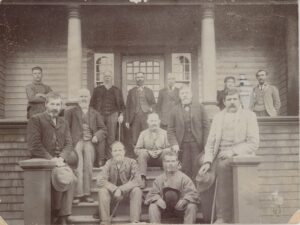
Ten of the first residents at the Provincial Home and three members of the staff in 1897.
“Once the men were taken in care the greatest administration concern seemed to be expenses. [Author Wayne] Norton embarked on this informative, telling micro-history after discovering notes from the Home’s superintendent seeking a few extra eggs and a turkey dinner instead of mutton for Christmas Dinner in 1916. The response came immediately from Victoria by telegram: ‘Supply mutton.’”
Review by Tom Hawthorn
The Inland Sentinel newspaper described the new provincial building as “an ornament to the city.” Built in the Queen Anne Revival style with a stone foundation and wood-frame construction, a government inspector noted the building’s “very picturesque appearance, with its half-timbered gables, bay and oriel windows, and copper-covered towers.” Verandahs offered views overlooking the confluence of the North and South Thompson Rivers, as well as the downtown of Kamloops, an anglicization of the Shuswap word meaning “where the rivers meet.”
It was 1895 and the provincial government had opened what would become known as the Provincial Old Men’s Home. It was to be a place of sanctuary for older men without family or the means to support themselves.
On a visit to Kamloops before construction was completed, Governor General Lord Aberdeen congratulated the newly incorporated city for being chosen for the home. “Its object is one with which everyone will sympathize,” the vice-regal representative said, “that of providing a quiet retreat and home for men, who came here as pioneers and without whose qualities of energy this country would never have advanced to the point it has.”
The first residents were miners and labourers who found themselves destitute late in life. They were unmarried and without family to assist in their care. They were also white, as racist provincial laws barred Indigenous men or those of Asian heritage from being residents. The same groups were also forbidden from building the Home or from working in it.
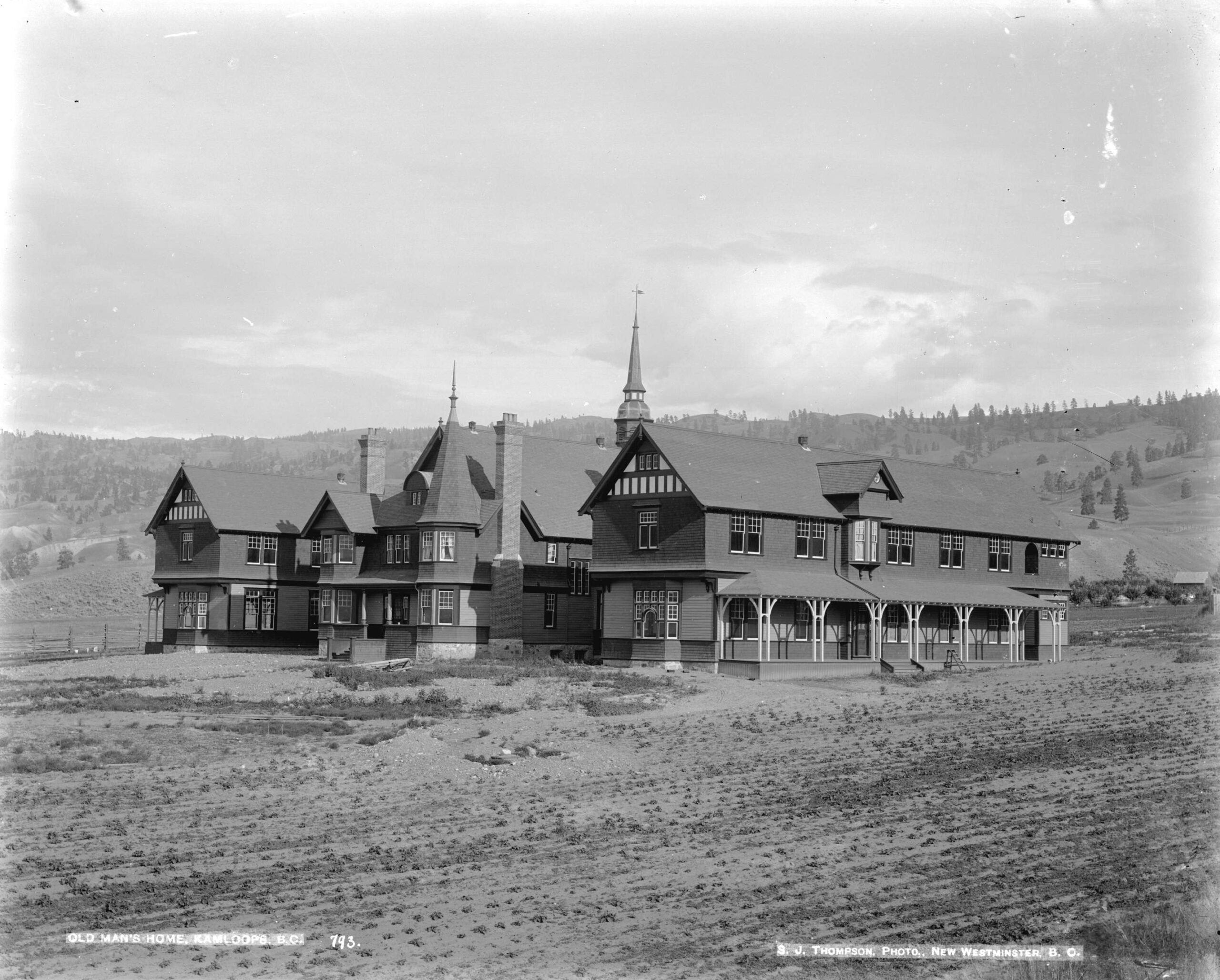
Provincial Old Men’s Home, Kamloops, BC, 1894.
At first, the home only had three salaried staff: a superintendent, Joseph Ratchford, who was a former hotelkeeper and widower who lived on-site with his two young children; a matron, Alice Pinchbeck, a widow who lived on-site with three sons; and a cook. The cook was to be paid $30 per month. The Home went through nine cooks in its first two years. As well, a fireman was engaged to handle the enormous amount of wood and coal needed to keep the large building heated. After a year, the superintendent and matron married at the Home.
The residents, who in the terminology of the times were referred to as “inmates,” paid a heavy cost for this care. The provincial government operated the Home more as a poorhouse than as a care home, so the men were forced to surrender their worldly goods and even lost their right to vote.
This was their reward after a lifetime of work, either as miners, farmers or labourers, though some professional and other middle-class men would also live at the Home.
The Home has all but been forgotten in the province’s history, and is but a distant memory even in Kamloops, where the destruction of the Home (in 1974) is already more than a half-century in the past. Wayne Norton shines a light on this forgotten history in Pioneers & Paupers: The Untold Story of the Provincial Old Men’s Home by Wayne Norton (Ronsdale $23.95), finding a marvelous topic for capturing a slice of the province’s social history, as he makes excellent use of the Home’s expenses and other minutiae captured in historical documents to tell the story of this ignored institution.
He has also made solid use of newspaper clippings from the Kamloops newspapers, as well as finding a marvelous quotation in Bruce Hutchison’s magisterial work, The Fraser (Clarke, Irwin, 1950/Oxford Univ. Press, 2009): “The present inmates, from all parts of the interior, represent, in the unnoted record of their obscure lives, the labour of ranch, of forest and mine, that has made British Columbia. In the busy tide of progress few people have time for the wrecks and derelicts, who cannot express the magic of a better time, and have learned, in a proud silence, to take their secrets with them.”
It is to Norton’s credit that he finds snippets of their biographies to share with us. In 1956, the Home celebrated the 99th birthday of inmate Alexander McMahon, who 71 years earlier had been present at Craigellachie for the driving of the last spike completing the Canadian Pacific Railway.
Hailed by politicians as the pioneers who built the province, once the men were taken in care the greatest administration concern seemed to be expenses. Norton embarked on this informative, telling micro-history after discovering notes from the Home’s superintendent seeking a few extra eggs and a turkey dinner instead of mutton for Christmas Dinner in 1916. The response came immediately from Victoria by telegram: “Supply mutton.”
Premier John Oliver visited in 1926, speaking with the inmates and reminiscing about the old days. He then signed the guest book: “Home in satisfactory condition.” He was less interested in the men and their lives than in whether the province was getting its worth.
In the depths of the Great Depression, instruction came from Victoria to “exercise not merely strict economy but positive parsimony.” Staff faced pay cuts. Amid these deprivations, funds were found for a commercial dishwasher, a piano and a new radio for the common room. As well, inmates began receiving $3 every Christmas from Charles Woodward of the Woodward’s department store, which became a welcome annual tradition.
The grimness of daily life was relieved somewhat on Christmas mornings when the band from the local Lodge of Elks performed a concert, joined one year by inmate Barney Wilson on violin. The Elks made sure each man also received a gift—a cob pipe and a packet of tobacco.
In time, the franchise was returned (in 1939) and racial restrictions removed (in 1955). The institution’s purpose as a poorhouse also evolved into becoming more like the care homes we recognize today.
Perhaps the most fortunate resident was Thomas Dewar, who had been a cook in the Yukon. Broke, he migrated to Victoria, where he was refused entry to the local old men’s home for not being a longtime resident. He applied and was admitted to the Kamloops home, where he was even hired as a cook for three months. Two years later, he received news both sad and joyous from the old country—a distant relative had died, leaving him the sole heir to an estate valued at 10,000 pounds sterling. The province even paid his way to Glasgow. 9781553807490
Tom Hawthorn’s most recent book, Play Ball!, is an anecdotal history of baseball in Vancouver.





Thank you for reviewing this book. I’m saddened to learn of the slighting the men and the home itself received. Hoping our local library or BC interlibrary will have this book for us to read and learn more from.