


Travels without leaving
June 23rd, 2026

Jan DeGrass writes in Sechelt, B.C., where she is the former arts columnist for Coast Reporter newspaper and former editor of Coast Life magazine. She is the author of a novel, Jazz with Ella, based on her student experiences in Russia—a country that continues to fascinate her. Part imagination, part memory, Temptations and Travels is a collection of stories that wander freely between fiction and lived experience. Here are tales of travels, trials and temptations. Some tales grow from remembered journeys; others from moments half-forgotten but reshaped and embellished by the storyteller. Her historical novel, Winter of Siege, (MW Books) also had its genesis in Russia. A non-fiction book, The Co-op Revolution (Caitlin Press), is an account of her time with the activist co-op movement in Vancouver. Her short stories have appeared in anthologies, as finalists in writing contests and have been published in Canadian Living, Chatelaine and Room.
Review by Cathalynn Labonté-Smith
When it’s challenging to find somewhere to travel to due to wars, politics, economics, as well as being unable to justify the consumption of fossil fuels to get there, Jan DeGrass’s book of 17 insightful short stories, Temptations and Travels: Stories (MW Books, 2026), is a welcome escape for armchair travellers. There are stories within that seem like they really may have happened to the author and some that seem somewhat surreal.
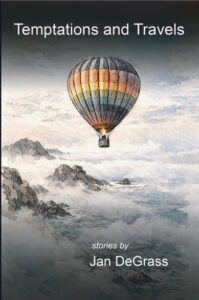
The whimsical cover of T and T itself is a conversation starter with its hot air balloon floating across a stormy sky high above rugged mountains. Have you ever had a ride in a hot air balloon? What was it like? Have you seen a hot air balloon festival? Where was it? Would you ever ride in a hot air balloon?
Who doesn’t love stories that you can learn from, like DeGrass’s opening story, “The Invention of Nylon,” where readers are transported back to when sheer, sensual, silky nylon stockings were first available post-World War II, when finally nylon could be diverted from manufacturing items for the war to this fashion necessity, through the character of Florence, who is a caretaker to an elderly woman. “. . .40,000 women wanted the 15,000 pairs of stockings available. Just yesterday the planets aligned. Florence had caught an early bus to Buffalo and waited in line at the department store , and this time she was not disappointed—there were plenty of nylons for all.” (Temptations and Travels: Stories, Jan DeGrass, p. 11.) Of course, many modern women (and some men and trans people) don’t want to be encumbered by hosiery if they can avoid it. Bare legs are acceptable now even in the workplace, especially in the summer.
 You may find yourself searching the web to see if there really was a cruise ship stranded by a tidal wave that sucked all the water from beneath it where it waited, like a beached whale, for the water to return, when you read “Sitting in a Dry Canyon While the World Has Gone Awry.”
On this aground ship, there’s no deadly Norovirus, Hanta virus, Covid, or Ebola outbreak onboard. Instead, passengers and crew helplessly wait for the water to return and float them back home. They can only hope that all souls will survive the sudden gush of the massive force of the return of the water.
When the water rushed away, somehow the prow of the cruise ship had found its way into a slim space between two gigantic rock towers. This positioning had saved the passengers from being swept away and shipwrecked. With the bow wedged firmly, the rudder had braced itself against a boulder and ship stayed upright on its rocky cradle, though slightly listing to starboard. (DeGrass, p. 56)
I’ve never been to Iceland and given the grueling journey to get there, I’m not likely to see it, but DeGrass describes a trip there on a tour that shows me what I’ve missing in her dazzling, descriptive prose that reveals her journalistic background.
The sky is blazing blue. The sea is a cold blue. . .Behind me is an iceberg the size of an oceanliner is floating past. . . .and stretching upward to the sky is vast ice field—the Vatnojokull glacier. Where the glacier meets the sea, it calves icebergs that eventually drift away from the group to shimmer and melt into the North Atlantic. The sunshine glints off the sparkling ice mountains. The tourists who have just stepped off a dark bus, are dazzled profusions of colour and light. (DeGrass, p. 123.)
I journeyed to St. Petersburgh, Russia via a stormy sea-sickness-inducing cruise of the Baltic sea over 15 years ago. Being a huge fan of Leo Tolstoy’s Anna Karenina, I had wanted to visit the city and palaces mentioned in the novel. Given DeGrass’s Russian travels, I found “Opening the Egg,” about a wooden, painted egg that rattles with a hidden family secret fascinating.
I studied the egg. It was similar in appearance to the wooden hand-painted egg that has sat in Granny Yevtushenek’s kitchen for all the 30 years of my life. But this egg was solid wood while Granny Y’s egg was hollow; it rattled teasingly when her children and later, her grandchildren, shoot it. Though it had a hairline crack around its middle, she would never let us open it, no matter how much we pleaded. She said the egg contained the most important thing—the secret of life. (DeGrass, p. 20.)
I have been to one place that DeGrass didn’t quite manage to get to, Sedona, California, where I hiked to a vortex on a mountain with a stunning view. I would love to return but like the majority of Canadians, I’m not travelling to the United States at this time, or for the foreseeable future.
DeGrass’s story, “Not Going to Sedona,” is about those thrilling adventures we have on the way to somewhere else when we end up at an unplanned or alternate destination. While searching for a vortex, the narrator and her traveling companion, Marlene, takes a frightening turn that says, they’re not in Sedona, after all.
Our van nosed along this perilous ridge for half a mile before the road dropped to cross a frozen creek bed. We climbed again, steeper this time, until we crested a lonely pass where the wind whistled and the air cracked as we pulled the thin oxygen into our lungs. Each bend offered new views, while the van lumbered on in low gear. (DeGrass, p. 138.)
In T and T, the reader can enjoy the pleasures of far-flung journeys real and imagined vicariously. It’s comforting that you won’t find here stories of tourists being kidnapped and held at gunpoint as their valuables are stripped from their bodies, or of being dogged by gun-wielding Cartel members on motorbikes, nor flung to the ground by ICE agents and dragged away, as can happen in reality.
Cathalynn Cindy Labonté-Smith taught English, Journalism and other subjects at Vancouver high schools. She currently lives in Gibsons (and North Vancouver), BC, where she founded the Sunshine Coast Writers and Editors Society. She has a new book, I’m Not A Mormon (Anymore), to be released in Fall 2026 and available for preorder from Caitlin Press or Amazon.ca.




Leave a Reply