

The last innings
George Bowering is easily one of BC’s most prolific writers and now, in his 90th year, he says he is publishing his last two books: a travelogue and a collection of new poems & essays.
August 18th, 2026
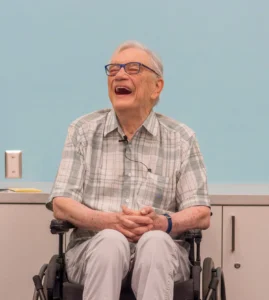
George Bowering is a Canadian novelist, poet, historian and biographer and Canada's first Parliamentary Poet Laureate.
“He doesn’t yet hear the gentle / footsteps the other side / of his very last door.”—George Bowering
Few authors have published over 100 books—Bowering accomplished the feat by writing across genres… and through diligent work. He is a poet (Canada’s first Poet Laureate from 2002 to 2004), novelist, nonfiction writer, memoirist, historian and editor. Almost unheard of, Bowering has won the Governor-General’s Awards for both poetry and fiction. As a passionate baseball fan, he has penned poetry books and memoirs about the sport. Like most writers, Bowering is an avid book reader and as of June 4, a new teaching space and reading room showcasing his personal library collection will be open to the public at UBC Library’s Rare Books and Special Collections. Here, we feature reviews of Bowering’s last published books.
*
Review by Heidi Greco
According to a recipe from the renowned food writer M.F.K. Fisher, it takes seven years for a pearl to form inside an oyster. In the case of George Bowering’s Pearl (Talonbooks $19.95), it took a lifetime of writing for this particular gem to come into existence.
In his preface, Bowering likens the process of a pearl’s creation to that of writing a poem, explaining it like this: “…something starts to irritate me in some way, some words, some passage in my life or some strange thought, or maybe a beautiful image of something I saw recently, such as a grackle or a curling stone.” That the objects of beauty Bowering names are as disparate as a bird and a curling stone should come as no surprise to those at all familiar with his unique point of view, as he often writes about things that are small or overlooked.
He describes Pearl as “a poetry book… a book that perhaps is interested in the making of poems, their fortune, what people are going to do with them, where they came from, and so forth.” A tall-sounding order perhaps, but a promise that is fulfilled, as the book contains not only poems but short essays, even a section containing nothing but interesting sentences—thoughts he may well have once used to start a poem.
At the heart of the book is the section called “Pearl,” a baker’s dozen of poems about his mother, named Pearl, a remarkable-sounding woman who was an athlete, a pie-maker, a spike-driving champion and more—who managed to live to the age of 100. Among the fond character sketches he’s written, her idiosyncrasies shine through: “…whatever / she was doing at the kitchen sink / window, she tried to / retain her cigarette ash / in one cigarette length.”
But Pearl is not the only character we meet here. Many of Bowering’s friends and relatives show up, sometimes in unexpected places, as in the short essay about the Ontario poet Stuart Ross, who appears almost magically in a kayak on a BC lake. Or David Robinson who founded Talonbooks, the Vancouver press which started out as a magazine called Talon. Other friends, Jamie and Carol Reid, are among those we encounter, though sadly, those two are among the friends who are now gone.
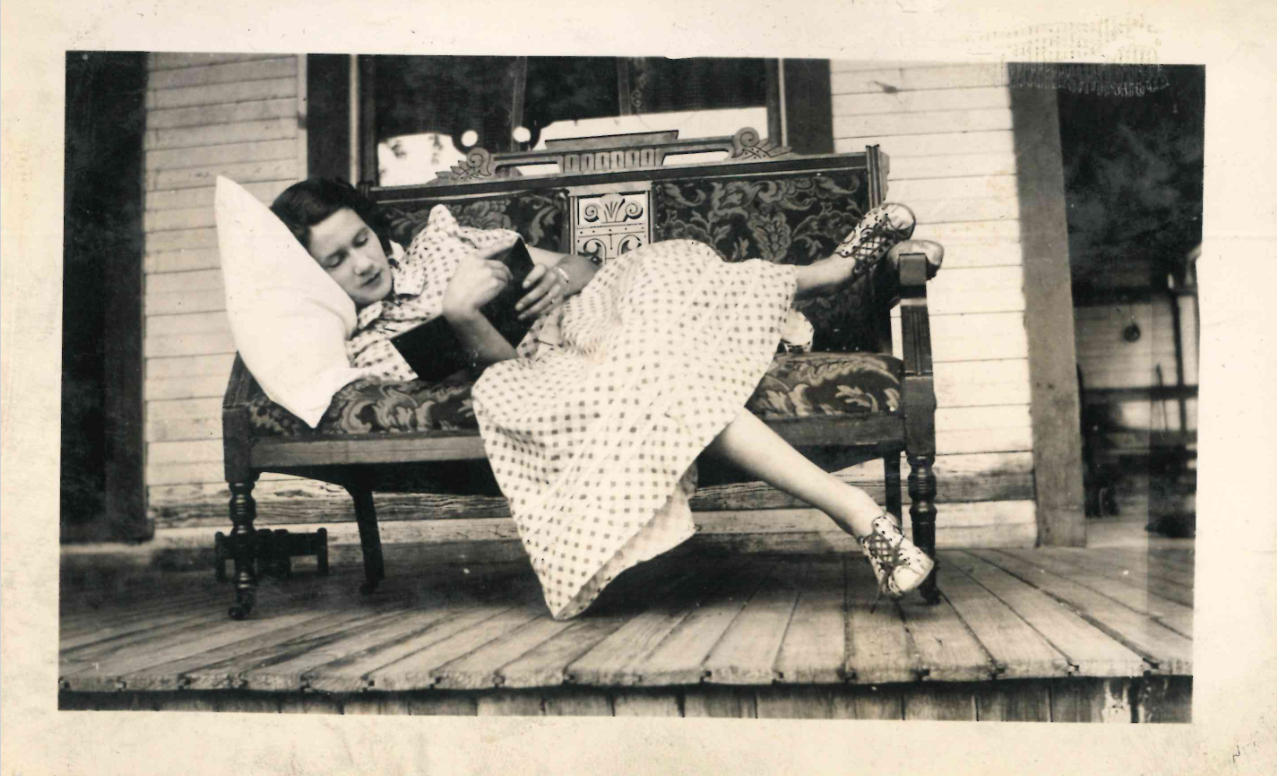
Pearl Bowering, George’s mother, c.1935.
Bowering also calls this book his “farewell book of poems” which is likely the truth, as he’s now 90, blind and only able to complete this work with the assistance of his wife, Jean Baird. In a poem called “Jean Drove,” he recalls lying on the sidewalk after having a heart attack while out walking his dog: “…a man sitting on me / banging at my chest / his fist pounding me / trying to get at my heart.” And later, among those stand-alone “Life Sentences” this zinger: “Late in life he had foreign objects in his hip and femur, his jaws, his eyes and his heart.”
It’s clear that Bowering has heard the angels (or whoever it might be who gathers us at the end) as some of the poems deal directly with the approach of death, none more beautifully than one that ends with this stanza: “He doesn’t yet hear the gentle / footsteps the other side / of his very last door.”
He applies lessons his father taught him about dribbling a basketball or throwing and catching a baseball to the art of composing poetry. “In baseball, as in poetry, you learn by reading and figuring out what previous players have done. Then you practise and practise. I would see how…Jackie Robinson started a double play and try doing it a hundred times.” And yes, baseball has always been Bowering’s game. He played shortstop in the 1970s for the Zephyrs in Vancouver’s Kosmic League and, as noted in He Speaks Volumes, Rebecca Wigod’s biography of him, was known for making loud remarks during play.
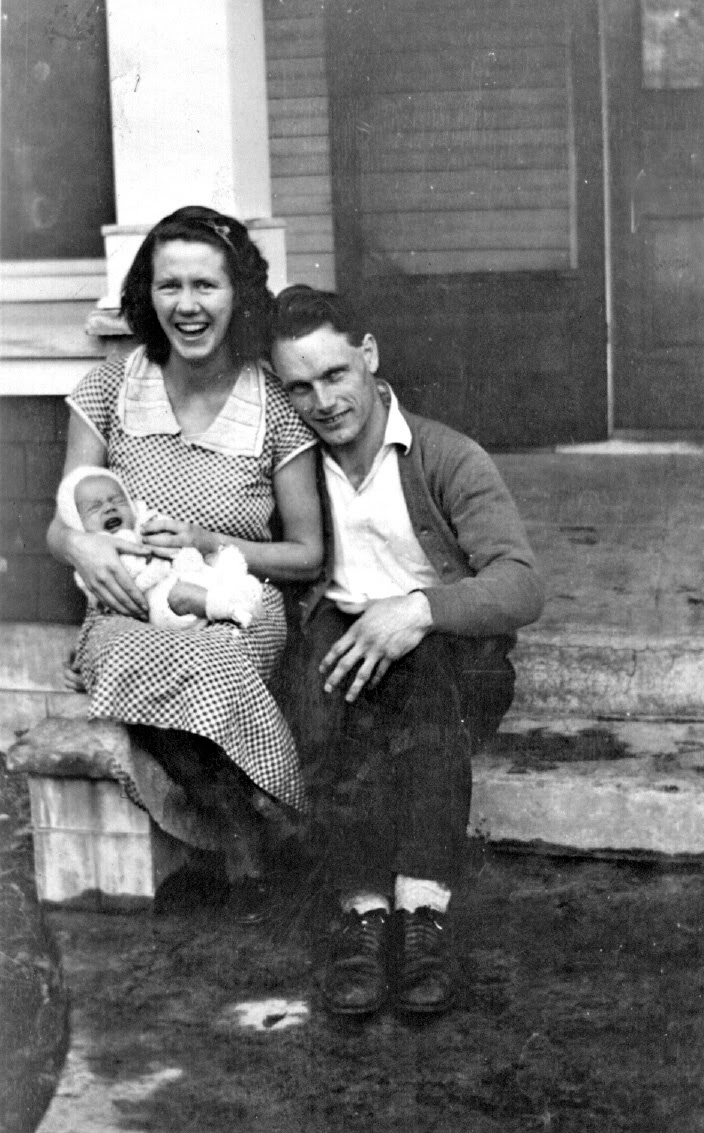
Baby George with his mother and father, Pearl and Ewart Bowering, c. 1935/1936.
Over the course of the book, Bowering offers insights into his own writing and influences, expressing clear admiration for William Carlos Williams. An example of how that poet’s work has inspired him is especially evident in a piece called “A Little White Bowl” which, with its clear simplicity almost conjures the cold plums Williams is so well-known for.
I’d be remiss if I failed to point out the humour at play in these pages, especially when it comes to his puns and silly “takes” on Robert Frost, one of which begins with these almost-too-familiar lines: “Whose words are these? I think I’m lost / I’d better go and read some Frost.”
Or, better yet, go and read some Bowering. 9781772017137
Heidi Greco lives on Territory of the Semiahmoo Nation in a house where one of the closets holds a box containing a baseball glove that belonged to George Bowering.





Leave a Reply