

Songs of life and death
January 05th, 2026

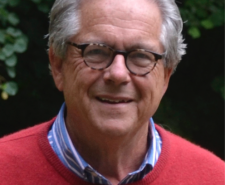
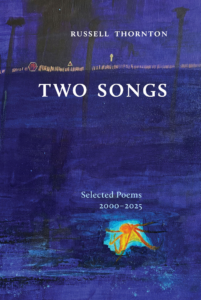
Russell Thornton is a North Vancouver–based poet whose work is known for its visceral lyricism and elemental engagement with life, death and transformation. The author of nine previous poetry collections, Thornton has twice been shortlisted for major awards, including the Governor General’s Award and the Griffin Poetry Prize and his poems have appeared widely in anthologies and international translation. His new collection, Two Songs (Harbour $26.95), gathers poems written between 2000 and 2025, tracing a lifelong pursuit of poetry as incantatory language shaped by lived experience, memory, love, loss and spirituality. Deeply influenced by the natural landscapes of the North Shore—its rain, mountains, forests and shifting light—Thornton’s work seeks to reconcile opposing forces, offering readers a sustained meditation on eros, mortality and the human imagination.
*
 Question: How do the Canadian poetic traditions of Layton, Birney, and MacEwen influence your contemporary voice, and in what ways do you diverge from them?
Russell Thornton: These three Canadian poets embody, for me, the essential lyrical voice, yet with a distinct Canadian resonance—both in sound and substance. They utter poetry that, to echo something DH Lawrence said, “sounds upon the plasm direct.” In their signature poems, they deliver a controlled shock of pleasure and delight, summoning an alertness that feels at once primal and spiritual. Layton, especially, has been a profound influence on me. I continue to be moved by his several masterpieces—their rhythms, verbal texture and colour, and the full, radiant passion of their utterance. In my own poems, I reach for a similar lyrical intensity, though the details arise always from my own lived experience. I write about many things—my relations with others, the places I’ve lived in and visited—but it may be the landscape of North Vancouver and the surrounding area that most powerfully shapes my imagination. The mountain, forest, mist, cloud, creek, river, inlet, and rain energies of my locale work their way persistently into my poems. It seems inevitable that I draw on details from this immediate non-human world. It’s an environment of movement, quick change, and pure vitality that continually incites transformative inner experience.
Q: Your work is described as having “scenes ranging from the Greek sun of the Peloponnese to the firs on Vancouver’s North Shore”; how does travel and geographical diversity inform and shape the elemental power in your poetry?
RT: There’s a saying: “Travels are the soul of the world.” I think in travelling you sometimes enter a state of timelessness—pure process, pure potential, pure relationship with whatever is before you. You move toward a promised land that seems to create itself moment by moment in the imagination. When I was a teenager, I was desperate, as many teenagers are, to leave my familiar surroundings; I ended up going away for decades, returning for brief periods to drive a taxi. Of course, what I was really desperate for was access to parts of myself that eluded me but felt necessary for my psychological survival. And at a certain point, travelling leads beyond the personal into the deeper, shared regions of the psyche—those ancient energies common to all human beings. In Greece I felt this repeatedly. I was struck by the power of the place—the hypnotic white light, the eerie omnipresent rock, the sea. And the people: their wild music, their gestures carrying excitation and vastness, energies that somehow gather into strict form and reserve and silent containment. I lived in Larissa and then Thessaloniki for three, four years and have returned several times, and feel a piercing nostalgia for these places. Greece tests a person; the culture insists that you reveal exactly who you are. You have no choice, just as the characters in ancient Greek drama have no choice in their defining moments. And yet for all Greece and other distant places have given me, I am finally nothing if not a North Vancouver poet. Leaving my home and returning to it has given me a renewed sense of the mystery of my origins. I’ve come to believe that we may be best equipped to perceive the mystery and magic of our birthplace precisely because it is ours. The deepest dreams and the fiercest wanderlust, I’ve learned, lead back to the ground first beneath our feet. One image is permanent in me and encapsulates this: looking west past the Lions Gate Bridge toward the Salish Sea, where the sun blazes over open water while rain falls softly on North Vancouver. The light pours through the rain in delicate, trembling rays. That moment contains the essence of travel: the desire for transformation, the dream of creativity. That interchange of sunlight and rain is a sudden conjuration: an elemental summons of attention. So, ironically, here, more than anywhere else, I have a chance to undergo and enact the transformation that once seemed possible only in faraway settings.
Q: You use a Nikos Kazantzakis epigraph for this collection: “Life and Death were songs…”; how does this concept of “life-death songs” serve as the central theme for the collection gathered over twenty five years?
RT: When I began to write seriously, a well-known older Canadian poet said to me, “There are only two subjects worth writing about, sex and death. Even when you think you’re writing about other things, at your best, that’s what you’re writing about.” At the time, I wondered if he was simply being provocative, but I’ve since recognized the truth of his words. Love, eros—the life-force—and its counterpart, death, are the poles across which the tightrope of our lives is strung. As Nikos Kazantzakis declares in his monumental poetic sequel to Homer’s Odyssey, life and death are songs. The poems in my collection record my attempts to sing my own versions of those songs. Gathered over two and a half decades, these poems trace the ways I have tried to walk that tightrope—striving to utter both desire and loss, presence and absence, and to negotiate the tension between life and death that defines what it means to be human.
Q: You define poetry as “a conjuring and reconciling of forces—the kinetic energy of words meeting vital experience.” Can you elaborate on the craft and intention behind this process within your own writing?
RT: I think a genuine poem occurs when language and experience meet—and become indistinguishable. The experience is extraordinary—and involves a fusion of thought and feeling; the language, too, is extraordinary. The writer of a true poem has something valuable to say and says it superbly. The other day I saw a sailing team practicing on Burrard Inlet. I saw the labour in motion—the sailors shifting their weight from one side of the boat to the other, rotating the boom, catching wind in the mainsail and jib, guiding the tiller. At every moment the current pressed against the keel and rudder; the winds came strong and changeable. I remembered the single time I’d been on a sailboat in open sea. I felt then that enormous forces were at play—but because they were expertly welcomed and managed, they produced an ongoing powerful composure. Air and water pushed against the vessel, yet its swift movement across the sea felt serene; there was a near miraculous stillness. In the continuing reconciliation of opposing energies, the sailors and sailboat seemed to become the lit, still core of the rhythm and glide. A poem, I think, works the same way: it conjures and reconciles forces. The kinetic energies of language meet the vital experience; sound and images spark associations that meet an open, alerted consciousness. In my own poems, I try to bring my experience into this kind of creative union with the living flow of language.
Q: Critics have praised your “masterful lyrics” and impeccable craft that balances “living with one’s gaze on mortality and suffering” with “healing and regeneration”; how do you approach maintaining this delicate balance in your poems?
RT: The “best words in the best order,” as Coleridge said; a “dream dreamed in the presence of reason,” in Tomasso Ceva’s phrase; “a room of marvels,” as Andre Breton called it—these and many other characterizations of poetry, offered by master poets both in their sayings and lyric examples, guide me in my own attempts. It seems inevitable to me that the highest levels of poetic craft enact a vision in which paradox opens its door to transcendence—where suffering and joy, hurt and healing, the material and the spiritual, mortality and the eternal move toward union and become one.
 Q: The back cover description of your book mentions finding beauty in the “dark emptiness” of amphoras, like a Cézanne still life; can you discuss the role of negative space, silence, or the “unspeakable” in your work?
RT: As a reader, the best poems render me speechless; they summon silence. They leave me with the sense that I’ve been changed—that I’m no longer quite the person I was before I encountered them. They initiate me into levels of my being that I can’t fully fathom. The experience is both visceral and spiritual, and it re-makes my awareness on the spot. In my own poems, I try to create conditions—through language and through content—that might provoke a similar experience. I want my awareness to begin again, before or beyond words, as if at the beginning of things and of myself, in a space where everything I know withdraws and then returns transformed. One of poetry’s primary purposes, I think, is to create such verbal spaces—to limit or contract space to set up intimations of infinite expansion. William Blake, Rumi, and others come to mind; this seems to be a fundamental creative principle. Perhaps all art imitates, or re-enacts in miniature, some original activity that once brought—and continues to bring—the universe into being. In any case, my own poems begin from this sense of a contraction or withdrawal, an effort to make a special space. The circumscription, the geometry, is the poem’s language; the space it shapes holds experience—my own, and more than my own. 9781998526574





Leave a Reply