


Fighting for dignity
How Joe Barrett chronicles migrant workers, human rights and the global impact of the Canada Line case.
December 10th, 2025

Joe Barrett has worked as a researcher/writer for BC construction unions for over 20 years
“Canadian union activists live by the principle that an injury to one is an injury to all. It’s more than a slogan. It’s achieved by bringing the abuses to light.”
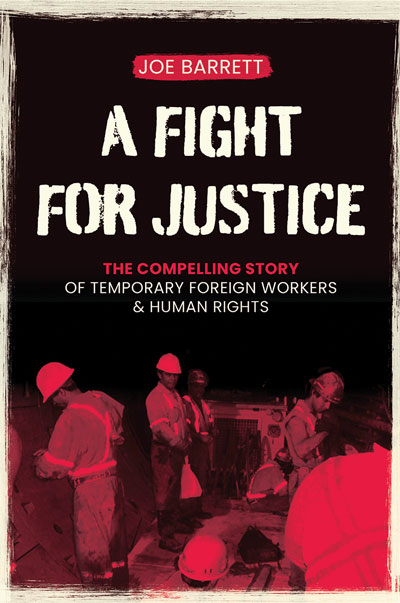
Joe Barrett talks to BC BookWorld about A Fight for Justice: The Compelling Story of Temporary Foreign Workers & Human Rights (Ronsdale Press $26.95).
As the world goes backwards in terms of progress in the areas of climate change, equality, democracy, health, truth and workers’ rights, we have a bold reminder in Joe Barrett’s A Fight for Justice that positive victories can be achieved — but it takes courage.
Barrett follows the true story of the foreign workers brought to Vancouver in 2006 to build the Canada Line SkyTrain. Though set in Vancouver, it is really an international story of exploitation that we’ve seen played out across the globe, such as in Qatar during the FIFA World Cup in 2022. What makes this book required reading for all activists and lovers of David and Goliath stories is the unusual bonding of unions and migrant workers acting collectively for justice. Barrett’s narrative follows a growing body of historical writing known as “history from below.” BC BookWorld spoke with Victoria-based Joe Barrett about his book.
*
BC BOOKWORLD: Your book is specifically about foreign workers in BC in 2006, but what makes it relevant internationally?
JOE BARRETT: All migrant workers are vulnerable. Many don’t speak English or French and many come from countries where labour rights are non-existent. While in Canada their work permits are tied to a single employer. If they are being abused, they can’t quit and take up a job with another employer. It’s like indentureship. If they are fired or quit, they can legally stay in Canada until their visa expires, but without a work permit there’s no income. They have a choice to leave the country or find work in the underground economy.
The Canada Line workers’ case established a global legal precedent. The BC Human Rights Tribunal (BCHRT) determined that the Latin American workers labouring on the Canada Line tunnel boring machine had the same skills as their European (Spanish, Italian, Portuguese) co-workers, yet the Europeans were earning twice as much and were provided luxury apartments compared to the motel housing provided to the Latin Americans. The Europeans’ meal and living allowances were more generous than the Latin Americans’. The discrimination criteria for human rights goes beyond skin colour or ethnicity; it also includes discrimination based on country of origin. The BCHRT decision said workers of equal skills coming from poor countries must be paid and treated equally to those coming from rich countries.
Internationally the decision changed the way global tunneling companies practice their business. The BCHRT set a global standard. Tunnel boring companies worldwide now treat all workers equally, irrespective of their country of origin.
BCBW: What inspired or deeply moved you most in the process of knowing the workers during their fight for justice?
JB: The Latin American workers’ humility, dignity and courage continue to move and inspire me to support all migrant workers in all industries. The Canada Line tunnel workers were young, most in their mid-20s, and most were married with young children. They sacrificed by being far away from their families to earn wages in Canada. They had the added burden of being unable to speak the language and were unfamiliar with our customs and culture. To defend their labour rights and dignity these workers risked their jobs, retaliation from their employer and their future careers.
They trusted Canadian union organizers and the Canadian legal processes from the start. In their home countries none had appeared before a formal legal tribunal as a witness in a legal case. It was another scary experience. They were supported by their families in Latin America with short telephone calls. The strength of their family and community bonds played a huge role in sustaining their will to carry on their fight for justice. The workers’ background was important. They came from a rural agricultural region in central Costa Rica. Almost all of them started working when they were less than 10 years old, picking coffee or working on sugar cane plantations. After that, many had worked in clothing factory maquiladoras before finding work operating tunnel boring equipment on a water diversion project in Costa Rica.
BCBW: What was the most remarkable aspect of the story of these workers?
JB: Their story has inspired me to get involved with the broader issue of migrant workers in Canada and around the world.
Since the Canada Line workers plight in 2006-2008, our country’s reliance on migrant workers has more than doubled. Statistics Canada tells us there were fewer than 111,000 temporary foreign workers in 2000 and just 90,000 under the International Mobility Program (IMP) — about 200,000 in total. In 2020 there were 117,000 temporary foreign workers and 407,000 IMPs, a total of 514,000. Today, that number is even higher.
Our society has a declining birth rate and a rapidly aging population. Canadian employers will increasingly rely on migrant workers. Whatever the industry — domestic/homecare, seasonal agricultural workers, service workers in fast food or hospitality industries, truck drivers and construction — these workers share the same vulnerabilities.
Ruthless labour brokers in their home countries and in Canada sometimes charge illegal placement fees. Once in Canada, subcontractors pop up then disappear, often leaving their migrant worker employees with unpaid wages or overtime issues.
The Employment Standards Act excludes agricultural workers from basic minimums afforded to most other workers (lower minimum wages and fewer overtime provisions). There is little or no oversight by the mandated authorities. Complaints to the BC Employment Standards Branch (ESB) can go unanswered for over a year. The ESB is known to try and resolve non-compliance by asking the victims of wage theft to accept a settlement. The settlement offers the victims half their stolen wages. Until BC and other provinces change their complaint-driven culture, these abuses won’t end. What’s needed are teams of ESB officers who conduct unannounced spot checks to monitor compliance.
BCBW: Describe the bond between the foreign workers and organized labour.
JB: Canadian unions have been on the front lines defending migrant workers. For example, for many years dedicated union activists from the United Food and Commercial Workers (UFCW) have stood by seasonal agricultural workers in their fight for justice. Construction unions as well.
All of the BC building trades unions were involved in defending the rights of the Canada Line workers but none as much as the Labourers’ International Union of North America (LiUNA). LiUNA provided free legal services at the BC Labour Relations Board (BCLRB) and never charged workers union dues. LiUNA made a commitment not to charge union dues until workers achieved a freely negotiated collective agreement.
Canadian union leaders’ and representatives’ solidarity came from the heart. It’s hard not to try and help vulnerable workers when you see them being abused for asking for basic rights. Canadian union activists live by the principle that an injury to one is an injury to all. It’s more than a slogan. It’s achieved by bringing the abuses to light.
Rank and file union members have seen the exploitation of migrant workers with their own eyes. Canadian union activists know if we don’t stand up to these abuses of migrant workers today, tomorrow it will be us facing the ruthlessness of some employers. A union’s strength is their unity; members have learned these lessons from their own experience.
BCBW: Your book demonstrates a passion for social justice. How did you come by that?
JB: Social justice was a part of my upbringing. Not only from my father, Dave Barrett (premier of BC, 1972-75), who led a passionate life in politics, but also from my grandparents and their working-class activism and from my teachers, friends and work colleagues. At an early age I was taught to get active and engage in social justice. I continue to be a member of the BC Employment Standards Coalition and have been involved in non-profits and community organizations to fight for social justice.
I keep aware of world and national events by following the news and investigating news sources. Then responding by doing what I can to support equality for all workers and people suffering under systems of oppression.
9781553807391





Leave a Reply