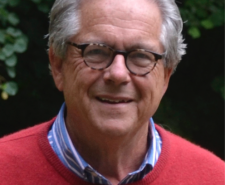


Hundreds of unheard species
Dick Beamish and Jeff Marliave explore one of the most productive fish ecosystems on the planet.
December 03rd, 2025

Dick Beamish is a member of the International Panel on Climate Change (IPCC) that won the 2007 Nobel Peace Prize.
“Once British Columbians see the bigger picture about the fish community in the Strait of Georgia they will want to know how governments are managing the community.”
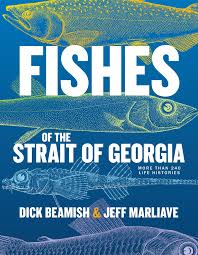
An essential companion for all students of the sea, Fishes of the Strait of Georgia (Harbour $80) is the encyclopedic new work co-authored by Dick Beamish and Jeff Marliave. Beamish, who holds a PhD in Zoology from the University of Toronto, is one of the living experts on the subject, having spent his professional life studying this bountiful natural sea environment. Marliave has a PhD in Zoology from the University of British Columbia. He was resident scientist, then VP of Marine Science, at Vancouver Aquarium.
The book covers the life histories, physical characteristics, social and economic importance and ecological place of 243 incredibly diverse species, ranging from the miniscule pencilsmelt to the gargantuan basking shark in the waters of the Strait of Georgia. Beamish is highly decorated, having received the Order of Canada, the Order of British Columbia and is a Fellow of the Royal Society of Canada.
*
 Question: This book is the first comprehensive look at the Strait of Georgia and its inhabitants. How did you identify this gap in knowledge and what made you decide to be the person to fill it?
Dick Beamish: Our experience is that Jeff was the resident fisheries scientist at the Vancouver Aquarium with hands-on experience of the day-to-day life of many of the fishes that live in the Strait of Georgia. He is also an accomplished SCUBA diver with extensive experience of how many species of fishes live in Howe Sound. I have studied a number of the species that live in the Strait of Georgia in the surveys that I conducted for over 40 years. Jeff and I used records available from SCUBA observations and from research and commercial catches to include species not found in museums and to identify relative abundances. There are other books that report on the fishes including a chapter in the book “The Sea Among Us – The Amazing Strait of Georgia” but our effort has a focus on how the fish use their environment. We wanted to show how each species uses their ocean space so British Columbians will understand that the Strait of Georgia represents hundreds of slightly different ocean habitats that enable a particular fish to survive as a population. Once British Columbians become aware of this complexity they also can make informed decisions related to government stewardship. It is a little like our appreciation of how species of birds use their environment slightly differently and the respect we have developed to protect the existence of the different bird species.
Jeff Marliave: Dick has worked with commercially important fishes whereas my work at the Vancouver Aquarium focused on beautiful shoreline fishes suitable for display tanks, so our backgrounds are complementary. Both our institutions are located in the Strait of Georgia. The last major compendium on fishes in BC, Hart’s Pacific Fishes of Canada, was published in 1973, so after a half century the time seemed right for a new, comprehensive book on fishes in BC, and the Strait of Georgia provided new information for a focus relevant to the people living here.
Q: What made you decide to stray away from scientific referencing and technical terms?
DB: We are introducing several hundred unheard of species to British Columbians. It would be unreadable if we used scientific terminology and referencing and the book would be too large to be in one volume. Scientists use their terminology and referencing to support interpretations made to other scientists. There is agreement that this is not a requirement with communication to the general public.
JM: Our primary objective is to provide a readable book that will influence our audience. Scientific terminology and referencing is intended for those who will search further for added details, but that higher density does not make reading any easier.
Q: How and why did you end up studying the waters and fish around British Columbia?
DB: Part of the answer is in answer #1. I studied the Strait of Georgia as my first job as a government scientist at the Pacific Biological Station in the early 1970s was to find a way to determine the age of lingcod and the Strait of Georgia provided my samples. Eventually I studied the early marine survival of salmon which required developing a new sampling method that was best suited for the Strait of Georgia. The early focus was on coho salmon and the best fishing was the Strait of Georgia.
JM: Our work institutions are located in the Strait of Georgia, and many sport and commercial fishing activities take place here. The Strait of Georgia is a major inland sea that provides living space for the majority of marine fish species in BC, so working locally has been expedient and productive for us.
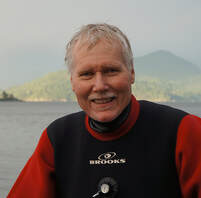
Jeff Marliave
Q: You make note of how important Scuba observations are to the cataloging and understanding of new species. Is this a newer way of gathering information about marine life?
DB: The use of Scuba observations is not new. It is new to recognize that qualified Scuba divers produce records that can be used to report on distributions and abundance.
JM: Boats and nets have enabled study of fishes for many centuries, whereas SCUBA diving only developed during the last century. It has really been during the last quarter century that camera equipment advances have enabled divers to capture images suitable for correct taxonomic identification, just as Dick has indicated in the book for use of cell phones on land. This book is ideally suited to enabling citizen scientists to make informed contributions to our knowledge of local marine fishes.
Q: Your wrote: “It is possible that prior to the commercial fishery, lingcod were the major fish predator in the Strait of Georgia. Removing large abundances from the strait would be the equivalent of removing the wolves and foxes on land and letting the rabbits take over an ecosystem.” I feel like I haven’t heard many people talk about the effects of removing predators from an aquatic ecosystem as they do about, as you said, removing land predators such as wolves. How does this affect life inside the Strait of Georgia?
DB: Removing major predators from the ocean or from lakes and rivers is recognized as changing the abundances of other species. A good example is the collapse of cod on the east coast and the resulting increase of shrimp. Lingcod probably were the most abundant large predator in the Strait of Georgia. We know they were abundant because of traditional knowledge. It is true that people do not talk about this for the Strait of Georgia and this is because there has not been a book like ours. We know that lingcod were overfished from the 1920s to 1970s and we know that Pacific hake were not abundant prior to about the mid-1970s. We think hake became abundant as lingcod abundance declined. As hake became abundant, seals were able to have an unlimited food supply and dramatically increased in numbers. In turn, seals became a problem until the transient killer whales showed up. Our book provides a complete picture of all the fishes in the ecosystem and for the first time allows the public to ask about the consequences of human induced changes.
JM: Predator removal has the same effect of reducing complexity of animal communities in the ocean as occurs on land. The example of dogfish removals demonstrates the historic overconfidence that people had in attempting simplistic “improvements” to ecosystems. This new book provides explanatory details that will enable readers to understand how human activities alter the balance of the marine ecosystems in the Strait of Georgia, as elsewhere.
Q: You wrote: “In an effort to maintain a fishery for Pacific spiny dogfish, and without any understanding of the role of dogfish in the ecosystem, the federal government embarked on a program to try to eradicate dogfish from the Strait of Georgia. In fact, there were 13 attempts up to 1973 to eradicate dogfish or at least reduce their numbers so that they were no longer a nuisance to humans.” How have attitudes/approaches changed in regard to the role of different fish in the ecosystem?
DB: Spiny dogfish is a very good example of not seeing a bigger picture. I wrote a keynote paper about this “The Sad History of Dogfish Management.” Dogfish live to be about 60 to 90 years old. Once they mature at about 20 to 30 years old they give live birth about every two years to about 8 to 12 cute little, wide eyed pups. Importantly they grow only a few mm a year meaning that they do not eat much so they are not the voracious predators that people/biologists made up. Believe it or not, fishermen still torture an unfortunate individual that gets hooked. It is unthinkable what some people do to these sharks that keep the Strait of Georgia ecosystem healthy. Again, when the public read our account of dogfish, which has not been written previously for the public, I think the attitude will change.
Q: You wrote: “The future of the lives of the fishes in the Strait of Georgia is in the hands of British Columbians. It is one more concern for all of us, but future generations will decide the success of our stewardship.” What do you see in the future of the Strait of Georgia?
DB: British Columbians, like most Canadians, care about their environment. Once British Columbians see the bigger picture about the fish community in the Strait of Georgia they will want to know how governments are managing the community. Until this book was published, there was no opportunity to find out what was there and what the public should be concerned about.
Q: Given free reign, what action would you implement to preserve the ecosystem of the Strait of Georgia? What needs to change?
DB: We probably need to begin in elementary school to teach how to understand ecosystems. Governments mostly now react to social science issues and this probably will not change. A few Federal Fisheries Ministers ago, the DFO Fisheries Minister told the public that she did not believe the science provided to her by her scientists. This probably was an extreme case, but the lesson is that science needs to communicate more directly with the public. But like all science, we need reporters/publishers that take the time to find the best science and not the promotional stuff.
JM: The incremental increase in focus and expertise with respect to marine ecology will enable more precise and realistic activities and regulatory decisions so that we will be able to accurately monitor and assess the impacts of our conservation efforts. Wise choices are needed in order for us to be able to assign spatial closures (fishing reserves or sanctuaries) where segments of the Strait of Georgia ecosystem will function without damaging impacts of human activities like fishing.
Q: This book is aimed at the many people who live near “one of the world’s most productive inland seas,” aka the Strait of Georgia. How can the general public participate in the care and maintenance of this aquatic resource?
DB: It may be as simple as the public including comments about the Strait of Georgia when there is an opportunity to influence politicians. We know that in the Great Lakes area there is strong public concern about the health of the lakes, yet we are nowhere near this concern for the Strait of Georgia. And I think there should be specific focus on the Strait of Georgia as it “operates” differently than Puget Sound or Juan de Fuca Strait. The term “Strait of Georgia” could be as familiar as “old growth” or “killer whales” or “Great Bear Rainforest”. The public will be more involved when efforts are made to honestly inform the public of what we know and need to know. This is different than wanting the public to agree with you.
Q: What do you hope that readers will take from your book?
DB: Our book is written for a general reader who may wonder why it has taken so long for the information to be available. A reader may than ask if responsible organizations will want to help understand how to be better stewards of a fish community on our doorstep in one of the most productive ecosystems on the planet.
JM: As the public becomes better informed, wise choices will become more frequent and the results will be more successful. A better-informed public will have the capacity to critically assess government policies and actions that affect our marine resources. It is our goal that this new book will bring the public closer to an accurate understanding of trends in fisheries conservation. 9781990776830
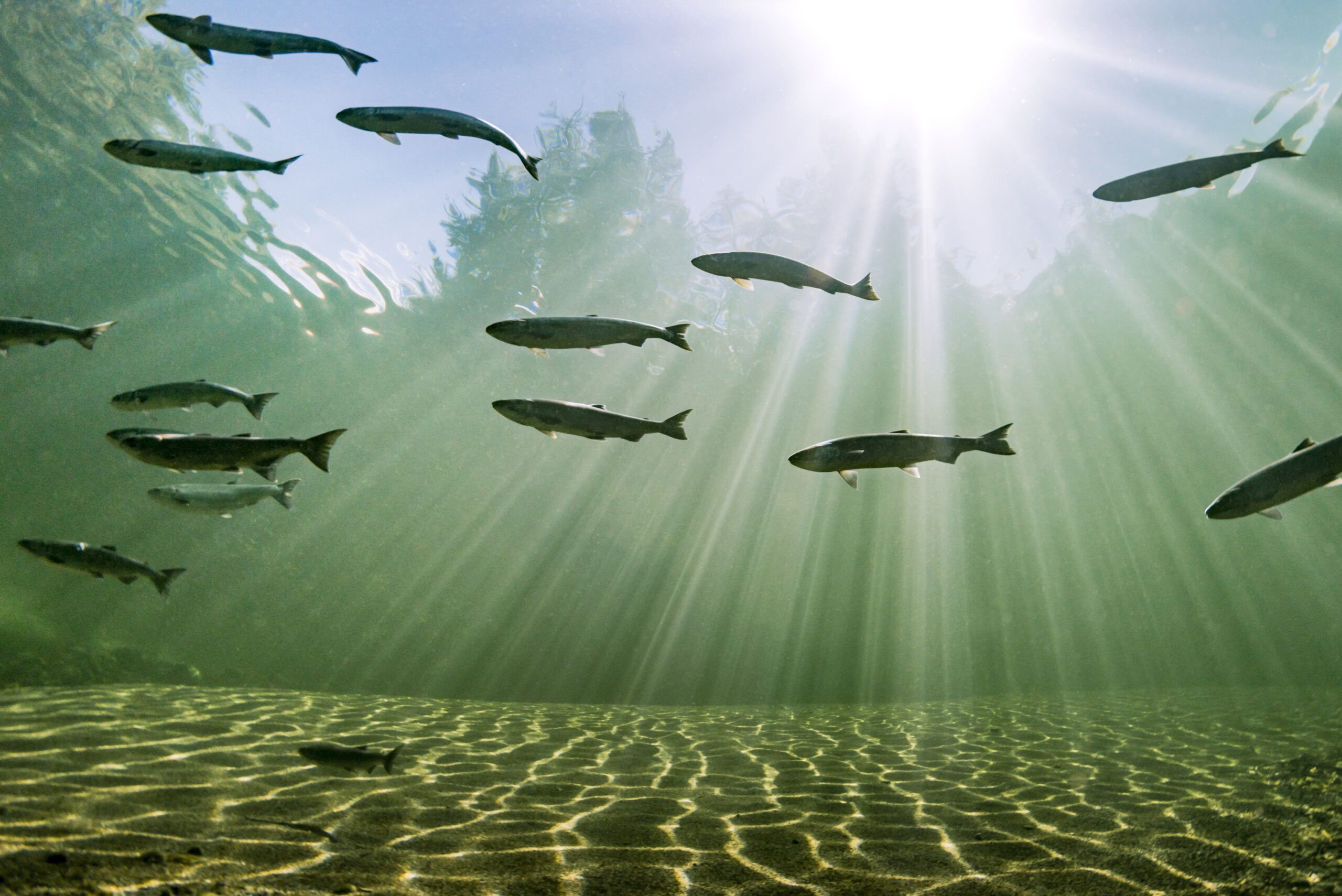
Sockeye salmon in the Strait of Georgia. Do you know any of the other 200+ species of fish in the Strait of Georgia?





Leave a Reply