

Exposing the Holocaust
At age 19, Rudolf Vrba (later a Vancouver resident for 31 years) convinced FDR, Churchill and the Pope to finally take actions to prevent the shipment of Jews to Auschwitz.
January 05th, 2026
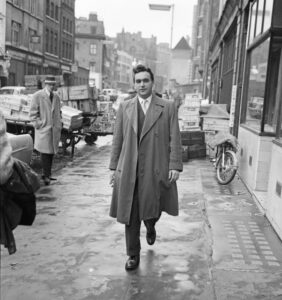
Rudi Vrba in London after the war, 1967.
“In 1944, Rudi Vrba escaped from Auschwitz-Birkenau and saved hundreds of thousands of lives by telling the truth about what was happening in the concentration camps.”
Review by John Moore
When I was young, I broke the First Parental Commandment; I talked to strangers.
In coffee shops, on buses and park benches I discovered the innocuous city of Vancouver was actually filled with people whose lives should’ve been shown in Technicolor at the old Orpheum Theatre. Many of them came from European countries crushed by the weight of too much history, seeking peace in a place that seemed to have too little. Rudolf Vrba was one of them.
I never met him, but Alan Twigg did. Thus began Twigg’s multi-year journey of research and writing about history’s most emotionally challenging subject. Now known simply as the Holocaust, the industrially-organized murder of millions of non-combatant men, women and children by the Nazi government of Germany is a millions-strong muster of ghosts that haunts human history to this day. Victims were primarily Jews from Germany and Nazi-occupied countries.
Most of Vrba’s adult life was spent as a tenured professor teaching Pharmacology at UBC. On casual acquaintance, you wouldn’t imagine that as a Jewish teenager in 1944 he’d escaped from the Auschwitz-Birkenau death camp, evaded capture, fought alongside anti-Nazi partisans in his native Slovakia, or that he co-authored the Vrba-Wetzler Report, the first account of the enormous genocide being perpetrated behind the curtain of “night and fog” that covered Europe during World War II.
In essence, the Vrba-Wetzler Report is the document that tore the scales from the eyes of Allied governments, forcing them to acknowledge that rumours about the fate of “relocated” Jews were not only true; the reality was infinitely more horrific than anyone imagined.

Rudolf Vrba’s number from Auschwitz.
Vrba and Alfred Wetzler were enslaved workers at Auschwitz when the camp was being expanded to “process” the entire Jewish population of Hungary. Surreptitiously they gathered facts and figures. Vrba even made maps of the camp and its “improvements.” Their report was not a cry from the heart; it was a statement of fact delivered as bluntly as the orders of the Nazi state.
Unfortunately, and tragically, while Allied governments could no longer deny the Holocaust (because Vrba and Wetzler’s reportage was so convincing), some of the Jewish Councils appointed by the Nazis to streamline the genocide (by telling Jews to obediently go to the train stations) chose not to alert their own people about what Rudolf Vrba and his escape partner had divulged.
For the rest of his life, Rudolf Vrba was not afraid to express his opinion that many Jews who survived (and made it to Israel) did so at the expense of others. Had the Vrba-Wetzler Report been widely circulated as soon as it was written at the end of April, 1944, he believed quite possibly none of the 434,000 Hungarian Jews murdered at Auschwitz between May 15 to July 9 would have ever boarded the trains.

Rudolf Vrba’s partisan identification, 1946.
In a tersely telegraphic style as compelling as the original Vrba-Wetzler Report, Twigg addresses the issue of complicit Jewish Councils as well as the post-war distortions by some historians of Vrba’s own personal story. Alfred Wetzler also wrote a fictionalized account that pleased authorities behind the Iron Curtain where he lived.
Wetzler lived most of his life in obscurity in the Czechoslovak Socialist Republic. Inevitably he became an ideological hostage to Soviet-controlled media whose publishers, film producers and state censors convinced him to emphasize the Communist component of Hitler’s “imaginary Jewish-Bolshevist Conspiracy.” Ignoring contrary evidence from Nazi files, according to the Soviet view the Nazis weren’t trying to make Europe “Jew-free;” they were just trying to get rid of those pesky Communists.
Despite the controversies, Rudolf Vrba never cut ties with his old comrade. He remained a supportive friend to Wetzler and a sociable, charming man imbued with sardonic wit, making him the chief instigator of any party, for the rest of his life. Given what he lived through, that in itself is a heroic achievement.
With Holocaust Hero, Twigg may have invented a new approach to writing history. Combining bullet-list timelines, narrative and transcriptions of interviews, he avoids the narcoleptic prose that often characterizes conventional history and brings to life the indomitable spirit of one of those apparently ordinary men who prove to be utterly remarkable when you hear their stories.
Holocaust Hero: The Life & Times of Rudolf Vrba (Firefly Books $29.95) for the first time reveals how Rudolf Vrba and Wetzler actually escaped from Auschwitz as discovered by Twigg in the Franklin Delano Roosevelt Presidential Library archives and confirmed by his long-time wife, former Vancouver realtor, Robin Vrba, who now lives in Rhode Island.
Alan Twigg is a well-known journalist and author who has written twenty other books on diverse subjects such as Canadian authors, Cuba, Belize and soccer. In the same month as the first volume of the Vrba biography appeared, Alan Twigg, founder of BC BookWorld, received the Order of British Columbia having already received the Order of Canada in 2015. 9780228105718
John Moore writes reviews from Garibaldi Highlands.





Dear Graeme. I am the author of the Vrba biography (Vol. 1). I was delighted to hear that you introduce your students to R.V. A few years back we sent copies of another book I did called Out of Hiding: Holocaust Literature of British Columbia to every high school in B.C. (It opens with Vrba.) Did your class or school ever see a copy? I am uplifted to know you are “out there” and educating B.C. students about Rudi. THANK YOU. I am easily found via BC BookWorld. — Alan
I was thrilled when a student of mine (from Kelowna) was catching the ferry to Nanaimo was excited to share with me what she found: an article and another book on Vrba.
I tell students all the time in my Social Studies, World History, Genocide and Holocaust classes that readers are leaders!
I do an extensive book study on Rudy Vrba in my Holocaust 12 class, and have also spoke and heard about Rudy for many years since 2006 at workshops and conferences, all over.
I just had a student participate in an international ArtEffect program on Unsung Heros, and she chose Vrba as her selection – amazing work of art, research and writing in her part.