

Adventures in Ethiopia
Marian Dodds has travelled from the Arctic to Africa, exploring colonialism, feminism and cultural learning. She is an SFU Writer's Studio graduate.
October 29th, 2026
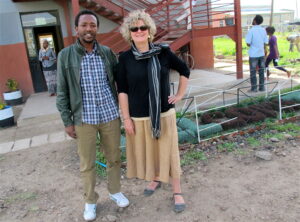
Marian Dodds (right) with Ethiopian university instructor and gender project team member Ato Kedir at Madda Walabu University, about 430 km southeast of the capital, Addis Ababa.
Having spent her career teaching and doing advocacy and international work, Vancouver-based Marian Dodds has written about her life-changing period as a volunteer in Ethiopia in Tizita, an Amharic word that roughly translates as “memory” or “story” and is also an Ethiopian musical genre. Dodds encounters both beauty and challenges aplenty in this male-dominated country yet ultimately finds Ethiopian people warm and kind.
Here we excerpt three sections from the book, in no particular order, illustrating Dodds’ exposure to Ethiopia’s coffee ceremonies with her first landlady (Asra) and her maid (Dirib)—who speak no English—along with her British colleague and roommate (Shelagh); an Ethiopian school dean, Ato Biru, with whom Dodds falls out; and lastly, a description of the natural beauty of the country by Lake Tana.
*
We’re just home from Saturday market when Asra bustles in wearing traditional dress rather than her usual caftan, sets up her charcoal burner, and begins a coffee ceremony. Dirib dutifully brings her the tray and cups. Accustomed to such random events, I rustle up cookies. It’s fasting season when Orthodox Christians are forbidden to eat anything from an animal, even a whey product lurking in a packaged cookie, so I read the fine print and assure her they are som (vegan). Offering food to Ethiopians is complicated with all the fasting days: fifty-five before Easter, weeks before Christmas, and every Wednesday and Friday too.
Unpacking our market bags, we entertain Asra and Dirib by naming each item, showing off our new words. “Sint now (how much)?” Asra asks. Thanks to Henok, we know our numbers. If we’ve paid the local price, Dirib shouts an enthusiastic “Gobez!” and Asra nods approvingly.
“Uh-oh, we forgot eggs. Let’s ask Dirib to get some at the neighbour’s shop. What’s egg in Amharic?”
“No idea,” Shelagh says. “Must be time for charades.” Flapping her arms, she squats, clucking like a chicken and reaches down to pull out an imaginary egg. Dirib shouts, “Inkulal!” and all four of us collapse into belly laughs. Sitting back in my chair, sipping Asra’s coffee, I think, How blessed I am to be here.
*
Two days later, Ato Biru appears unannounced and pulls up a chair beside my desk for his makeup class, plunking his workbook on top of my papers and nonchalantly flipping through blank pages, holding his pen as if expecting me to dictate the answers. These one-to-one sessions are meant to add flexibility for those who miss class for good reasons.
“You’ll need to complete your workbook first, then come back to discuss what you’ve done,” I tell him. “I can’t do it for you.” Taking the bull by the horns, I add, “I’m hoping you’ll be a role model for the others by following the ground rules we all set up together.”
“Ishi, I will try.” He tips his head in a “yes boss” fashion. Is he trying to be charming? Possibly. Or insulting.
“Let’s hope he smartens up and stops breaking every one of these,” I say afterward to Shelagh, pointing at the Ground Rules poster.
“Hard to imagine him changing his ways.”
As seasoned teachers, we’ve dealt with our fair share of chauvinists colleagues and manipulative boys who expect to sail through on their charms.
*
Close to sunset we hop into Hailu’s boat for a bird-watching tour. Steering past herds of cattle wallowing in shallows with egrets perched on their backs, he heads across the Lake Tana, cutting the motor to point out an eagle, a kingfisher, and yellow weaverbirds flittering in papyrus grasses. Slowing to a crawl, we watch purple jacanas strut across lily pads and huge crested cranes bobbling along the shoreline, pecking tall grasses. Closer to shore, a tree erupts into a cloud of bright red suncatcher.
“Oh look, a baby!” Carol has spotted a hippo family. Large humps of heads with small round ears emerge at eye level.
“Will they open their mouths?” I ask, thinking back to a pool of hippos I’d seen in Tanzania a decade ago, remembering massive jaws and teeth.
“Better not make them angry,” says Hailu, steering away from danger.
Twilight sky swirls with an avian symphony of soaring, swooping birds. Silhouetted against a magenta sunset, sacred ibis, herons, and cormorants alight on trees, flapping and rearranging themselves to roost.
From our dining room window back at the Kiriftu, we see a flock of bright white ibis alight on the branches of a large tree, creating an enchanting candlelit Christmas tree effect.
“Marian, if I don’t see another thing,” Carol sighs, “I’ll leave happy.” 9781038344144





Leave a Reply