

A life that named mountains
February 03rd, 2026
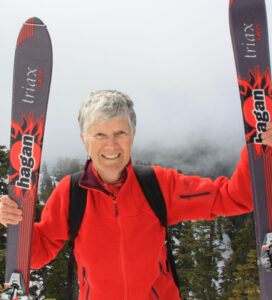
A mountaineer, medical researcher and lifelong wilderness advocate, Lisa Baile (at right) brings rare intimacy to John Clarke: Explorer of the Coast Mountains (Harbour Publishing $29.95). Having climbed alongside Clarke and co-founded the Wilderness Education Program with him, Baile writes not as a distant biographer but as a trusted companion, weaving his words, photographs and philosophy with firsthand experience. Her portrait of John Clarke captures both his unmatched legacy of first ascents in BC’s Coast Range and his quiet devotion to environmental education. Long active in the BC Mountaineering Club and Alpine Club of Canada, Baile balances scientific rigor with deep respect for wild places, making this biography both authoritative and deeply personal.
*
Question: The introduction of the book refers to Howard White of Harbour Publishing encouraging John to write a book about his experiences. John never ended up writing his own work, but many parts of your book are in John’s own words, including excerpts from his journals and letters. Do you feel like he co-wrote this book with you?
Lisa Baile: John was definitely by my side for the writing of his biography—I couldn’t have done it without him. It was fun to get to know him even better by reading his notes and published articles about his exploration of the rugged mountain ranges of the wild West Coast. What was intriguing to me was that I knew little about his early life and wondered whether he would be the same or a different John from the one I knew. But when I got to meet his family and close friends—of course it was exactly the same John!
Q: In the foreword, Wade Davis calls this book “heartbreaking.” What is it about this memoir that builds such an emotional connection in readers? What do you think it is about John’s story that moves people so deeply?
LB: John Clarke had a magnetic personality, and he made everyone he met feel special—and they were. I think he captures the hearts of his readers right from the first chapter, in which a mountain is being named in his honour. His eight-year-old son Nicholas is present. The heartbreak is that John never got to know his son for more than a few months before he was diagnosed with a brain tumour. The night before his operation, he wrote a letter to Nicholas—which still makes me cry! Friends have told me that they too cried after reading this first chapter.
Towards the end of the book, people have got to know and love John through his explorations, conservation and education, and they’re totally unprepared for his death. He has just got married, had a son and is over the moon, and then few weeks later he’s diagnosed with a brain tumour. This is another heartbreak. Finally, he gives us the ultimate gift of how to die with grace, good humour and acceptance. He was a born entertainer and his one-liners were legendary. He’d keep his many visitors to palliative care laughing and crying at the same time.
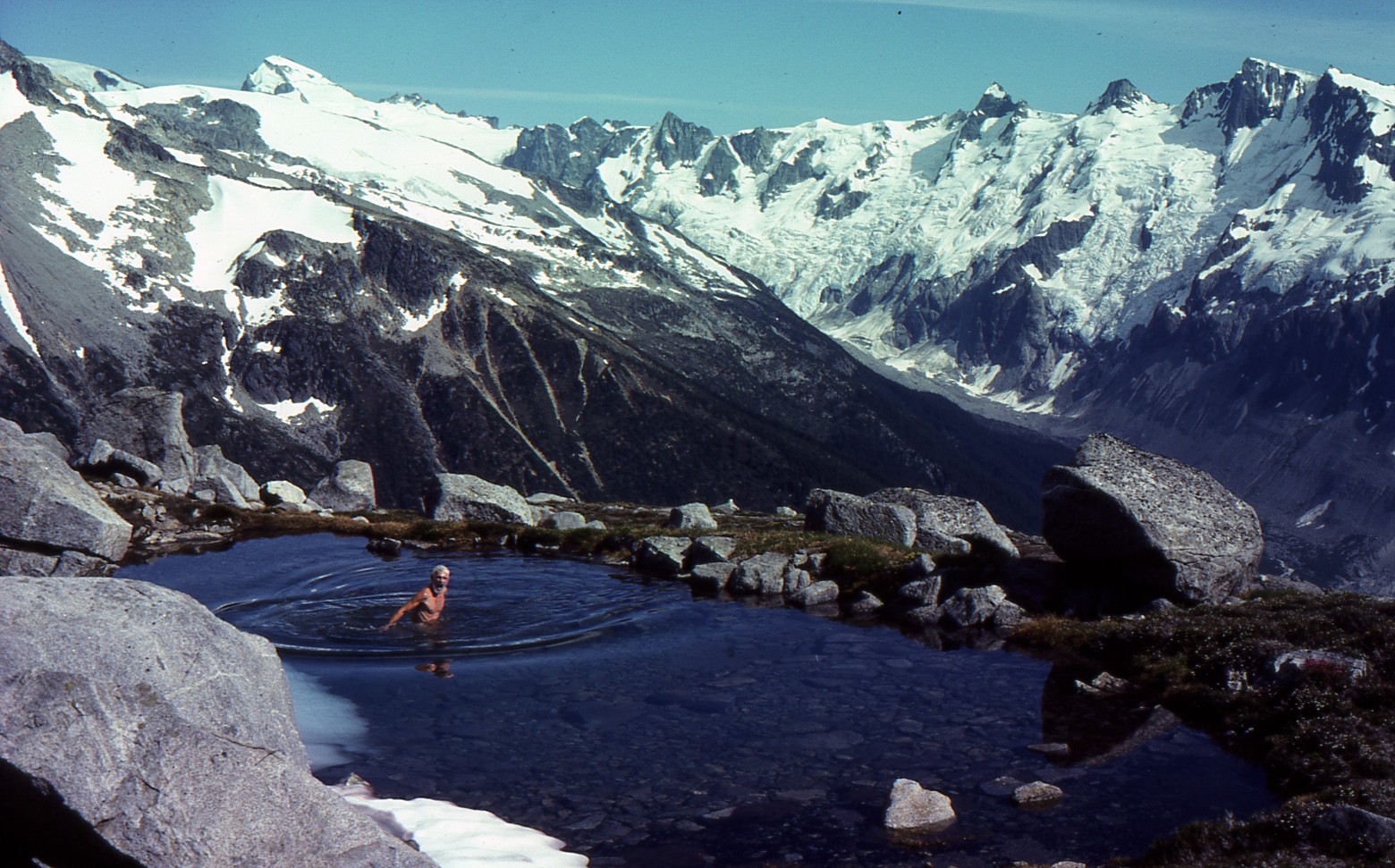
John Clarke swims in a tarn, circa 1980s. Photo: John Baldwin.
Q: John’s first high-peak climb was Mount Cheam, which he could see from the bell tower at Christ the King Seminary School in Mission. How formative do you think it was for him to grow up with BC’s mountain ranges dominating the skyline around him?
LB: When John’s parents emigrated to Canada, they lived on the doorstep of Vancouver’s North Shore Mountains, stretching for 1,500 kilometres towards the BC–Yukon border. It was love at first sight for young John. This passion was cemented when he attended the Benedictine monastery in Mission, surrounded by towering mountains, Mount Cheam being the most spectacular. John’s attention in the classroom was often drawn to the view of the mountains. They were to become his vocation—his spiritual home.
Q: What is it about the Coast Mountains that was so captivating to him?
LB: When John arrived on the scene, few of the Coast Mountains had been climbed and there were all these blanks on the map. What an enticement for twenty-year-old John, growing up with 1,500 kilometres of Coast Range in his backyard, to fill in the gaps on the BC map. For John, as he’d often say, it was as if Columbus never came. But I’ll let John explain: “When you grow up in Vancouver and climb the North Shore mountains, you look north and climb those mountains, and you look north again. Well, it just never stops. If you become interested in the Coast Range, there’s no cure for it.”
Q: In the 1990s, John switched his focus from climbing to the conservation of BC’s natural areas. Did his background in mountain climbing make him an ideal or unexpected candidate for environmental education?
LB: John was both an ideal and an unexpected candidate for environmental education. John, as it turned out, had the ideal qualifications for environmental educator. He had an engaging speaking style, never spoke down to his audience and always had an uncanny way of gauging the right level, no matter their age. He stuck to the facts and let folks make up their own mind. He was an optimist and his message was not doom and gloom, but “Hey, we can do this.” He had an encyclopedic knowledge of BC’s wilderness. His life-size images of wild places most of us can scarcely dream about were to die for. But above all he was fun and captivated the hearts and minds of his audience.
Q: In 1997, John began hosting a series of Witness programs with the Squamish Nation, based on traditional First Nations ceremonies. How did working with the local First Nations shape his conservation efforts?
LB: The collaboration with the Squamish First Nation during the Witness Project broadened John’s conservation efforts. He introduced Squamish Nation youth to the wilderness through an Indigenous Youth Ambassador program, to reconnect them to their territory which they had never visited. A deep friendship developed between many of the Witness volunteers and members of the Squamish Nation, and together they were able to introduce an innovative, powerful message of conservation through peace, education and connection to the land.
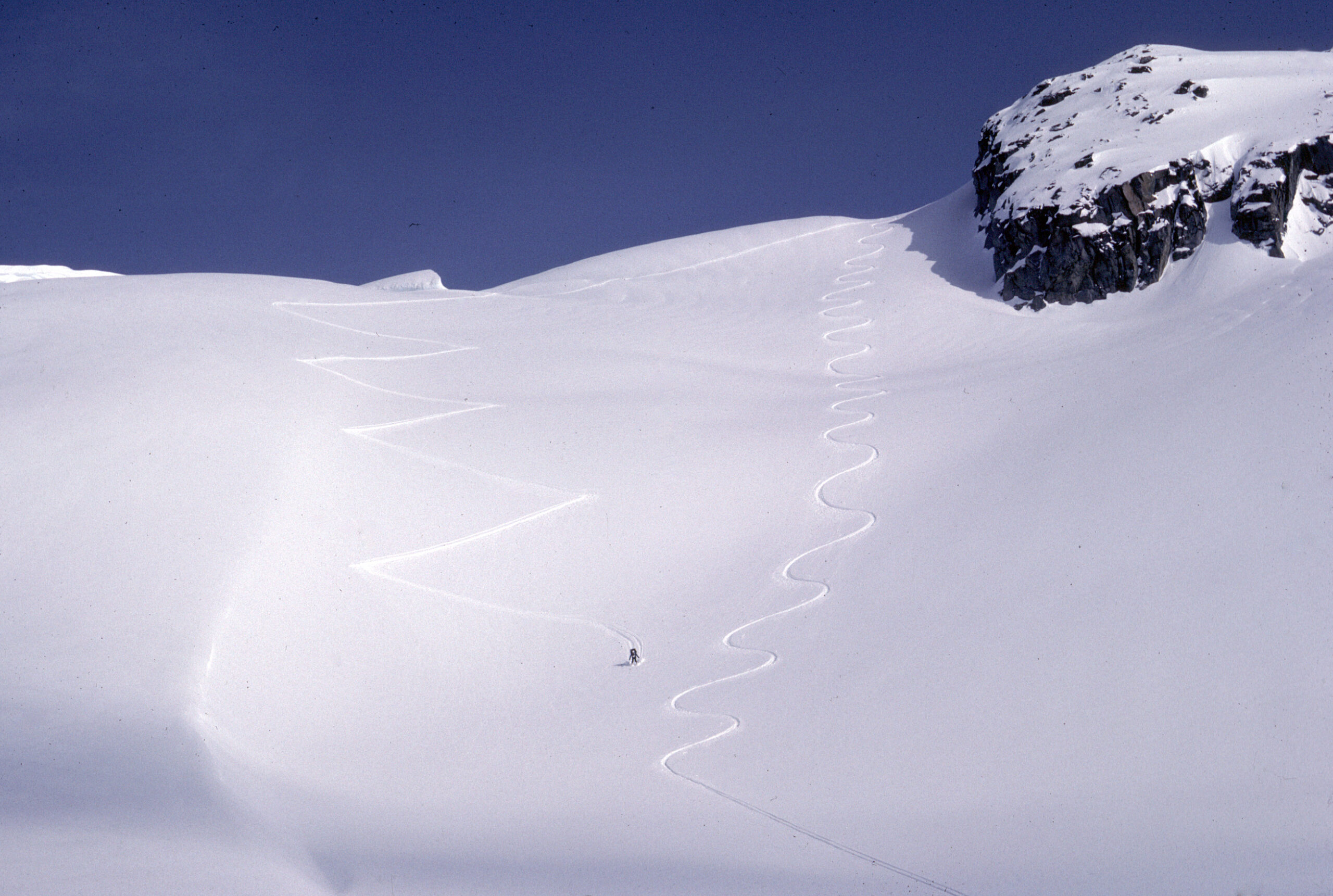
John Clarke’s ski tracks. Photo: John Baldwin.
Q: How can readers and wilderness lovers carry on John’s legacy?
LB: Do your best to maintain John’s vision of preserving wild places as a celebration of his life. Get outside, appreciate and become familiar with wild nature. Wild places can be as small as your backyard or as large as an ancient forest, a wetland or a river. Nature needs all the help we can give her, especially now in this time of a changing climate. Connect with others, your friends—and have fun out there!
Q: It’s been almost sixteen years since the naming of Mount John Clarke. Have you gone back to revisit it?
LB: I went back to visit Mount John Clarke in 2013, along with three members of Harbour Publishing—Howard White, Heather Lohnes and Annie Boyar—as well as several of my mountaineering friends. We placed a copy of the book cover, John Clarke: Explorer of the Coast Range, in the summit cairn. John is still a source of inspiration to all who visit.
We plan to revisit Mount John Clarke this coming summer.
Q: What do you hope readers take from your book?
LB: A deeper connection with nature, a respect for the natural world, do more with less, and get outside and have fun! 9781998526536





Leave a Reply