


A wildcat for BC’s labour movement
Les McDonald skied, rock climbed, hiked, scaled mountains and led the 1966 wildcat strike at the Lenkurt Electric plant in Burnaby, leading to the formation of BC's most successful independent union.
October 06th, 2026
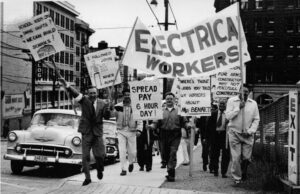
Les McDonald (far left) leads Local IBEW 213's left-wing faction en route to a demonstration of unemployed building trades workers, Vancouver City Hall, 1960.
“The walkout began when plant workers, most of them women, charged off the job to protest hard-nosed company attitudes. When they delayed their return, Lenkurt [the company] fired all 257 employees, the confrontation erupted into mayhem, on the picket line and within the union.”
Review by Rod Mickleburgh
Les McDonald was a rabble-rouser extraordinaire. He shook the rafters of Local 213 of the International Brotherhood of Electrical Workers with a boisterous activism that drove conservative IBEW leaders around the bend, worried to an extent that seems quaint today about “reds under the bed” of their union. And indeed, McDonald was a Communist, the Red Baron of this book’s title, The Red Baron of IBEW Local 213: Les McDonald, Union Politics, and the 1966 Wildcat Strike at Lenkurt Electric (Univ of Athabasca Press $39.99) but one who caused consternation for leaders of the BC Communist Party as well with his affinity to rush to the barricades without waiting for their direction.
In the 1960s, he was in the forefront of numerous IBEW campaigns and disputes, not all of them sanctioned by the union. Most notably he was part of the 1966 wildcat strike at the historic Lenkurt Electric plant in Burnaby that had a profound impact on the BC labour movement. Some credit a fiery speech McDonald made in the bitter aftermath of the failure of the Lenkurt strike with galvanizing workers to form what became one of BC’s most successful independent Canadian unions.
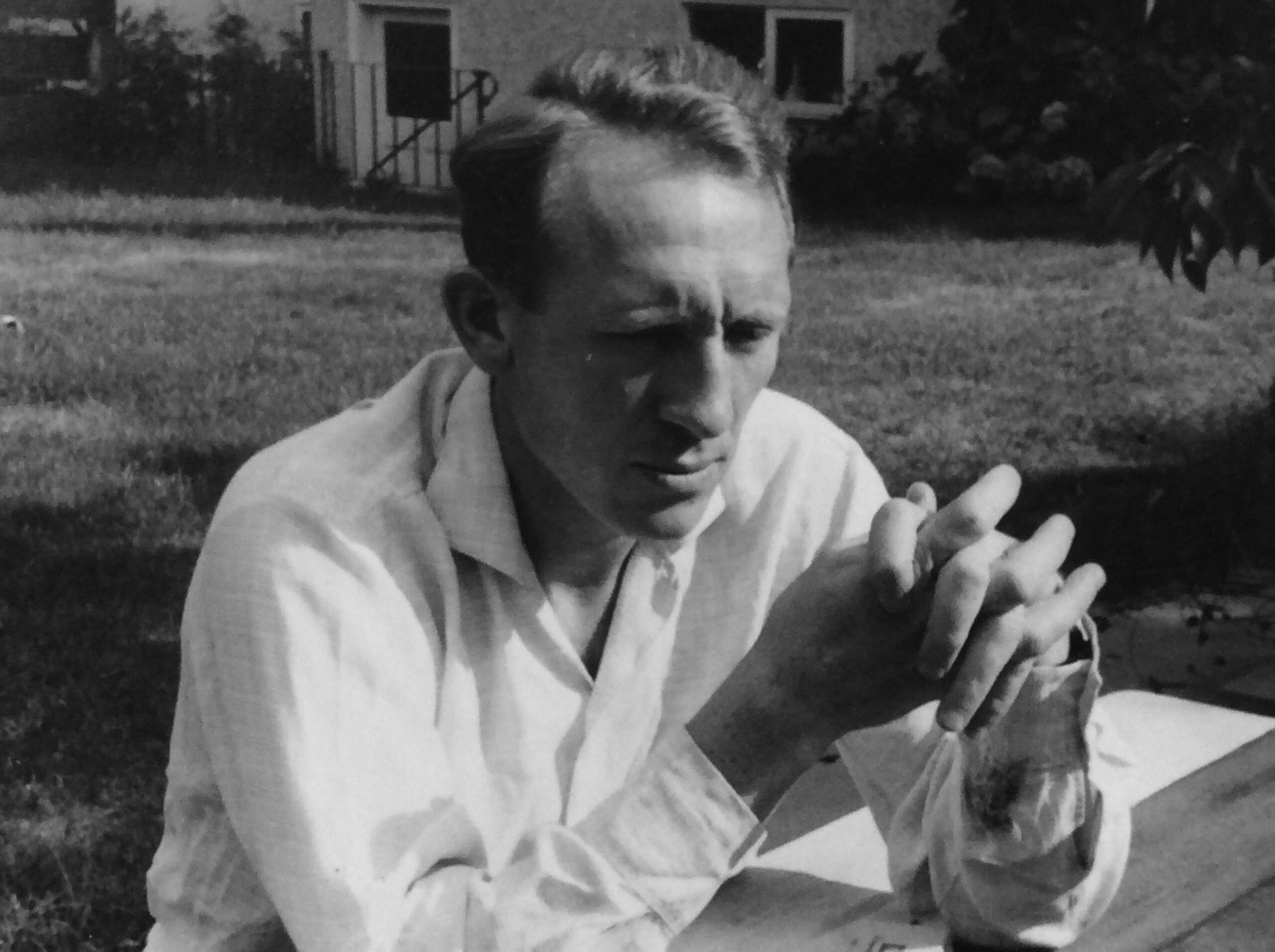
Les McDonald in his North Vancouver backyard not long after receiving a 30-year suspension from the International Brotherhood of Electrical Workers (IBEW).
But McDonald’s exploits did not stop with raising ruckuses at union meetings or on the picket line. He also applied his energy to what may have been his first love: outdoor physical activity. He skied, he rock climbed, he hiked, he scaled mountains and eventually he embraced the supreme test of the triathlon. McDonald threw himself into the latter sport, both competitively—a multi-time world champion for his age group—and administratively. As head of Triathlon Canada, he spearheaded the founding of the International Triathlon Union and was elected its first president. Using some of his old trade union skills, he is widely credited with prodding Olympic poobahs into adding triathlon as an Olympic sport for the first time at the Sydney Olympics in 2000. Under McDonald’s influence, triathlon was one of the first sports to provide equal prize money for men and women competitors. In recognition of all he did for the sport, and for his promotion of women athletes, McDonald received the Order of Canada in 2013.
The citation made no mention of his trade unionism.
This remarkable individual, who died in 2017 at the age of 84, is now the subject of a full-length book, written by his son, Ian McDonald. The reader gets a sense of what is to come with the book’s evocative cover photo. It shows Les McDonald in full activist mode, gleefully holding a sign in each hand as he leads a march for the 6-hour day with a huge grin on his face. His happy place. It makes me laugh, in a good way, every time I look at it.
But there is more to the book than Ian’s dad. The author does a deep dive into the tortured history of Local 213 and the drive by its international representatives to purge the local of Communists and other opponents of the status quo. Through this one local, Ian McDonald opens a window into an era of BC labour history when McCarthyism and the hunt for “Reds” had shamefully seeped into the province, tainting what was Canada’s most militant labour movement.
By then, Communists were nowhere near the force they had been when they led the great industrial organizing drives of the 1930s and 1940s. Yet they still exercised an influence in unions such as the IBEW out of all proportion to their numbers. This was not because union members were itching to follow the red flag of Leninism, but because they recognized Communists as organized, effective trade unionists. The fact they were there, however, was anathema to the higher-ups.
In 1955, Local 213’s popular business manager George Gee was ousted from the union for life, accused of “working in behalf of Communist causes”, whatever that meant in a peaceful, democratic country like Canada. Eighteen others received suspensions of ten to thirty years. But ideological turmoil continued to roil Local 213, outlined in such detail by the author that Les McDonald doesn’t show up until page 93.
The impassioned electrical worker joined the Communist Party in 1958 and received his journeymen’s ticket in 1963. He wasted little time embroiling himself in the ongoing battle against top-down, business unionism that was trying to keep the lid on people like him.
These tensions erupted into all-out war during the ill-fated wildcat strike at Lenkurt Electric. The walkout began when plant workers, most of them women, charged off the job to protest hard-nosed company attitudes. When they delayed their return, Lenkurt fired all 257 employees, the confrontation erupted into mayhem, on the picket line and within the union. There were violent scuffles with police as picketers from all over the Lower Mainland ignored court injunctions and converged on the site to try and keep scabs from going into work. The international then enraged union members by suspending Local 213 business manager Art O’Keeffe and signing an agreement that did not ensure strikers would get their jobs back. O’Keeffe’s replacement was angrily ejected onto the street, followed by a week-long occupation of the union hall, led by, who else, Les McDonald.
In the end, there was no course but surrender. McDonald and others were suspended for up to thirty years by the union. Four union leaders, including O’Keeffe and Vancouver Labour Council president Paddy Neale, were sent to jail for defying court injunctions, and seventy-six plant workers were not rehired.
The battle takes up a large chunk of Ian McDonald’s book, as befits one of the province’s most intense labour flare-ups. The details still amaze. Given the extent of the defeat, he bemoans the decisions that turned a planned, one-hour “wobble” into an all-out illegal strike. But most wildcats are emotional from the get-go. Expecting angry workers to always do the right thing is asking a lot when they want to fight, no matter the odds. As it is, the high-profile jailings of Paddy Neale et al, spurred the BC labour movement to launch a full-blown and ultimately successful campaign to end the use of injunctions in labour disputes once and for all. Les McDonald’s call to disgruntled Lenkurt workers to form an all-Canadian union was taken up, leading to the establishment of the Canadian Association of Industrial, Mechanical and Allied Workers (CAIMAW) which grew to more than 6,000 members. That was one of the highlights of McDonald’s trade union career, his son writes. Sadly, however, his dad didn’t join the very union he set in motion. Communist leaders didn’t believe in dual unionism and Les McDonald remained a member of the IBEW to the end.
Although Ian McDonald’s book is perhaps overly long and discursive at times, it is good to see attention paid to this forgotten chapter of BC labour history. It is a tale greatly worth telling. 9781771993470
A former labour reporter for the Vancouver Sun and The Province and a senior writer at The Globe and Mail for more than twenty years, Rod Mickleburgh has authored several books including On the Line: A History of the British Columbia Labour Movement (Harbour, 2018), which won the George Ryga Award, and co-authored with Geoff Meggs, The Art of the Impossible: Dave Barrett & the NDP in Power, 1972 – 1975 (Harbour, 2012) that won the Hubert Evans Prize.





Leave a Reply