


In the age of Heated Rivalry
How a gay man came to love hockey, a white-male, machismo-leaning sport—and why he became an activist to change its culture for the better.
October 06th, 2026

“My own fascination with Bure began with the Christmas morning-like atmosphere—the excitement of gift unwrapping—of his first media conference with the Canucks. In those days, the internet was still in its infancy, so there were few images of Pavel Bure in circulation.”
Growing up in Nanaimo as a closeted gay boy, Daniel Gawthrop enjoyed watching hockey with his family. Their favourite team was the Montreal Canadiens and the young Gawthrop became a fan of Guy Lafleur who wore the number 10 jersey for the Habs.
Looking back, Gawthrop realizes that apart from Jim Neilson of the New York Rangers, born to a Cree mother, he did not see any BIPOC players when he was a kid. “This was the big white world of hockey men I’d witnessed since my earliest days of fandom,” he says in Cutting Edge: Hockey as Queer Culture (Arsenal Pulp $24.95), his exploration of the role of gender, toxic masculinity and sexuality in defining—and too often demeaning—Canada’s national sport.
Gawthrop played hockey in his teens, soon learning it was a homophobic world. For a while, he abandoned the game, saying, “there is much to learn about how bad hockey homophobia could get and why gay men like me felt we needed to cancel hockey before hockey cancelled us.”
When he started his career as a journalist, Gawthrop began playing hockey again, eventually co-founding a gay hockey league called The Cutting Edges. He also works to make the professional sport diverse and safer—and to inculcate more queer culture in the game. He gained attention during the 1994 NHL playoffs when articles he published in a local gay magazine and the Vancouver Sun about the sex appeal of Vancouver Canucks player, Pavel Bure, got mentioned on Hockey Night in Canada by Don Cherry. Here we excerpt Gawthrop’s book about this period.
**
To say that the Russian Rocket was the biggest star the Vancouver Canucks have ever had, apart from Quinn Hughes, would be an understatement. Pavel Bure didn’t just score more goals per season than any other player in team history; he also scored more goals per game than any other NHL player in the modern era not named Mike Bossy or Mario Lemieux. His talent was so off the charts that the Canucks would rename their Most Exciting Player Award after him. (This was after his induction into the Hockey Hall of Fame, when he became the only player to have spent most of his career with the Canucks to claim that distinction.)
Bure thrilled fans every night with the explosive power of his skating, his electrifying speed, and his deadly shot. He scored on most of his breakaways—of which there were many—and he always found the right moment to bring fans out of their seats. He could skate around Norris Trophy–winning defenders like pylons, make Vezina Trophy–winning goalies look silly with highlight reel dekes, and reduce general managers to tears at the thought he could have been theirs.
On top of all this? The twenty-year-old Pavel Bure who arrived in Vancouver in the autumn of 1991 just happened to satisfy every other prerequisite for super stardom in the pop culture stratosphere: he was exotic, mysterious, charismatic, and drop-dead gorgeous. It was my privilege, toward the end of his Calder Trophy–winning rookie season, to join what I called the Pavel commentariat. These were local Vancouver writers, not confined to the sports media, who shared their thoughts on the phenomenon that was Pavel Bure and what it all meant.
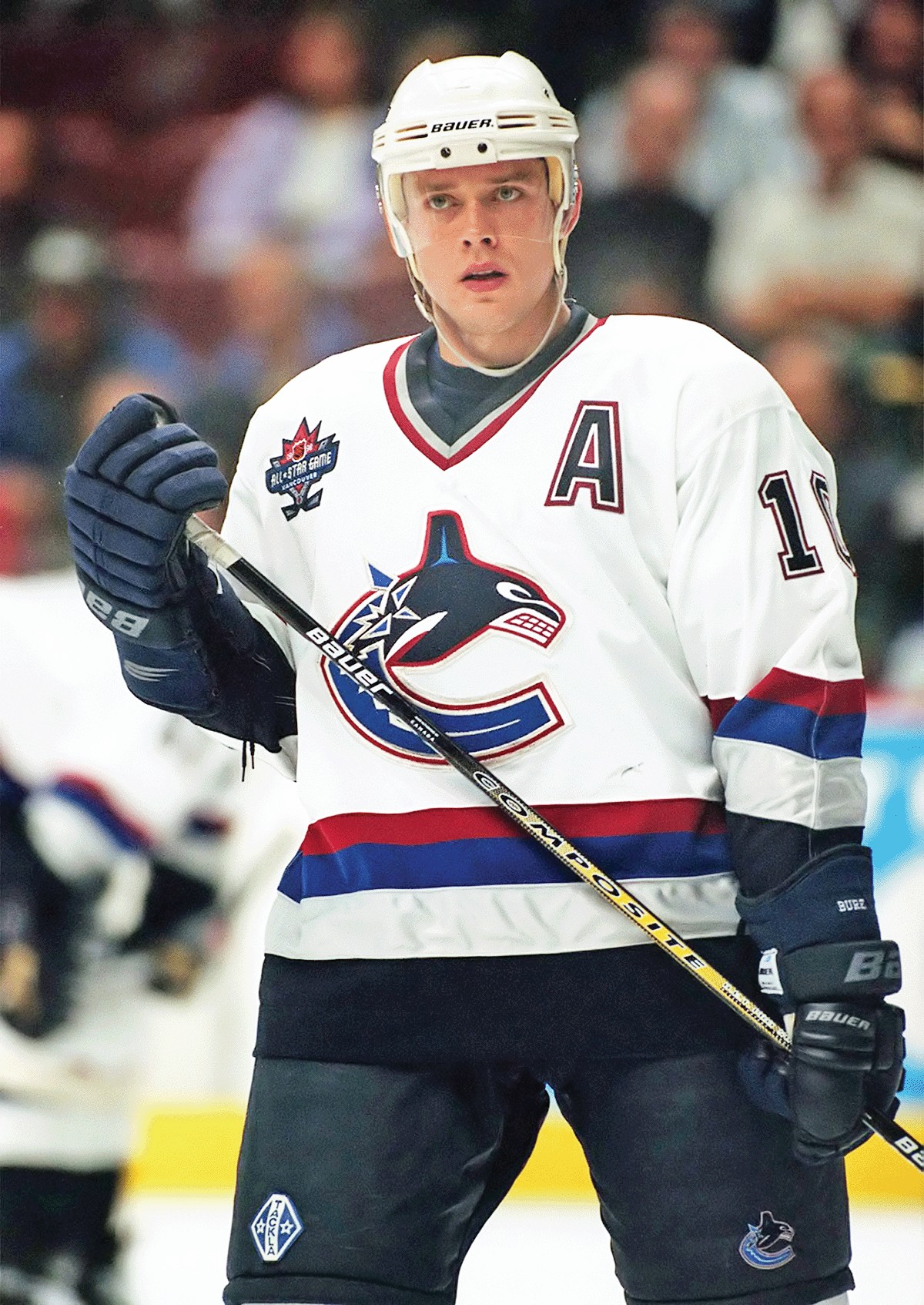
Pavel Bure, Vancouver Canucks, in Vancouver, 1997.
My own fascination with Bure began with the Christmas morning-like atmosphere—the excitement of gift unwrapping—of his first media conference with the Canucks. In those days, the internet was still in its infancy, so there were few images of Pavel Bure in circulation. A subject of the Soviet Union just before its collapse, he was a highly gifted player whose progress international scouts had been tracking for years. But his media presence in the West was limited to a few grainy bits of footage from the World Junior Championships of 1990 and 1991, his features obscured by the cage of his helmet. So when he arrived in Vancouver after a cloak-and-dagger departure from Russia via the US, the mystery surrounding him only added to the anticipation of that media scrum, which was held two days before his first NHL game. Like most Canuck fans, I watched the whole thing on TV during that day’s evening news sports report.
When Bure stepped into the room to reveal himself, the strobing effect of all the camera flashes going off had a Hollywood feel to it. Like Tom Cruise arriving on the red carpet for Oscar night. What a stunner, I thought. A perfect 10 … and oh, look, that’s the jersey number they’re giving him. Guy Lafleur’s number. My number … Bure was dazzlingly pretty, his symmetrical Eastern European features worthy of a runway model. This was a presence seldom seen in the rough-and-tumble NHL, a league overpopulated with mullet-maned, meat-and-potatoes regular dudes. The blond-haired Bure was an Adonis with lips like rose petals and sparkling green-blue bedroom eyes. His astonishing beauty combined the cherubic androgyny of River Phoenix with the mystique of Rudolf Nureyev or Rudolph Valentino and the insouciance of James Dean. Smoking hot. Apart from being blown away by his looks, Canuck fans like me were left wondering how such features could survive the wear and tear of a lengthy NHL career. As we would soon discover, Bure’s being faster than everyone else would help.
It would take the Canucks a long time to realize what they had. Too long, in my view. I did not begin writing about Bure until I saw what was lacking in their promotion of him. Once I did, I found there was plenty to say. In joining the Pavel commentariat, I soon learned that I was the only openly gay writer among its ranks. My interest began innocently enough: a hot young prospect arriving in town to save the Canucks from chronic mediocrity turns out to be much more than anticipated. Were the Canucks taking full advantage?
Later I would be accused of stalking Bure with my interest, my “obsession,” even. Apparently there was something tawdry—a breach of good taste—in an “older” man objectifying a defenceless young male athlete. But I was still in my twenties, like Bure, so the age objection was groundless. And this defenceless young male athlete also happened to be a millionaire, soon to be loaded with money, lawyers, agents, and media handlers. He had power and influence, while I had words. He was fair game. 9781834050485





Leave a Reply