


Teach a man to fish
How a poor immigrant family built one of BC’s largest fishing operations in the 20th century.
September 08th, 2026
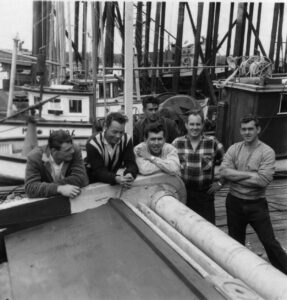
Nelson Brothers Port Edward seine boat crewmen Arnold Pearson (behind) and (left to right) John Nelson, Willy Brillon, Dempsey Collinson, Frank Shannon and Melvin Leonard.
“Perhaps it was their having worked their way up in the industry from a Fraser River gillnet skiff, but the Nelson brothers had particular skills at matching seine skippers and boats.”
Review by Alan Haig-Brown
There was a time in British Columbia when a young man could leave a poverty-stricken fishing village in Asia or Europe and find a good life as a fisherman in British Columbia. They arrived in the early twentieth century, worked hard, built lives and settled happily in Steveston, Prince Rupert and other coastal towns. But few, if any, matched the success of the Nelson brothers from the impoverished fishing village of Tromsø, Norway.
Ritchie Nelson, who would go on to found Nelson Brothers Fisheries with his brother Norman, was born at Tromsø in 1898. He followed older relatives to BC in 1909. They settled in the little Norwegian immigrant community of Sunbury on the Fraser River’s south shore across from New Westminster. While still a child, Ritchie was able to go out with his brothers to help pull the gillnets that caught sockeye from the huge Fraser River runs. He saved his money and in 1914, Ritchie bought his own 5 HP gillnetter.
After a brief stint at a Lutheran college in Everett, Ritchie joined his brother Norman in the fish business. They were aggressive and got bigger boats, explored the whole coast and even fished halibut in Haida Gwaii. In 1919 Ritchie arranged to buy troll-caught salmon on the West Coast of Vancouver Island to pack and sell in Seattle. In 1920 the brothers added a second boat, the American-built seiner Gradac, to their fleet. This allowed them to pack more fish and started a growth curve that would continue for decades.
Rags to Riches: The Story of the Nelson Brothers Fisheries (Caitlin $27) is an insider look at the remarkable focus and talent that led Ritchie Nelson, with his brother Norman, to form one of BC’s major fishing companies.
If the beginning of Ritchie and Norman’s company was somewhat conventional, the growth and management was less so. The brothers proved to be canny businessmen. In the 1930s, the pilchard fishery became the backbone of their company. The little fish were caught by the hundreds of tons and rendered into meal and oil. Ritchie’s innate business sense, enriched by the ups and downs of both fishing and packing, gave him an edge over his more corporate competitors. He understood how to manage hard times, which hit when pilchard disappeared from the BC coast. It didn’t stop the Nelson brothers, though. To invoke a contemporary business term, Ritchie and Norman “pivoted” their focus to seining and gillnetting salmon to provide for their canneries.

Stuart Nelson
Perhaps it was their having worked their way up in the industry from a Fraser River gillnet skiff, but the Nelson brothers had particular skills at matching seine skippers and boats. Boats are expensive to maintain and they require a lot of tender care when working; therefore, it is better to give a productive skipper some pride of ownership, which became an integral part of the Nelson Brothers’ management style. Ritchie’s gift was giving each fisherman the boat that best suited them. For example, an Indigenous fisherman who favoured his local ancestral waters could do well with a smaller boat; a Croatian immigrant fisherman to whom the whole coast was to be fished hard might do well with a larger, faster boat to attain a higher production. Within those general groups there were multiple individual fishermen and Ritchie and his managers made a point of getting to know each one to ascertain each man’s talents.
In the 1950s, Ritchie brought his son Dick into the company. All the Nelson family boys were given entry level jobs in the industry and then, with time, they would be promoted to a level that Ritchie decided met their abilities. The 1950s, culminating in the spectacular Adams River sockeye returns of 1958, were good times for the BC fishery and good times for the Nelson Brothers. Ritchie was heard to grumble, in private, having sold some equity in the company to BC Packers (BCP) in 1941: “The worst mistake I ever made.”
Like so much in the industry, this remained hush-hush and the company continued to operate independently while maintaining its successful growth. The aging St. Mungo cannery in Sunbury was replaced by a modern new plant in Steveston. The company also built extensive operations in Port Edward, which continued and evolved to meet shifting demands. In the early 1960s, herring reduction and oil production provided another steady source of income as did a number of other small fish.
The fact is that BC’s fishery seldom, if ever, had two decades in a row without major shifts in catches or permitting of fishermen. The Nelson Brothers were adept at shifting their operations as necessary. Secrecy was also the norm. Fishermen made different deals for vessel purchase-and-lease with the companies. Companies also made secret deals with each other. Throughout the 1960s, rumours persisted among fishermen that BC Packers owned Nelson Brothers, but it wasn’t until the end of the decade that it was proven when a Nelson became senior manager of BCP.
The last half of Rags to Riches documents the complex changes in ownership, including the takeover of BCP and Nelson Brothers by the Weston family. The younger generation of Nelsons was managing BCP and they were not happy when Galen Weston took the helm of the parent company, signaling that the end of the Nelson family in BC’s fishery was only a matter of time.
Happily, the family had totally devolved their participation in the industry before the sale of BCP by the Westons to the Pattison Group. There was no need for this final chapter in the book as the Nelson family was completely out of ownership by then. 9781773861777
Alan Haig-Brown, from one of BC’s renowned writing families, began his career as a fisherman before becoming an award-winning writer himself. His most recent book is Raincoast Chronicles 25: m̓am̓aɫa, goes fishing, released by Harbour Publishing last year.





Leave a Reply