


Doing small things with great love
August 05th, 2026
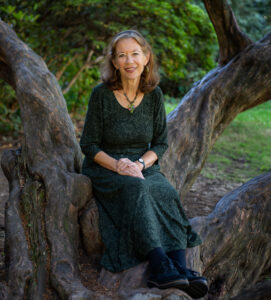
Marlene Schiwy, Ph.D., is a writer, workshop leader, university instructor, Jungian counsellor and Body Soul Writing mentor.
“Because Schiwy views ritual as a sacred part of the creative process, many of her workshops include components with dance or movement to stimulate the mind-body connection: ‘An animated body will have a different relationship with words than one that is sitting the entire day.’”
Review by Sonja Pinto
If you sign up for one of Marlene Schiwy’s workshops, you’re in for a mind and body experience. You’ll likely be greeted with soft music, flowers, candles, freshly baked pastries, coffee and tea, and an ambiance that is warm and inviting—and that’s all before the workshop even begins.
The Art of Creating Workshops for Women: A Guide to Facilitating Soulful Spaces, Events, and Retreats (New Society $34.99) invites curious or prospective workshop facilitators to consider sensory indulgences, rituals and interactive activities as pathways to the creative self. Still, you might be wondering what flowers and candles have to do with workshops for women. Well, for Schiwy, the scaffolding of a creative workshop is just as important as the content of the workshop itself. Her workshop philosophy extends well beyond worksheets and writing exercises.
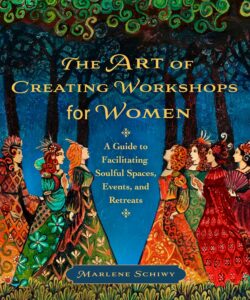 Drawing on decades of workshop facilitation experience, Marlene Schiwy distills sage advice to any who hope to pursue the vocation of leading workshops. To Schiwy, the goal of a successful workshop is to create a space where women can “step away from the obligations of daily life and enter the realm of imagination.”
Her advice ranges from staunchly practical (do not quit your day job, she stresses) to more abstract perspectives on teaching: “to be a workshop leader is to put ourselves in service of the soul.”
According to Schiwy, the foundation of a workshop is temenos, an ancient Greek word meaning a sacred space for reflection. Schiwy fosters temenos in each workshop, which is how people become comfortable, over time, to share their writing with each other; it requires trust and safety to share one’s writing and art.
In her early facilitation days, she hosted workshops DIY-style in her living room while she taught part-time at a university. One of her very first workshops came about informally after a course she was scheduled to run was cancelled due to low enrollment. By request of her prospective students, she facilitated a small group of student writers out of her own student lodgings, baking muffins and serving coffee out of her personal coffee maker. Despite the humble circumstances, Schiwy found that the group felt intimate and close—this affirming experience sparked her passion for workshop facilitation.
As she facilitated more of these workshops, Schiwy noticed a sense of purpose: “It became increasingly clear that my calling was not to attempt great things but to ‘do small things with great love.’”
Each workshop is infused with great care and attention at all levels from carefully selected flowers to mood lighting. This deliberate cultivation of space combined with practices like movement and meditation create an embedded sense of ritual, forming the basis for flowing connection with words for participants. These choices foster an environment where women can let their guard down and surrender to the experience: “The kind of workshop I’m writing about invites participants to embark on a journey without knowing in advance where it may lead.”
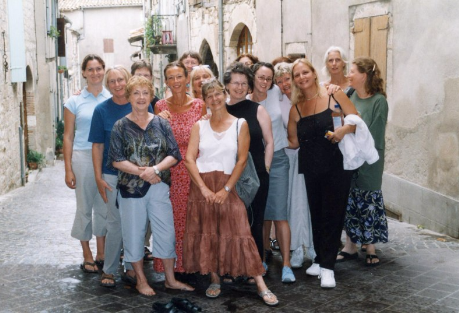
Writing in Europe Workshop by Marlene Schiwy.
The inspiration for these workshops partially came from what Schiwy wished she could have had herself: “As a lifelong journal writer, I had always longed for a small circle of women with whom to explore this curious habit of committing our deepest thoughts and feelings to paper.”
Indeed, Schiwy believes that workshop facilitation must come from a place of passion and genuine curiosity rather than financial incentive. “This book is not about creating and developing your brand,” she cautions—those interested in creating a highly polished and marketable workshop series designed to rake in the dough need not read on.
If you decide to stick around, Schiwy’s reflections on workshop facilitation are worth your time. She covers single-day workshops running just a few hours to multi-day international retreats where sessions span several days.
Her book offers a comprehensive overview of the practicalities of hosting workshops, such as locating and vetting venue spaces and how to go about attracting workshop participants. It also covers the nitty-gritty of payment: how much should you charge? When will you allow a refund as opposed to a non-refundable deposit? Will you ever offer your services for free?
But this book goes beyond just practical considerations. Schiwy suggests areas where facilitators might encounter challenges, such as setting boundaries with potential participants that might not be ready for the time and emotional commitments of the workshop or dealing with well-meaning participants whose ambitious ideas veer scheduled workshop activities off course.
Of course, Schiwy also covers potential workshop content. She shares different techniques that she’s used over the years to help people write, including plentiful examples of writing prompts and exercises.
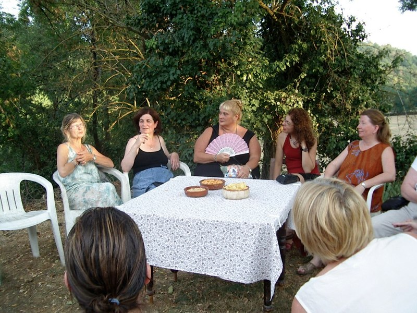
Writing in Europe Workshop by Marlene Schiwy.
Some ideas include process journals, dream writing, poetic forms, guided visualizations and using mythology and fairy tales for prompts. For Schiwy, much of the workshop process is being comfortable sitting in uncertainty and allowing yourself time to explore your psyche: “You never know what strange and beautiful creature your imagination is gestating, so give it your attention and care.”
Because Schiwy views ritual as a sacred part of the creative process, many of her workshops include components with dance or movement to stimulate the mind-body connection: “An animated body will have a different relationship with words than one that is sitting the entire day.” In terms of promotion, Schiwy has a modest style. Eschewing social media, she instead relies on word-of-mouth, hand-crafted flyers and email lists. This minimal approach to marketing has worked for her. Schiwy recalls that “many participants come back again and again.”
The reward for leading workshops for women was never boundless growth: “I never aspired to be bigger or more visible in my work, which made me unfashionable (to say the least) in a world that regards fame, fortune, and public acclaim as measures of success.”
The Art of Creating Workshops for Women reads as part instruction manual and part manifesto. It contains personal anecdotes along with templates and checklists for optimal workshop planning. Though Schiwy provides ample tips and templates, she emphasizes following your own creative instinct: “We teach through who we are.”
At the heart of Schiwy’s ethos is her care for each woman as an individual being. Each workshop is scrupulously planned and thoughtfully executed, tailored to that specific group of individuals. This book is essential reading for anyone interested in workshop facilitation, but even if you have no desire to lead workshops, Schiwy’s insight and thoughtfulness are a treat for any reader. 9781774060254
Sonja Pinto is a writer, photographer, printmaker and book reviewer. They reside on the unceded territories of the lək̓ʷəŋən peoples (Victoria, BC).





Leave a Reply