


Anti-colonial poetry
June 01st, 2026
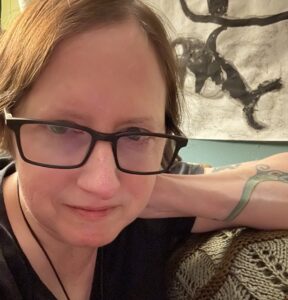
Review by Jillian Maguire
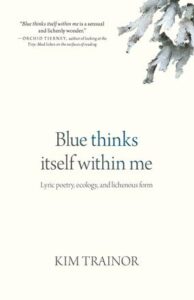
Blue thinks itself within me: Lyric poetry, ecology, and lichenous forms (Univ. of Regina Press $27.95) by Kim Trainor (at right) is a book that, as my friend Kate put it, “you can just open anywhere and start reading.” I had already read three quarters of the way through in my colonizer-educated way—books go from front to back, with each chapter building on the next. If you miss a lesson, how will you ever catch up? And, of course, we can’t waste time playing outside cause then we won’t finish the curriculum kinda’ thing.
I’d always thought of lyric poetry as short, contained pieces of writing, “hermetically sealed” as Trainor likes to say (not about poetry per se, but about the capitalist mind in general). But maybe all the lyrics in the world are just pieces of the wilderness of language—like humans, though our techno-feudal lords are trying to convince us otherwise, who are also just one piece of the vast natural world. Hishuk ish tsawlk (the Nuu-chah-nulth First Nation word for “we are one and all interconnected.”) And even though there is lyric poetry in the book, the book is not lyric poetry. Or is it? Following Kate’s method, I will open the book randomly three times.
 The first opening or, as Trainor would say “aperture,” landed on her witty adventure into what lyric poetry is. In this chapter, she battles with, though I had not previously heard of the fellow, the aptly-named Francis Ponge, who appears to be a big fan of anthropomorphizing. I think there’s some argument to be made that the Old White Male Poets projecting themselves onto everything they saw were a founding pillar of colonialism, but I digress.
Trainor writes: “The subjective is chided within the tradition of the lyric poem—by which I take Ponge to mean that language in lyric poetry most often attempts to present the thoughts, sensations, qualia, of the poet herself and becomes too self-preoccupied, too human-preoccupied. Lyric poetry, misconstrued in this manner as locus of such subjectivity, has too often been the whipping girl of post-structural theory, when in fact, lyric can and has been subversive, political, capable of speaking in code, sympathetic to other beings, attentive, entangled.”
I also take issue with Ponge suggesting that lyric poetry is more “human-centred” than his descriptions of snails or staplers that he has imbued with human characteristics. I would go even further and suggest that the anthropomorphizing of rocks and stones and trees and snails, like Adam naming all of the animals at the request of his great Father, God, is far more human-centric than the lyric poet expressing her web-like relationships with the world around her. Hishuk ish tsawlk.
The next aperture takes me to the first page of chapter 6: “PIIIIIITUUU / SONG KIN,” beginning with the chickadee’s alarm call, the humpback whale song and the grief of ravens and crows. “Humans are not the only species that creates poetry or song; there are many forms of culturally transmitted song, liked to each species’ way of being in the world,” writes Trainor. Throughout colonized history, the “thinky” dudes have been racking their brains to figure out what makes humans qualitatively different from and superior to the “beasts” of the world. The first myth was “man the toolmaker” until Jane Goodall, in a few weeks in the bush at 26 years old, found apes using all sorts of tools, like a stick to get ants out of a hole. Then it was language, i.e. Noam Chompsky and his absurd Language Acquisition Device which was challenged by the cleverly-named Nim Chimpsky. Then it was meta-perspective, empathy for other species (though our factory farms and torturous slaughterhouses suggest otherwise in humans), etc. Then science seemed to give up looking, but still hasn’t truly accepted that humans aren’t the be-all and end-all of the animal world. If we accept that humans are part of the natural world, not overlords tasked with “civilizing” and “developing” it, what will happen to the patriarchy and capitalism, that rely on rigid hierarchies and domination? Kim goes on to introduce the term “umwelt,” coined by Jakob von Uexkull: “Umwelt refers to the sensory world that is accessible to an animal—everything that it can sense and experience…sound contours the Umwelt of so many of our more-than-human kin, just as it lies at the heart of lyric poetry,” writes Trainor. Lyric poetry and song expand the human umwelt, giving access to what may be referred to as a “sixth sense” and just might aid in the dismantling the colonial mindset.
My final aperture lands me smack in the middle of chapter 4, Vigilance, with the RCMP raiding Fairy Creek: “The RCMP came on foot, observing, taking photos across the bridge up the hill…one green, two blues,” writes Trainor. “The green was brusque—insisted we would have to move back to the middle of the bridge as they began the first extraction. A paddy wagon arrived, two or three cars, an excavator, three blues who stood and watched us from beyond the yellow caution tape they’d set up. Five or six blues and a green carried out the excavation with pickaxe, drills, chainsaw—chewing out pieces of wood from the support structure of the bridge. It was difficult to watch—imagining the woman in the hard block, fragile, flesh contra sharp and metal and electric tools. It took them two hours and forty-five minutes to excavate her. Intermittently, we stood on the bridge at the caution tape, singing, and calling encouragement to the girl.”
This harrowing passage brings to mind Phillip Zimbardo’s horrible Stanford Prison Experiment, where regular college boys transformed into the monstrous torturers of such infamous U.S. detention facilities as Abu Ghraib, within 6 days of being given the title of “guard” in a mock prison in the basement of the university. The image of uniformed men putting a young woman’s life at risk in order for the extractivist colony of the Empire to decimate the last of the world’s pristine old-growth forest, replete with endangered specklebelly lichen—a sign that the forest has been untouched since the Ice Age, is truly fucked.
I encourage everyone to acquire this important book and do as Kate suggested—open it whenever, wherever. Unless we start unravelling this capitalist nightmare system that is destroying everything we should know, love and feel cosmically connected to, we will lose it all. You can find the book in a lot of places, but I like to shop at indigenous-owned Massy Books in Chinatown.
Jillian Maguire, aka Foghorn Lil, is a teacher and rebel singer-songwriter residing on the stolen ancestral territories of the Musqeum, Squamish and Tsleil-Waututh peoples.





Leave a Reply