


From ruler to refugee
Sent to the Korean peninsula to join the Japanese army that had occupied the country since 1910, Konosuke Masuda had to escape North Korea in the last days of World War Two.
April 29th, 2026

Keiko Honda translated her grandfather's journals for her latest book.
“[My grandfather’s intention] was to bear witness to, ‘the dehumanizing nature of conflict.’ His hope for humanity was that by revealing, ‘the universal aspect of the human condition in the face of extreme adversity,’ we might be inspired to transcend ‘the divisions between enemies and allies.’”
Review by Trevor Carolan
Other than a few episodes of Reilly, Ace of Spies (1983) on PBS, the Russo-Japanese War (1904-05) fought in China and adjacent waters, is rarely mentioned. Japan’s shock victory made it a world power and shady deal-making gave it all of Manchuria and Korea. Japan installed a puppet-emperor in the former and annexed the whole of Korea in 1910, remaining the colonial power until 1945. Few there have yet to forgive the brutality of Japanese rule with its attempted cultural genocide of Korean identity.
As translator Keiko Honda acknowledges in her introduction to this memoir, The Broken Map Home: Escaping Korea, 1945 by Kenosuke Masuda (Caitlin Press, $22.00) by her grandfather, Koreans were forced to “adopt Japanese names, speak the Japanese language, and worship at Shinto shrines…Korean history and culture were suppressed.” She adds that, “Korea’s natural resources were exploited, Koreans were forced into labour camps, subjected to discrimination and violence, and often denied access to education and employment.” Worse, from 1931-1945 between 20,00 to more than 100,00 Korean women, mainly poor, some as young as 12, were trafficked as sex slaves for the Japanese armed forces and were raped and abused by from 5 to 60 men daily.
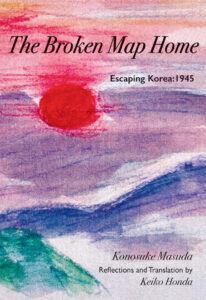 With Japan’s Second World War defeat in 1945, everything changed utterly. The Koreans with their US and Soviet military occupiers retook control. More than 750,000 Japanese, drawn by economic opportunities throughout Korea, were now stranded from their “home islands.” Honda’s grandfather, Kenosuke Masuda, a bank employee who had been conscripted into the Japanese army only three months before the war ended would become a wandering refugee in what is now ultra-communist North Korea.
In later life, as his granddaughter Honda tells us, Masuda undertook to record his hardships and experiences as a post-war refugee. His intention, she believes, was to bear witness to, “the dehumanizing nature of conflict.” His hope for humanity was that by revealing, “the universal aspect of the human condition in the face of extreme adversity,” we might be inspired to transcend “the divisions between enemies and allies.”
On August 15, 1945, private Masuda was marshalled with his fellow Japanese soldiers and expatriates in their camp square. It was the first time any of them heard their emperor’s voice, as he broadcast in complicated classic language the government’s acceptance of America’s demand of unconditional surrender. Masuda relates that soldiers were left with only a “general idea that we had lost the war.” He says that he felt a sense of relief and expected to be discharged to home and family. What he thought Koreans, Americans and Soviets might think is not clear.
Soviet troops compelled Japanese officers to surrender their units in person. Not to disarm meant death, but word leaked that disarmed troops were being taken prisoner and sent to Siberia where many Japanese spent up to 10 years in slave-labour camps and tens of thousands died. Masuda reports how, courageously, his commanding officer insisted that since his men were mostly local recruits, they should simply be permitted to return home. With fates uncertain, when a camp-guard issues three passes for a labour detail outside, after stuffing their pockets with tobacco, Masuda and two others flee. His refugee odyssey begins.
For four dangerous months, on foot, hopping railcars, and, despite arrest and questioning several times, Masuda manages to escape deportation to Stalin’s gulags and survives failed attempts to cross into American-controlled South Korea. In plain language, his modest 65-page narrative recounts tramping through small towns, past wrecked railway lines, urban chaos and dodging Soviet soldiers. The trio inch forward, encountering furtive groups of other Japanese hiding in fear. The US and Soviets have already divided Korea at the 38th Parallel into separate capitalist and communist occupation zones. Masuda sees evidence at stations of a new Korean government authority emerging in the north, negative toward the Japanese and led by Stalinist hardliner, Kim Il-Sung, whose pathologically antidemocratic regime continues as a family power-lineage to our present time. Masuda doesn’t comment on this, although he has intimidating encounters with Red Korean security officials.
Detained in Rako town, on seeing agitated Koreans with guns, Masuda fears execution. But rounded up on a train, he is moved deeply when crowds of ordinary Koreans wave sympathetically and call out farewell to the vagabond Japanese refugees. When slack security makes escape possible, he bolts. In Hamhung, Masuda notes the rise of food black markets and a Japanese refugee association actually finds him work. Survival remains day-to-day: when the fortunes of war reconnect him with an old banking friend, quickly, Masuda sets off for the border with a new escape group. There’s tension as they avoid Soviet patrols in the mountains. While passing golden rice-fields, they are helped by kindly Koreans at risk to themselves as Masuda recognizes. Alas, identified, the escapers are sent north again.
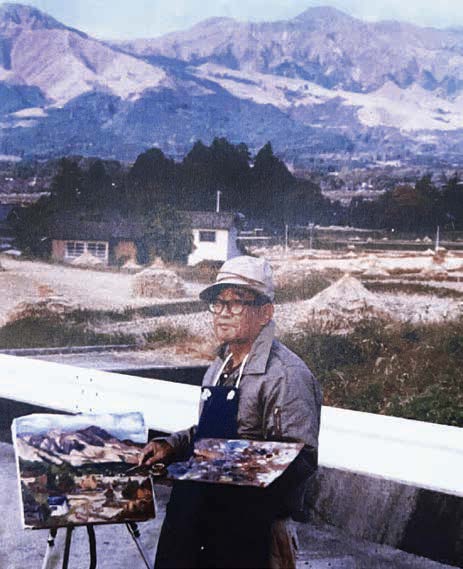
Konosuke Masuda, painting his favorite subject, Mt. Aso, Japan, 1985.
Becoming a tale of refugees shunting back and forth on trains between destinations without apparent logic, Matsuda’s narrative turns hellish when Soviet soldiers make repeated night raids on the trains, seizing and raping helpless Japanese women. It’s a terrible mirror of the kidnapped Korean comfort women with the Japanese now the prey.
Doing whatever it takes—sleeping rough, avoiding typhus, suffering malaria and with unexpected Soviet help—against extreme odds Masuda is able to reunite with his family at Songjin. Repatriation to Japan might yet come. Some deeper reflection on Japan’s treatment of those it exploited, or its wartime conduct would be appreciated, but this is a survivor’s story, humbly told, of a now near-forgotten time. 9781773861760
Trevor Carolan has written on Asian arts and culture for more than 40 years. He lives in North Vancouver.





Leave a Reply