


Mind your microbes
Yes, many bacteria are bad for us but avoiding all microbes, even the good ones, is not healthy.
April 21st, 2026
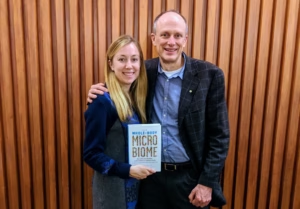
Jessica Finlay, a CU Boulder assistant professor of geography and her father, Brett Finlay, a professor of biochemistry and microbiology at UBC.
“Cell phones carry ten times more bacteria than most toilet seats. Yet, ironically, unlike the bathroom, people rarely clean or disinfect their phones.”
Review by Graham Chandler
In 2017, B. Brett Finlay co-authored Let Them Eat Dirt: How Microbes Can Make Your Child Healthier (Greystone, 2016), a book that cautioned parents not to create hermetically sealed cocoons for their young children, “because early exposure to a wide variety of microbes is key to firing up the immune system,” he wrote.
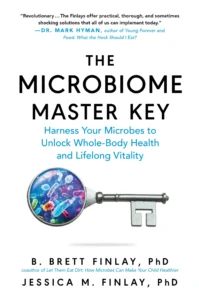
The field is still extremely new and Finlay’s latest title, The Microbiome Master Key: Harness Your Microbes to Unlock Whole-Body Health and Lifelong Vitality (Douglas & McIntyre, 2025), covers the latest findings about the role microbes play in all phases of our lives, starting with birth. “The moment you’re born, you receive your very first and very best birthday present: a big dose of vaginal and fecal microbes,” say the authors.
 There is some surprising information about everyday life routines such as eating and drinking. For example, while drinking alcohol in excess is unhealthy, moderate consumption of red wine has been associated with health benefits including protection from cardiovascular disease and type 2 diabetes. Red wine is a component of the Mediterranean and MIND diets, both of which lessen the risk of neurological diseases such as dementia, the authors point out. Also stressed is the importance of regular exercise.
It was interesting to learn that microbes play a role in susceptibility to Parkinson’s disease, the second most common neurodegenerative disease after Alzheimer’s. Parkinson’s affects 3 to 5 percent of over-85s and is thought to start 20 to 30 years earlier in the gut. (Historically it was thought that the gut could be a source of reasoning, hence the common expressions “gut feeling” and “go with your gut”.) Most common clues to Parkinson’s are constipation and loss of sense of smell—both of which hint at microbe involvement. In fact, much of the research data point to Parkinson’s disease being associated with gut microbes before brain symptoms are noticed—a paradigm shift in thinking about the disease, say the authors. Moreover, microbes associated with the MIND diet are thought to significantly delay onset of the disease; additional studies are underway to see if and how this is associated with microbes.
“There is one number that predicts your health and life expectancy more than any other: your postal code,” the Finlays write, adding that it’s a myth longevity is determined by genetic factors. Instead, they maintain that the everyday social and physical conditions of life—where you live, who you interact with, what you eat, how often you exercise—can influence health and longevity to a much greater extent (about 75 percent in studies) than genes (about 25 percent).
The role played by microbes is unavoidable. “Every time you open the front door, a gust of air carries microbes into your home—as do dogs, visitors, Amazon packages, and your own body, which picked up microbes from your car, the sidewalk, your office etc. These microbes are critical, as Americans now spend about 90 percent of their time indoors,” say the Finlays. “This goes against human nature. We did not evolve in sterile chambers or closed rooms, but rather in contact with nature. We slept on cave floors, had limited hygiene rituals, and spent most of our time outside with other people and animals.”
“We may be more productive, connected, and technologically advanced compared to our ancestors, but we’ve also alienated ourselves from many of the essential microbes that evolved with us,” they go on to say. “This shift to the sterilized indoors has had some unintended consequences.” They illustrate with an example: “Children who grew up on Bavarian or Amish farms, and in close proximity to livestock had significantly lower prevalence of some allergies.”
One place where there are probably too many microbes is on our cell phones. The new research on cell phones is surprising: they are far dirtier than we might ever have expected. “They are actually vast reservoirs for bacteria—the more microbes they collect, the more microbes wind up on our hands, face, and everywhere in between…one study showed that Americans check their phones on average 144 times per day, which provides plenty of opportunities for microbes to move from our fingers and palms to our phones.” University of Arizona researchers have found that cell phones carry ten times more bacteria than most toilet seats. Yet, ironically, unlike the bathroom, people rarely clean or disinfect their phones.
There’s lots more. This volume is chock-full of results of new and fascinating research; all written and presented in easy-to-understand prose. Sidebars supplement the text where needed—many to clear up “myth versus fact.” Extensive references are presented as well as useful “Key Tips” at the end of each chapter. Read it. It could change—or possibly save—your life. 9781771624428
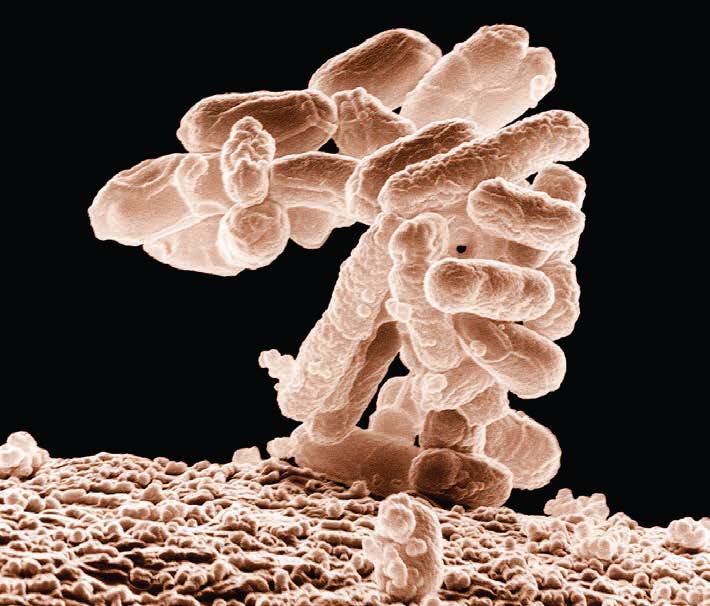
A cluster of Escherichia coli bacteria magnified 10,000 times.
Graham Chandler is a Vancouver-based freelance writer.





Leave a Reply