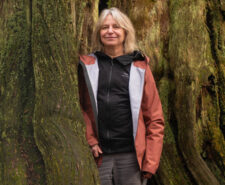


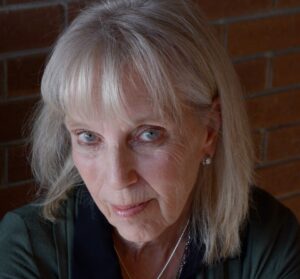
Farrant learns new things about dandelions, wall lizards, rats, robins, wild cyclamen, snowdrops and waiting as she tackles the despair of life lived online with nuggets of humour and wisdom in every paragraph.
Review by Caroline Woodward
It’s unusual to call a memoir timely as well as timeless, but in the hands of short fiction master M.A.C. Farrant, Seventy-Two Seasons: A memoir about noticing (Ronsdale Press $22.95) is just that. Eschewing traditional narrative structures, as always, Farrant decided to spend a year inspired by the Japanese concept of 72 seasons of five days each, not the usual Canadian four, annually.
“I’m hoping that noticing nature will be an antidote to the distraction of happenings in the wider world around me via a small screen. That practice has yielded nothing but despair,” writes Farrant.
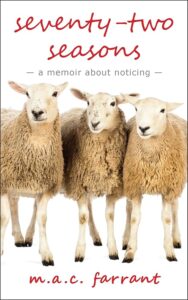 She begins in mid-May, living as she does on the southern end of Vancouver Island, to welcome, observe and write about the flowering hawthorn trees. As with enjoyable essayists like the American author, Rebecca Solnit (who wrote, among other notable books, Men Explain Things to Me) and the BC writers Elspeth Bradbury and Theresa Kishkan, Farrant deftly embeds nuggets of humour, wisdom and information in every paragraph. She discovers what it means to really stop and watch the flowers bud, blossom and drop. Farrant also discovers the beauteous hawthorn flowers smell like “decomposing vegetables” but on the upside, their berries are used for jams and have a long history in medicinal heart remedies.
Onward we go, in five-day increments, learning about dandelions, wall lizards, waiting, rats, robins, urban beautification, wild cyclamen, leaves, snowdrops, the four seasons (with notes on Vivaldi in his impoverished final years, teaching orphaned girls how to play the violin, including his now-famous cycle of compositions dedicated to the seasons), what’s in her neighbours’ blue recycling bins on the curb, cats, dogs, childhood double Dutch code language, vertebrates with hair and a hilarious account of retrieving a much-coveted boulder by four jolly men, all friends and neighbours, as well as the author’s husband.
“It was a balmy July morning, a Saturday, the tide was out, and the sky along with them, was clear and high,” writes Farrant. “They were after a huge chrysanthemum stone on the shoreline: oblong, smooth and covered with perfectly formed ‘flowers’ … Its estimated weight was two hundred pounds. It had been on the beach for years … They set off around ten that morning—the beach was two blocks away—pushing our green wheelbarrow with two six-packs of beer inside it.”
I will not spoil the outcome of this adventure by “four latter-day Tom Sawyers” but it demonstrates so well how the curiosity of Farrant leads her to doing the literary equivalent of slapstick comedy one minute followed by soulful meditation the next—the kind of meditation she had hoped to do while seated serenely on the chrysanthemum rock, eventually.
Then there is a grateful ode to a small, overgrown field, a field with poor soil, growing couch grass and “an assortment of weeds” surrounded on two sides by the inevitable blackberries, a haven for deer, mice and cats on a mission.
“The field functions as an oasis amidst a clutter of houses and roads,” says Farrant. “It’s rumoured to be owned by someone in Ontario, though we don’t know that for sure. Maybe it’s being held in trust and has been forgotten, its taxes paid automatically from a computer. Maybe no one knows it exists. If a field could escape from development, this would be the best way to do it: lie low, keep quiet; enjoy being a field that’s fallen between bureaucratic cracks.”
Farrant’s book is filled with quotes by other great minds throughout, and her acutely observed and beautifully written 73 subjects/chapters, with one extra to explain the Egyptian 360-day calendar and the five dangerous “extra” days until it meshed with the 365-day solar calendar. All this, combined with a blazing final paragraph from the Queen of Quotes, Joan Didion, is employed by Farrant to exhort us all to seize the moment—essentially, to live our lives to the fullest. The list of sources and notes for each of the chapters is a treasure trove in itself.
M.A.C. Farrant dedicates Seventy-Two Seasons to Karl Siegler, her longtime editor at Talonbooks, which has published ten of her books. To date, she has published three books of miniature fiction, one novel, four nonfiction books, including My Turquoise Years (Greystone, 2004/Talonbooks, 2024) for which she also wrote the script for one of her two published and produced plays plus more than a dozen chapbooks. “Brilliant”; “Canada’s most acerbic and intelligent humourist;” “Like a tap dancer on a tower of encyclopedias”—all apt descriptions of Farrant’s long and prolific career. This memoir is the perfect read for those of us harried and hounded by the daily news (which is pretty much all of us) who need a deep dive into contemplation, lightness and clarity. 9781553807438
Caroline Woodward writes, come rain, sun or snow, in New Denver, BC.





Leave a Reply