

Poetry, chess and climate change
March 11th, 2026

Poet and author Renée Sarojini Saklikar discusses Bramah’s Discovery (Nightwood $24.95), the third installment in her ambitious thot j bap series. Saklikar delves into the “breakthrough moments” that led her to merge speculative verse with climate fiction, explaining how a miniature chess set became a metaphor for global power struggles and how the 2021 B.C. heat dome inspired the creation of shape-shifting mythical beasts. 9780889714946
*
Question: Your new book, Bramah’s Discovery, is the third in the thot j bap book series. The book blends speculative verse, mythology, climate fiction and an epic family saga. What inspired you to bring these elements together?
Renée Sarojini Saklikar: As a child, I loved fantasy fiction, especially stories featuring time travel and magic. I also loved ballads, fairy tales, and rhyming riddles. High fantasy fiction often involves alternative worlds where time travel and magic happen alongside battles for good and evil. Epic poems are long narrative poems told in different poetic styles. In my series, you’ll find both genres combined within the structure of an epic, written in verse.
Q: How did you approach balancing poetic form with such a sweeping narrative?
RSS: The first “breakthrough moment” occurred when I discovered that my imaginary world-building fit well into long-form writing. I started playing with sound and images, and things just clicked, like a key turning a lock. As I wrote the poems, I found ways to embed the poetry with a pattern. I just tried to stay open and go where sound and image took me.
My second “breakthrough moment” occurred when the poetry started revealing characters such as Bramah and the Beggar Boy. These characters sprang out of the world building, almost always in snippets of verse! Over the years, the more I read about climate change, political issues, and racial and gender inequities, the more they fed into my imagination and world-building. I realized I was writing an epic.
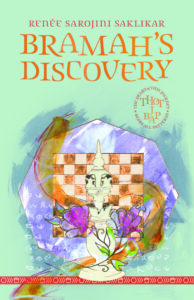 Q: The idea of “Climate Chess” and the Eternal Game is a striking concept. How did you come up with this, and what do you want to say about the power struggles shaping our ecological future?
RSS: My husband is a fan of chess, and we have lots of books about the game and its origins. We also have a miniature chess board with tiny chess pieces that sits in a green velvet pouch on our dining room table.
As I was researching the science about accelerated climate change, I started to think about “what would happen if” scenarios involving my characters, and the role that chance, and fate might play in their lives. I started moving a chess piece across the board, and this simple action just unlocked my imagination. What if the beggar boy was trapped into a chess game with unimaginably high stakes: such as the fate of the planet. The more I wrote into that concept, the more the idea of linking chess and climate change acted as a magnet. Plot and verse ideas seemed to flow and chess as a metaphor for global politics in a dystopian future clicked into place.
Q: The key character, Bramah, faces enemies ranging from drug-lords to shape-shifting mythical beasts to climate-induced crises. Which challenge was the most compelling for you to write, and what did it allow you to reveal about her demi-goddess identity?
RSS: I’ve been fascinated by the role mythical creatures play in epics and fantasy stories, so the idea of making Bramah face challenges from mythical creatures was the most compelling.
Since the inception of the series, I’ve wanted to pay homage to Dante’s mythical creatures. And of all the mythical creatures, the ones that shape-shift, have long intrigued.
Literature and mythology use such creatures to explain how the planet and the universe work. The more I researched climate change; and, particularly after/during the pandemic, and then the 2021 heat dome in B.C., the more I witnessed accelerated weather changes, I started to receive emanations, that’s the only way I can put it! Of how the months, and the seasons were shifting.
The idea of the months April and October, shape-shifting into mythical creatures slowly took hold of my imagination. Ultimately, the creatures took the shape of two large cats, Fanon (named after the political philosopher, Franz Fanon) and Gavroche (named after the doomed street urchin in Victor Hugo’s Les Misérables).
I knew that Bramah’s encounters with both would be complicated and would force her to make tough choices about what is good and what is evil in a world experiencing unprecedented change.
Q: Bramah’s motto—“Let all evil die and the good endure”—is a significant part of her moral journey. How does this ideal evolve for her throughout the story, especially as she faces the moral ambiguity of a world in ecological and economic collapse?
RSS: The evolution of her ideal(s) is one of heartache and resilience throughout this story. She starts the book with her morals intact and her magical powers at their height. However, faced with the temptation of finding out answers to one of her great yearnings, to find out about her origins and the fate of her parents, she succumbs to the wiles of an intriguing rapscallion, a quasi supernatural, Lord Vish-Verge. (He thinks of himself as a kind of incarnation of both Lord Vishnu and the poet, Vergil). From the moment Bramah chooses to follow Lord Vish-Verge, her ideals are not only tarnished but also almost broken. The speculative world, combining a genre fantasy story-arc with poetry, entices Bramah into a series of events from which she must extricate herself and ultimately her choices reveal both strength and a disarming vulnerability. She has to face a key test: give up her powers or stay true to her friends?
Q: What themes run through Bramah’s Discovery?
RSS: Key themes include the struggle between good and evil; the role of chance and fate in determining outcomes; the impact of accelerated climate change on the lives of ordinary people placed in extraordinary times; the choices humans must make when faced with catastrophic circumstances, including whether to use violence to overcome injustice.
This book is my most personal, most political, and most fantastical: all three aspects weave together in ways that surprised me:
– The death of my mother and the “feels” of now being without both parents;
– The terrible news about events in Europe and the Middle East;
– The climate change emergency, which is forcing all humans to stake stock about how we live.
The writing of Bramah’s Discovery gave my imagination the opportunity to take all these and put them into a futuristic world of magic, mythical creatures, chess, supernatural powers and accelerated climate change.
The story combines real-politk, personal heartache, and epic fantasy. I think it’s my favourite book to date!
Q: Can you give us a sample poem?
RSS: This poem is from Part I of Bramah’s Discovery.
Bramah has just encountered the Oracle, Abisha, disguised as a warrior.
They meet in the city of Ahmedabad, where the book begins.
It is the year 2110.
AS YOU WISH: ABISHA, DISGUISED, TESTS BRAMAH’S INTENTIONS
Warrior with a sword, lounging at the Gate.
The first thing Bramah heard her say,
I longed for a friend and a cuppa tea.
All I got was wars and killing, a sword, my destiny.
Then she scoffed, tossed back a long sheaf of hair,
leant against the scabbard of her weapon,
and stared at Bramah, her voice a razor cutting air,
So locksmith, we meet again.
Do you know who I am?
Bramah’s turn to stare back, silent.
And the Sword said, How many have you even killed?
This time Bramah smiled, lopsided, nodding:
I do my best to turn and click, not kill.
The Sword straightened, arm extended, flick,
and pointed her edge straight at Bramah’s heart.
Where were you, goddess in half, when Consortium
forces shot that Seed Saver, face down into the street?
Where were you, late arriving, when Guards of the Fifth
shoved her body clean off the funeral pyre?
Where were you when we carried her limbs
to the wishing well outside the gates of the old city,
shots fired at us, teargas cannisters rolled?
Bramah longed to say, I was at the bedside of the parents
their young child held hostage—
Instead, she looked into the Sword’s face and replied,
You have your mother’s eyes.
That’s when the woman lunged, sword hand raised.
Bramah didn’t flinch, palms raised, skin unbroken.
No sooner than her back turned
but a drone dropped circling low,
blue light emissions pulsed,
red light on the drone’s forehead
blink, shift, blink again, paused, peered closer:
Bramah quick to hide her face, satchel lifted
she cried to the Sword, Have you a light?
And then both turned toward the drone:
Consortium edicts banned warm yellow light,
Before-Time nostalgia for electric, scoffed.
Intent on incineration the drone emitted a command,
Bring me your letters, your ripped-out pages!
The Sword gathered up her silken hair, top knot shining
fingernails painted blue, long sharp weapons
quick as lightning, tapping the top of the drone
breath in quick gasps, tone, mocking:
Locksmith, use your pick and pliers, drill and turn!




Leave a Reply