


Overwhelmed
A 23-year-old poet meets an older artist who lures her to be his model and muse. Over forty years later, the model comes to terms with this episode in her life.
March 17th, 2026
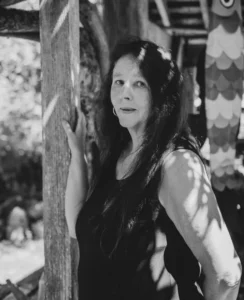
Theresa Kishkan is writer and publisher living on the Sunshine Coast. Photo by Chelsea Roisum.
“It is seldom that we hear from an artist’s muse. [Theresa] Kishkan reclaims autonomy by humanizing herself to the viewer (and reader) and parsing through questions of consent, naïveté, trust, power, beauty and complicity.”
Review by Sonja Pinto
Each day when descending the staircase in her home, Theresa Kishkan comes face to face with her double: her face, decades earlier, immortalized in a painting. The face is familiar, yet somehow foreign: “It wasn’t me and yet it was, in a way,” says Kishkan.
The Art of Looking Back: A Painter, an Obsession, and Reclaiming the Gaze (Thornapple $34.95) tells the story of this painting and how it, and dozens of others painted and sketched of her, came to be. Now in her sixties, Kishkan unravels the complex moral and psychological ramifications caused by her relationship with the painter.
Kishkan grew up in Victoria where she developed her talents as a poet and writer. Attending the University of Victoria, she became part of the local arts scene that included familiar names such as writer Robin Skelton and his wife, Sylvia Skelton. Through the Skeltons, she was introduced to a local painter who became immediately and obsessively enamored with her. So began an uneasy relationship that haunted Kishkan for decades.
She’s twenty-three years old when she meets the painter Jack Wilkinson, who is “the same age” as her father. Shortly after the meeting, Wilkinson wrote to Kishkan, saying “as you might deduce, I am enchanted.” Initially, they bond over their love of art and Kishkan describes being flattered by the older artist’s attention. Wilkinson seems genuinely interested in Kishkan’s artistic pursuits and opinions, a kind of respect that can be scarce for young women in the arts.
Kishkan describes the pressure and urgency she felt from Wilkinson for contact. “Jack wanted to see me daily,” Kishkan writes, and “he drew me obsessively.” Once, they shared a picnic at a beach, talking of art and poetry. Wilkinson later gave her a sketch of this encounter; except in the sketch, Wilkinson portrayed himself as a naked satyr and also drew Kishkan naked, emphasizing her breasts. Kishkan includes a scan of the cartoon in this book.
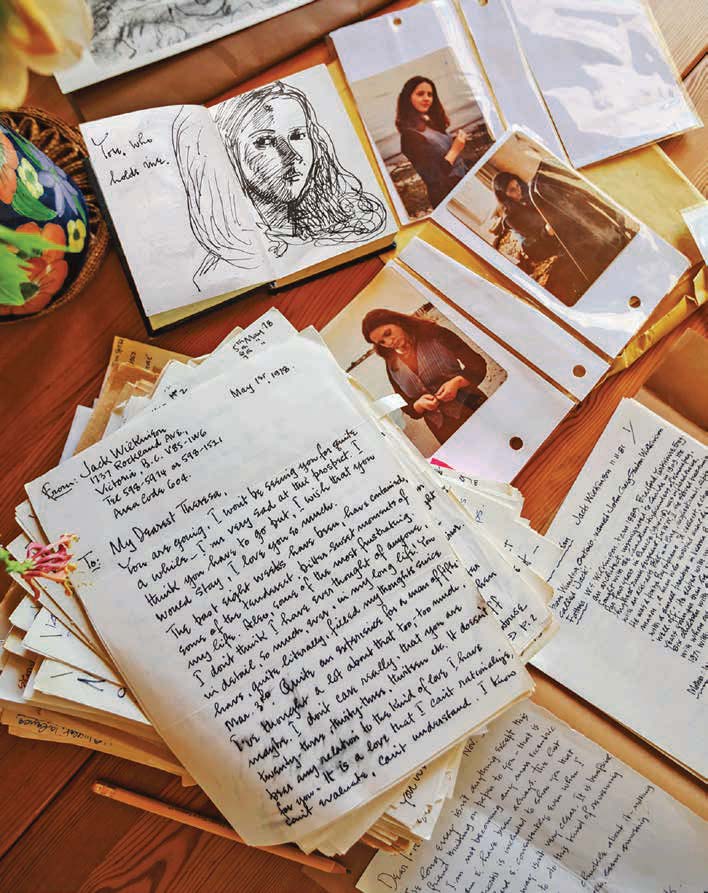
Some of the many letters, drawings and photos that Jack Wilkinson showered upon the young Theresa Kishkan. “I don’t think I have ever thought of anyone, in detail, so much, ever, in my long life,” Wilkinson wrote to Kishkan.
Despite Wilkinson’s lust, the relationship is not romantic to Kishkan: “I was overwhelmed by his attentions but I wasn’t attracted to him, didn’t want him as a lover.” Now in her later life, she can recognize that “I was too inexperienced to firmly decline his affections, though I did decline his physical advances.”
Jack Wilkinson was a prolific artist based in Victoria. He notably designed part of the fountain in Centennial Square, a public area adjacent to Victoria’s city hall. Wilkinson, a married man, had a teenage child with his wife. “There was more than a whiff of scandal,” Kishkan laments. Indeed, to further complicate things, Kishkan closely resembled his daughter, who was only slightly younger than her.
As their relationship continued, so too did the drawings. “The self you saw reflected in his eyes, in Jack’s eyes, was not the self your friends saw,” Kishkan writes. Wilkinson insists that she is his “archetype,” a figure who attracts him physically and intellectually.
Kishkan sometimes visited the house where Wilkinson lived with his wife and daughter. She had a good rapport with the whole family, and they seemed to enjoy her company. With insistence, Wilkinson finally convinced Kishkan to let him paint her nude in his studio—”I’d learned that he never wanted to take no for an answer,” she says.
When Kishkan sees the nude painting now, the hesitation and discomfort of the moment seem to be smoothed away: her portrait shows “no sign of goosebumps, though you remember them on your arms the time you took off your clothes.”
Rumours circulate about Wilkinson having an inappropriate relationship with his daughter. Kishkan is aware of them at the time, but cannot come to terms with it: “I pushed the question away,” she confesses.
Time has allowed Kishkan to reconcile with the likelihood of abuse. Wilkinson also obsessively painted his daughter, often portraying her in intimate and vulnerable moments. Kishkan specifically references one painting of his daughter that portrays her as a preteen, unclothed in her bedroom, lurching towards the door to shut it. To Kishkan, the painting “had, has, something to say about younger girls, power, the ominous dangers that wait for them beyond the safety of their bedrooms.”
Though Theresa moved abroad a year after meeting Wilkinson, that is not the end of their correspondence. He found her years later after she had married and had kids. He gifted Kishkan’s children some of his paintings of her, including one where she nurses her child, and wrote her a biographical essay about his life titled “My Life for Theresa Kishkan.”
It is seldom that we hear from an artist’s muse. Kishkan reclaims autonomy by humanizing herself to the viewer (and reader) and parsing through questions of consent, naïveté, trust, power, beauty and complicity.
Throughout the memoir are images of the paintings, sketches and letters from Wilkinson, which capture the obsessive longing that characterized his affections for Kishkan. Now, after decades have passed, the subtext of these letters is legible to her in ways that her younger self couldn’t understand.
The Art of Looking Back is an honest, tender reflection on a version of a younger self, mediated through the male gaze, and all of the complexities of emotion, power and social dynamics that come with a relationship that lives in a “grey area.” The prose is a stunning landscape of memory, archive and art that reads like a confessional. This haunting story of subversive beauty is not to be missed. 9781997702061
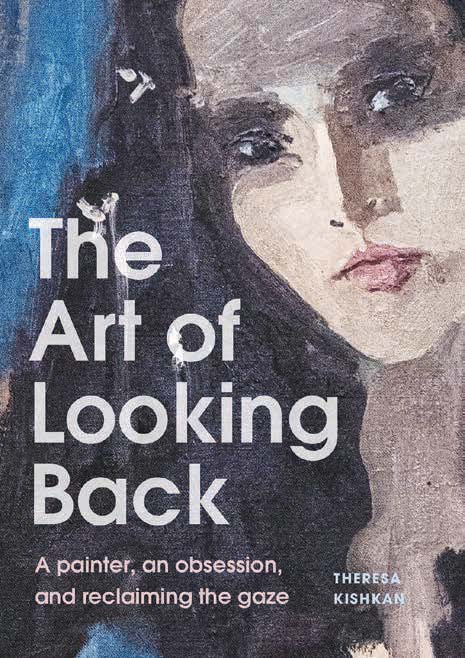
A detail from a photo of a painting of Theresa Kishkan, aged 23. by Jack Wilkinson is used on Kishkan’s book jacket. The actual painting still hangs in Kishkan’s home reminding her daily of her younger self.
Sonja Pinto is a writer, photographer, printmaker and book reviewer. They reside on the unceded territories of the lək̓ʷəŋən peoples (Victoria, BC).





As a person who had an artist father who tried to have a (not totally successful) sexual relationship with me as a teenager, I have some understanding of Theresa’s story. Though I loved my father, and have some conflicted feelings that still occasionally arise, I have long since forgiven him. He was a truly wonderful artist and left me some lovely drawings he made of me as a child, but he never had the confidence to quit his job and become what he was meant to be. He was never truly happy and became depressed as the years went by. I took a lesson from that and though I had a large family I went back to school and fulfilled my dream of becoming a sculptor. At the age of 71, when arthritis had set in, I began writing a series of books for young people, self published, (I was in a hurry and not too confident of myself as to my abilities as a writer) but have done rather well with them. Now 91 and unable to know when to quit I am working on two more. So I say to all those whose lives have been scarred by unwanted attentions, regardless of whom, do the thing you love most and life will answer not only with healing, but fulfillment.