


A ferry good way to travel
Ferries and passenger ships have long been a colourful part of life in BC and a big part of its history.
March 04th, 2026
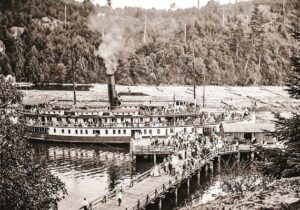
Despite the war, SS Bowena (ex–E&N SS City of Nanaimo) had plenty of passengers here at Snug Cove on Bowen Island in the summer o f 1917. Note the log booms behind the ship.
“It’s easy to forget that up to the 1950s travel by ferries and other passenger vehicles was crucial for the movement of people, mail and goods to and from coastal communities. Sometimes, the ferries only came once a week. Social gathering opportunities and contact with the outer world were a common feature near ferry docking areas … for many decades ‘boat day’ was a major event in the Gulf Islands.”
Review by Graham Chandler
Our BC coastline stretches more than 25,000 kilometres and can boast over 40,000 islands. That’s a lot of territory to cover. For many years, coastal communities were cut off from the mainland and only accessible by water and air—there were no roads linking them to the outside world. Ferry vehicles and water taxis of many sorts became common sights to British Columbians.
Want to learn more? Check out historian Derek Hayes’ new title, Coastal Connections: A History of British Columbia Ferries and Passenger Ships (Harbour Publishing $50.00). It’s a source book. It’s a history book. It’s a picture book. It’s a get-smart book. It’s a fun-read book. Leave it on your coffee table. Your dinner guests will flip through it with the occasional “Well, I’ll be darned!”
Of course, those guests, and readers who have read any of Hayes’ other 19 history books will still be “darned.” Because he has a knack for digging up fascinating minutiae. Hot on the heels of his 2022 BC history/geography volume Incredible Crossings: The History and Art of the Bridges, Tunnels and Inland Ferries That Connect British Columbia (Harbour, 2022), Hayes’ new tome is a compelling complement.
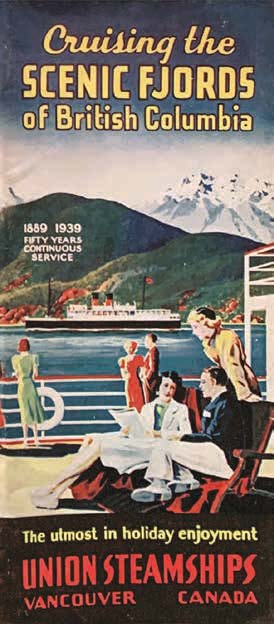
The cover of a Union brochure issued in 1939 commemorating the company’s 50th anniversary that year. Promoting style and elegance, the colourful artwork is typical of that in many such items published over its lifetime.
“Well, I’ll be darned …”
Did you know the first regular ferry service in BC was in 1859 by a sidewheel steamer named Eliza Anderson operated by the United States Mail Service?
The first ship to arrive on the Northwest Coast specifically designed to carry cars was in 1918.
The MV Scenic was billed as “the only floating post office in the British Empire” from 1932 to 1968.
The SS Canora was the only BC coastal ferry to be armed; it was fitted with a gun during World War II.
Built in Vancouver in 1924, the MV Harbour Princess was said to be the first diesel-powered vessel on the BC coast.
The first regularly-scheduled hovercraft service in the Americas was in 1969 from Nanaimo to Vancouver.
Dinner menu items on the 1920s Victoria-Seattle-Vancouver Triangle route included “Scrambled Calf’s Brains on Toast” and “Calves’ Foot Jelly.”
In 1907, Union Steamships’ Camosun became the first ship on the BC coast to have a wireless telegraph installed.
In July 1937, Union Steamships’ Lady Rose became the first diesel-powered single-screw (i.e. single-propeller) vessel to cross the Atlantic.
Here in BC our ferries have come a long way. Consider, for example, “taking a car on the ferry in the 1920s was a totally different experience compared with today’s easy drive on and drive off [also called roll-on, roll-off],” writes Hayes. “Many ships were designed to take freight unloaded and shipped by itself, and ships had low overhead space on the cargo deck. This necessitated expediencies such as letting the air out of tires or even removing them entirely, removing the top (if it was a convertible) or removing the windshield—basically anything that would reduce effective height.”
Those early days are a contrast to today’s experiences as well as today’s main uses of our popular coastal service. It’s easy to forget that up to the 1950s travel by ferries and other passenger vehicles were crucial for the movement of people, mail and goods to and from coastal communities. Sometimes, the ferries only came once a week. Social gathering opportunities and contact with the outer world was a common feature near ferry docking areas says Hayes, noting that “for many decades ‘boat day’ was a major event in the Gulf Islands, not only for the interesting activity it brought but also for residents to collect their mail. After being offloaded the mail usually had to be sorted, but it was worth waiting for when it was your only link to the larger world,” writes Hayes. “And the ferries were critical for economic activity. Farmers were able to sell their produce in Vancouver and Victoria only because of the ferry. Mayne Island, in particular, had a large business growing greenhouse tomatoes, which, because of longer hours of sunshine, were ready two or three weeks before those grown in the Fraser Valley.”
One of the major players in the early BC coastal shipping and ferries business was Union Steamship Company. This company certainly had marketing smarts. In addition to serving isolated settlements, logging camps, mines and mills it developed tourist destinations. Through acquisitions, Union Steamship owned destination resorts at Selma Park, Bowen Island and Sechelt. They also developed a cruise ship-style event for day trips, variously including dancing, midnight cruises and more. As well, Union Steamship’s sharp marketing staff created company picnics for businesses with clever and colourful artistic posters and other promotional campaigns.
Another large company historically operating in our tricky west coast waters was Black Ball Ferries that was later taken over by the BC government in 1961. It was an early catalyst for a revolution in marine traffic. Although the company wasn’t the first to develop the concept of roll-on, roll-off vehicle loading it was certainly its most fervent popularizer. And Black Ball was no slouch in marketing either, jumping on to the latest artistic and design trends like Art Deco with the Airstream-looking Kalakala, one of the more fascinating stories in this book. Originally a San Francisco commuter ferry called the Peralta, it was caught up in a 1933 Oakland fire and written off by the insurance company. Black Ball bought the hull and rebuilt it in Art Deco style using a new arc-welding construction method which enhanced its revolutionary streamlined styling. Returned to service in 1935 as Kalakala, it set a precedent by being the first time an Indigenous-derived name was used on a ferry. However, despite its revolutionary aspects, like many other firsts it had its share of problems. The Kalakala had restricted vision over the bow which increased the propensity for collisions. It also had unsolvable vibration issues. Finally, increasing operational costs including load space restrictions forced its 1967 withdrawal from service. The Kalakala had an ignominious end as an Alaskan seafood processing plant.
Black Ball is generally credited with bringing modern concepts to a marketplace that, early on, was “largely more sedate, with the leisurely, more formal, and often overnight services epitomized by Canadian Pacific Railway (CPR). [In contrast] Black Ball’s concept was to find the shortest route and get there as fast as possible—exactly like BC Ferries today,” writes Hayes.
And thus was born the BC Ferries of today. It was the summer of 1958 and Vancouver Island was essentially cut off by strikes at the two main ferry providers CP and Black Ball. Long-time BC Premier W.A.C. Bennett’s government was unable to intervene as the ferries were federally regulated. It was a tumultuous time in BC labour relations: Bennett invoked the Civil Defence Act, putting Black Ball under trusteeship. Next day saw police read the Riot Act at the ferry terminals. But it was to no effect. A full-on strike against Black Ball began on 18 July 1958. Bennett then threatened court action and a decision to create a BC Government service themselves. “Many historians consider 18 July 1958 to be the origin date for BC Ferries,” writes Hayes.
But Bennett apparently had no immediate candidates with any good ideas about how to run a ferry business. So who did he call on? Why, none other but the infamous “Flying Phil” Gaglardi, and his reputation of a “let’s get at ‘er and get ‘er done” attitude. Under his leadership, BC Ferries thrived: it “spent the first half of the 1960s building large ships, and the first half of the following decade making them bigger, increasing capacity by lengthening them or adding another car deck. Passenger numbers rose rapidly. “In its first year of operation, BC Ferries carried 692,000 passengers,” writes Hayes. “By 1970 it was 5 million and by 1979 it doubled again to 10 million.”
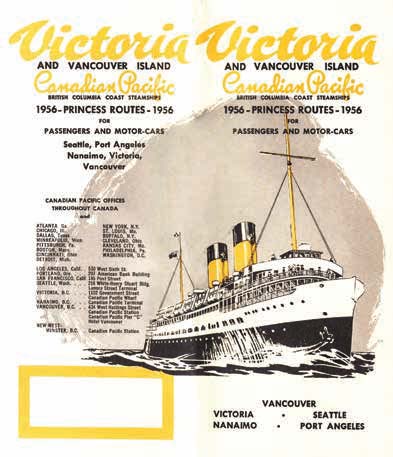
Brochure and timetable for BCCS routes from Vancouver to Nanaimo and Victoria, and from Victoria to Seattle, for both “passengers and motor-cars” was published in 1956, still emphasizing the romance of the Princess fleet.
For the first time, some serious competition came from airlines: Queen Charlotte Airlines (later Pacific Airlines) began twice-daily flights to Powell River from Vancouver in July 1952—a service that became popular and could transport surprisingly large numbers of people with multiple daily flights. They were competitive too: in 1950, flights from Vancouver to Prince Rupert were $44.85, as compared with $36.25 by sea, but the flight took 5 hours, 15 minutes whereas the sea trip took 37 to 42 hours.
Much of the 1990s was spent seeking faster crossings. In 1994 BC premier Mike Harcourt and ferries minister Glen Clark announced that three totally innovative ferries would be built for the Horseshoe Bay to Nanaimo run. They’d be fast (69 km/h), aluminum two-hulled catamarans capable of carrying 250 cars and 1,000 passengers. The cost for all three was estimated at $210 million. The first, Pacificat Explorer, was demonstrated on 12 November 1998 but a long series of problems surfaced, including need for a new engine design, loading balance difficulties, sewage dumping problems and more. Unable to efficiently redesign, the project was cancelled. Final cost total came in at almost $460 million. They were auctioned off for $19.4 million.
That’s just one of the many politics-related stories that Hayes covers in some detail in this volume.
The book wraps with a useful bibliography and recommendations for further reading. But the final sections before that are in some ways the most interesting—such as how ferry art images show creativity in photography. The Way Ahead section discusses the future direction of BC Ferries’ major vessels, which is threefold: larger, greener and standardized. Plans have been announced for up to seven of some of the largest double-ended ferries in the world. And, in meeting the new criteria, their engines are designed to use biofuels and will include a battery-hybrid propulsion system that will allow for full battery-electric operation once shore-based charging systems become available.
Meticulously researched and lavishly illustrated with over 300 historical images, this tome will make your next ferry ride a whole new experience. Not to mention your coffee table. 9781998526383
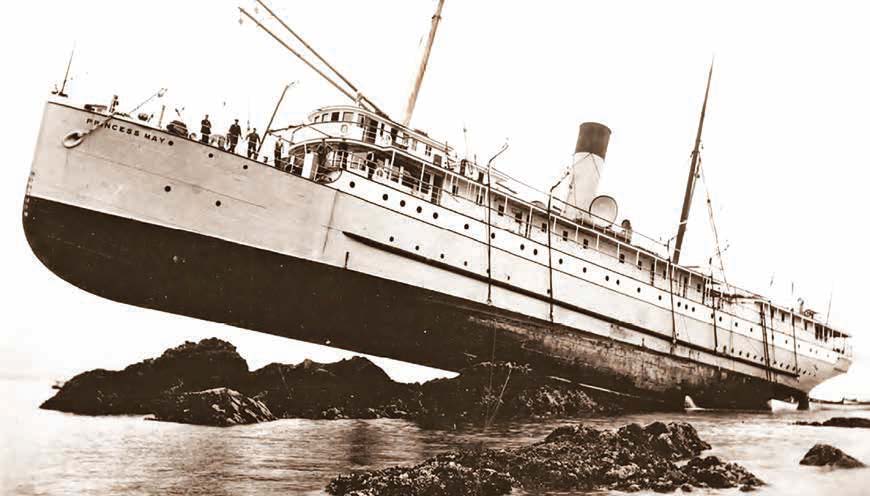
Canadian Pacific’s The Princess May after crashing into Sentinel Island in thick fog on Lynn Canal in 1910.
Graham Chandler, a long-time freelance writer based in Vancouver, enjoys ferry travel.





Leave a Reply