

Working to death
Raised on horror movies and sketch comedy, Doretta Lau brings sharp wit and dark absurdity to her acclaimed short fiction and debut satirical novel as revealed in this Q&A.
November 16th, 2026
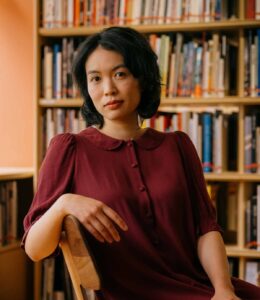
Doretta Lau is a Columbia MFA graduate and former Hong Kong arts journalist.
“To extract from an employee even after death I thought was the most nefarious possible thing that a corporation could do.”
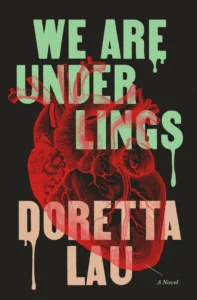
Author and journalist Doretta Lau blends horror, sketch comedy and offbeat absurdism into sharp literary fiction. After earning an MFA in Writing from Columbia University, she worked in children’s publishing in New York and spent years as a cultural journalist in Hong Kong—experiences that fuel the biting workplace satire and transnational settings of her work. Known for immersive research, Lau spent two months living in a haunted house while drafting her debut novel, We Are Underlings (House of Anansi $26.99), a dark comedy about a dysfunctional office struggling to launch a death-themed amusement park. Senior editor, Sheldon Teitelbaum caught up with Lau for this interview.
*
By Sheldon Teitelbaum
BC BookLook: In the mid-1980s, I visited Epcot Theme Park and complained to my favourite uncle that its animatronics came up grievously short of my Westworld expectations. At first glance, We Are Underlings gives me precisely what I was pining for: Weekend at Bernie’s meets Severance in a Hong Kong theme park. What came first for you – the park, the corpse or the office?
Doretta Lau: Oh, the original Westworld movie is so fun! I watched it because of a Stephen Malkmus song “Jo Jo’s Jacket,” about the actor Yul Brynner. The office in We Are Underlings came first. I was working at a visual culture museum in Hong Kong that was very bureaucratic. We needed six signatures to get most requests approved and I began to wonder, what would happen if someone on that list went on sick leave? And then I thought, what if this were a novel and someone died? Would a workplace be desperate enough to go Weekend at Bernie’s?
BCBL: Nine Circles turns death into scheduling, staffing, branding and damage control. Were you trying to make death itself banal – or to show a corporation working furiously to make it banal while grief refuses to cooperate?
DL: I loved the idea that behind the curtain of any entertainment spectacle is a group of people who could be working in any sort of office doing similar banal things. The accountant at a theme park would be doing the same work for a pharmaceutical company or a grocery store or a publishing house. An inspiration is the office scenes in the movie The Cabin in the Woods. I also wanted to explore the idea that we can get tunnel vision about our duties at a job and we lose sight of the fact that filling out our spreadsheets or performing edits might be doing harm along the way.
 BCBL: Clause 15.4 allows the company to claim an employee’s “life rights” after death. Meanwhile, the Silicon Valley fantasy is not to accept death but to defeat or transcend it. Were you thinking about a class divide in which death becomes banal for underlings and optional for their masters?
DL: I wanted to show that reading the fine print pays off and that a lot of corporations will take as much as they can from a worker—including items like non-compete clauses for years. To extract from an employee even after death I thought was the most nefarious possible thing that a corporation could do. And even management isn’t exempt from suffering this in the novel.
BCBL: The title’s Julius Caesar epigraph says the fault lies in ourselves for being underlings. Your novel then shows contracts, rent, health insurance, prestige and deadlines rigging the choices. Where do you finally place the blame – inside the worker, inside the system or in the bargain between them?
DL: The system is the problem. Unfortunately we have to pay rent and bills and finding a workplace that aligns with our values but will also pay for our very specific skillsets is a huge balancing act.
BCBL: Zita and her allies do not remain morally spotless: they hack, blackmail, bluff, manufacture synthetic media and plant evidence. Did you want a dirty victory because a clean one would have been dishonest?
DL: I let the characters do whatever they needed to do to make the narrative feel satisfying. It’s more fun to have them enter into morally grey areas rather than performing goodness.
BCBL: The workers force genuine reforms, and the result is a more humane workplace that is also more efficient and profitable. Has the revolt succeeded – or has capital simply learned to metabolize it?
DL: In the end, they’re still serving capitalism. When I was writing the novel, I was envisioning the final scene of the movie 9 to 5. My editor pointed out that my first draft was a little too rosy, so I had to rethink how to deliver the right sort of ending.
BCBL: You set the opening on September 20, 2018 – before Hong Kong’s 2019 protest movement and before the pandemic, while Arnold’s fictional scholarship examines SARS and media rhetoric. What did that precise date allow you to see in retrospect?
DL: When I first started writing the novel in 2016, I didn’t pin the story to a specific timeline. But then the protests and the pandemic happened, and those events changed what life is like in Hong Kong so pinned the narrative to 2018 so that the petty office politics could unfold without readers wondering how the characters could be navel gazing in the midst of greater historical events.
BCBL: We Are Underlings is satire, but it is not a lark or a send-up. You have said your ideal fiction finds the right ratio of funny to sad; elsewhere you put one grief story at roughly two to one. How did you know when a joke had earned the right to sit beside a body?
DL: I mapped out the entire book ahead of time and let the characters exist within the structure and somehow that produced the humour. I never set out to write a joke; usually what happens is I write a scene and the context and the characters produce something funny. The goal is to capture a moment and to expose folly. I learned that from Jane Austen—my English degree comes in handy in these moments.
BCBL: App Arnold dispenses the advice Zita never wanted while her father was alive; Information Arnold can draw on hundreds of hours of his recorded work. At the end she stops him before he can answer. Does her interruption reject both the demand that the dead keep performing and the technological promise that simulation can transcend death?
DL: Part of the stopping before he can answer in that scene is that I didn’t want to add a massive speech to the closing of the book—it wouldn’t have served the narrative to have that in that moment. But this choice does produce the feeling you describe.
BCBL: Your dedication is to your father, Kwok-Tat Lau. If you are comfortable going there: what emotional truth from that loss did you permit yourself to transform for Zita, and what did you keep private?
DL: My dad was a lot different from Arnold Chang in the book—I don’t write memoir because I enjoy my privacy and I’ve seen what happens to my friends whose life stories are out in the world for public consumption.
I’m a writer because there was zero pressure from my dad to pursue anything in life other than what I wanted. While I was writing the novel both my parents died, as did two of my close friends, writers Rebecca Godfrey and Y-Dang Troeung. The day before my mom was scheduled to die, I wrote to my agent and sent her a partial manuscript and asked her to tell me I had a novel even though it was missing two chapters because I needed something to look forward to in my life. So by the final drafts of the manuscript, I had a different understanding of death and grief than I had before. There’s life before a parent dies, and then there’s life after that and no one really understands it until they experience it. 9781487014308




Leave a Reply