

The marvel of old-growth forests
Bestselling forest ecologist, Suzanne Simard delves into how we can save our forests by learning from First Nations’ historical stewardship (hint: it’s not consistent with corporate forestry clearcut-logging practices initiated at the beginning of colonial times.)
October 21st, 2026
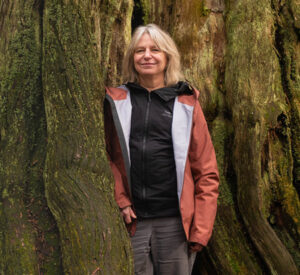
“European settlers did not understand that the existence of abundant forests was deeply influenced by age-old ancestral [Indigenous] stewardship that honoured the natural cycles and connections of the ecosystems.”
Review by Sonja Pinto
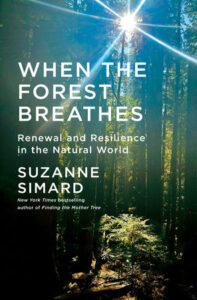
Our province’s old-growth forests hold untold superpowers—and no, not the Marvel Comics kind. In When the Forest Breathes: Renewal and Resilience in the Natural World (Allen Lane $39), Suzanne Simard explains the mystifying mechanisms and connections of forests in British Columbia and across the world. Her research with the Mother Tree Project, which Simard first wrote about in Finding The Mother Tree (Penguin, 2023), illuminates how proper forest stewardship informed by Indigenous wisdom has the potential to heal the damage done by extractive forestry practices.
Simard’s team of researchers have been studying forests for decades. Their groundbreaking research on mother trees—the oldest, most resilient trees in a forest—challenges conventional clearcut logging practices: “Our data clearly shows that leaving primary and old-growth forests intact, allowing the trees to grow to old age, as nature intended, is the best way to mitigate greenhouse gas emissions from land-use change,” she writes.
These mother trees are vital. They share their abundant resources and knowledge with younger trees, strengthening the entire area. The project’s research findings suggest that “trees in forests have powerful abilities of perception and communication, and they co-exist in a finely attuned dance of reciprocity.”
 From seedlings to rotting carcasses, trees have many roles to play in sustaining an ecosystem. The cyclical pattern of life and death provides the structure that sustains forests, regenerating and evolving over millennia. The forests affect us humans, too: “trees and humans are intimately interdependent, breathing in and out each other’s essence in rhyme,” says Simard.
When the Forest Breathes documents key moments of Simard’s research, including experiments done in several British Columbia forests around mother trees and how different logging practices impact the health of a forest. It’s a memoir-style retelling of such expeditions, describing the toil of working through conditions like intense heat and bug infestations. Simard’s team survives several close calls with wildfires and escapes from wildlife such as bears.
This book will satisfy those who are academically inclined. It contains abundant citations and further reading. However, it will do just as well for someone with no interest in the nitty-gritty of scientific papers and methodology. Readers will be enthralled by descriptions of trips to local sites like Ada’itsx (Fairy Creek) and places as far off as the Amazon rainforest.
These trips include anecdotes of Simard’s closest colleagues and students like her co-researcher Jean, who “once hauled [Simard] and [her] backpack up a ten-meter cliff on Vancouver Island to escape the incoming tide.”
She meets many people throughout her travels who teach her and share knowledge with her. One such person is Dave, a Nlaka’pamux man who shares that connections between trees are part of his people’s creation story. Moreover, his nation has had to fight for the ability to steward their own land. For the ability to log their own forests, they must accept restrictive conditions from the government.
Through relationships like these, Simard observes that Western science has had a “roundly disparaged” view of Indigenous ways of knowing. It is for this reason that her research project is titled after the mother tree, a metaphor that nods to ancient Indigenous knowledge.
Simard knows that her research findings are supported by centuries of Indigenous wisdom. According to Dave, “the forests are not being managed for the local ecosystems or the local people,” he says. “They are being managed based on the values of the big corporate owners. These corporate values do not reflect our local values.”
Indeed, BC’s forestry industry profits from maximal resource extraction, placing its interests at odds with the health of the ecosystem as a whole. There are disastrous outcomes for clear-cut areas of forest, which struggle to fully recover and lose massive amounts of their carbon storage.
Part of Simard’s work is to collaborate with loggers on a way forward. She engages with them at conferences, detailing the often-strenuous encounters. Despite attempts at cooperation and collaboration, Simard meets friction from the motivation for profit. “Clearcutting was undisputably the easiest and cheapest method of harvesting trees. It required little knowledge of the forest or understanding the ecosystem,” Simard explains of the logging method.
Though she now advocates for sustainable forestry practices, Simard’s ancestors worked in logging. In her earlier years, she too had ambitions to serve colonial forest stewardship practices, but laments that “the goals were wrong.”
She has had to unlearn our culture’s flawed ideologies around natural resources: “European settlers did not understand that the existence of abundant forests was deeply influenced by age-old ancestral [Indigenous] stewardship that honoured the natural cycles and connections of the ecosystems.” Early settlers viewed Pacific Northwest forests as “untouched wilderness” and ignored, or were ignorant of centuries of sophisticated Indigenous stewardship, such as cultural burning and forest gardening.
By accepting a holistic view of forests and how they function, Simard gains insight on the interconnectedness of forests. “Not unlike humans, trees are deeply influenced by their families and local neighbourhoods,” she writes.
Though the book contains in-depth explanations of the Mother Tree Project’s data and scientific findings, When the Forest Breathes is written to be accessible to a non-specialist. Simard is gifted in translating a wealth of technical knowledge into interesting, easy-to-digest anecdotes and explanations for the layperson.
The Mother Tree Project data paints a bleak picture about the state of forests if logging practices continue clear cutting. But Simard insists on hope—all is not lost in our ecosystems she says: “Even after the most destructive logging practices, forests strive to heal.” 9780735241725
Sonja Pinto is a writer, photographer, printmaker and book reviewer. They reside on the unceded territories of the lək̓ʷəŋən peoples (Victoria, BC).





Leave a Reply