


Saying goodbye to Sherry
A beloved children’s author shares the story of the last year of her wife’s life as she seeks medical assistance with death.
September 15th, 2026
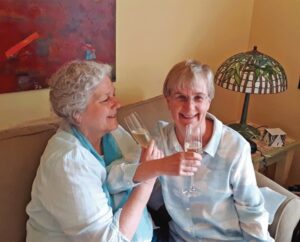
Sarah Ellis (right) with her wife Sherry
“In real life, when you have the luxury of paying attention, the ordinary and the amazing turn out to be one and the same thing.”—Sarah Ellis
Warning: The following review deals with aspects of euthanasia.
Review by Carellin Brooks
My partner’s dog had developed paralysis in its back legs and could only be lifted from the house into the yard. Incontinence set in. Regretfully, she decided it was time. She called the vet, who arrived and administered the injection. All of us stood in a circle, holding the dog as it died.
A few months later, my grandmother finished affixing the Post-Its to the back of her paintings and tables, each with a name in her cursive handwriting. Then she mixed the pills she’d hoarded into the chocolate pudding. There was one more Post-It on the front door, for the cleaner who was scheduled to come the next morning. “Don’t come in,” it read. “Call the police.”
Why was the death of an animal, even one as beloved as that dog, handled more compassionately and carefully than my grandmother’s? Why did she have to die alone? But I knew the answer. In 2001, suicide was still a crime. If any of us had held her as she died, we would have been under investigation by those same police.
Twenty-five years later, MAiD has made such heroic measures unnecessary. It is no longer a crime to kill yourself at a time of your own choosing. But when Sarah Ellis’s spouse, Sherry, decided to take her own life rather than become increasingly debilitated by multiple sclerosis, only a condition where death was foreseeable was eligible for MAiD. To kill herself, Sherry would have to travel to Switzerland, where the procedure has long been legally available, even to those who don’t meet the Canadian criteria.
At first, Ellis can’t believe Sherry is serious. After all, Ellis is so adorable and their life together so rich: surely, she’ll reconsider? But Ellis reckons without her partner’s strength of mind, complex moral code and ultimate choice to die with dignity rather than submit to the increasing loss of autonomy inevitable with the disease’s progression. Soon enough, they are trying to sleep in an anonymous Swiss hotel room decorated with origami animals brought from hometown Vancouver, the night before the administration of the drug that will take her spouse from Ellis for good.
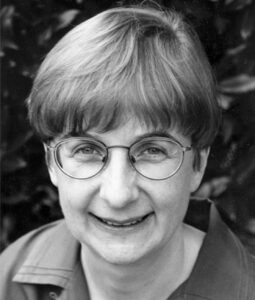
Sarah Ellis, circa 1980s.
This memoir, written in heartbreak, chronicles Ellis’ experiences both of the year leading up to her spouse’s death and the aftermath of that decision. Ellis is unflinchingly honest about her own refusal to face the reality of her partner’s condition and her own limitations. She shares her dual thinking: Sherry will die, and she will not.
If this sounds like a grim premise for a book, to the contrary. Ellis, one of the foremost writers for children in Canada, is too good of a writer for this memoir to be anything but a surprising delight. Her own personality shines through these pages. As someone who has chosen to look closely and to love all around her, including her lover, whether Ellis is observing children at play, describing a cherished book or trying to wrap her head around Sherry’s decision, it’s a supreme privilege for us readers to peer over her shoulder.
There are singular and surprising side effects, it turns out, of your spouse announcing her intention to die within the year. Time slows down. The generic bucket list, with its travel to far-flung places and exotic experiences, turns out to be both impractical and uninteresting. Entirely ordinary moments become those that matter, because only a finite number of them are left. “In real life,” Ellis writes, “when you have the luxury of paying attention, the ordinary and the amazing turn out to be one and the same thing.”
These insights, the kind best understood by those in extreme situations, are sprinkled throughout the prose. Light and lovely illustrations by Libbie Bake do not so much anchor Ellis’ words as float alongside them. And did I mention that Ellis is genuinely funny? Her chronicle of the free table she and Sherry set up outside to get rid of the latter’s possessions—the man who takes things each day, and his wife who sneaks back to return them each night—is priceless. And even heartbreak moments are shot through with absurdity, as Ellis describes when they negotiate the steep steps to the Switzerland clinic: “For a fleeting second I got concerned that she would have trouble going back down this flight of stairs. Oh.”
In lighter moments, Ellis describes their alternating taste in entertainment. “In our years together Sherry and I went to many movies, alternating her choice (which I characterized as something like an earnest documentary about a women’s health collective in Bolivia) and mine (which she characterized as a moody story of a child in Ireland watching rain slide down a window).”
Many aspects of this memoir, in short, are a delight. But I did miss one facet of the story. Memoir, Ellis confides, was never her chosen form. She’s an accomplished writer, but confessional writing is not a natural fit. And so, maybe because of a squeamishness about her own privacy, or perhaps in trying to honour her late spouse, Ellis tells us very little about Sherry and about their life together. We learn sparse details—Ellis’ previous bad breakup and legal settlement, perhaps the reason they are content to live separately, and Sherry’s current life as a landlady after MS has made other career paths impossible. But Sherry has money, Ellis tells us, and doesn’t want to use it to pay for home care once her disease progresses. The contradiction is never explained and although the reader senses that this point of tension is important in the relationship and in Sherry’s decision, we learn no more.
Eliding these personal and financial details does protect Sherry’s privacy and, by extension, Ellis’. What it doesn’t do is really allow the reader to know Sherry well enough to walk alongside Ellis in grieving her loss. A reluctance to write in this genre may have been because Ellis didn’t want to step on any toes. “My task and my ethical responsibility was to see her as clearly as I could and love her,” she writes of her spouse. True. But her task in this book, My Year in Fairyland: Grief, MAiD, and a Lifetime of Books (Stonehewer $22.95), and it’s a tall one, is to convey that seeing so that readers can see it too.
Nevertheless, Ellis chronicles her less edifying thoughts with a clarity and honesty I suspect readers in the same situation will find a relief. When she hears of her spouse’s decision for the first time, early in their relationship, Ellis is confident that “life with me would be so delicious that she would never really want to let it go.” Alas, that turns out not to be true.
When I was young, I asked my grandmother what she wanted when she became infirm: should I move in with her, would she like to choose a seniors’ residence? “Don’t worry,” Grandma told me. “I’ll take care of it.” Sure, I thought. I dismissed the idea from my mind so fully, in fact, that I only remembered her words after her death. Ellis at least does not dismiss her partner’s wishes, nor does she try to prevent her from carrying them out. She honours Sherry’s purpose, even if she doesn’t understand or agree with it. There’s no better testament to a partnership that endures until death than this one, faithfully chronicled and thoughtfully mourned. 9781069236265
Carellin Brooks lives in Vancouver. She is the author of Learned (Book*hug, 2022), One Hundreds Days of Rain (Book*hug, 2015), Fresh Hell (Demeter, 2013), Wreck Beach (New Star, 2007), and Every Inch a Woman (UBC Press, 2005).





Leave a Reply