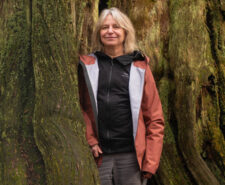


Bowering in Mexico
In one of his last books, famed BC writer, George Bowering tells of his seven trips to Mexico in his 70s and early 80s. His favourite spot was the small village of La Manzanilla.
August 25th, 2026
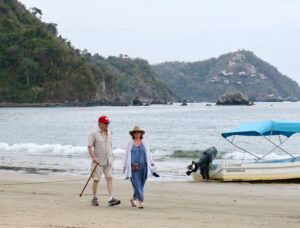
George Bowering with his wife, Jean Baird, La Manzanilla, Mexico, 2018.
“[La Manzanilla] boasts a mangrove swamp inhabited by crocodiles and local characters, such as Pedro, whose red ball cap reads ‘Make America Mexican Again!’”
Review by Gene Homel
Increasingly, Canadians escaping cold winters are heading down to Mexico as an alternative to the United States and, now, Cuba. Famed BC writer, George Bowering recounts his Mexican travels in his new book, Barefoot Gringo (UBC Press $26.95).
In this case, the gang of barefoot gringos consists of Bowering, his beloved wife Jean Baird and a circle of elderly, good friends who take to the mid-Pacific coast of Mexico in the winter months.
Barefoot Gringo is both a travelogue and daily diary based on seven stays during the 2010s in La Manzanilla, a small fishing village on Tenacatita Bay hours south of Puerto Vallarta and not far from Melaque, another village popular with, as Bowering says, “a lot of pretty ugly-looking gringos” from Canada’s west coast. No wonder National Hockey League jerseys are found in the local village markets, and in Puerto Vallarta, which hosts “one or two zillion US tourists.”
Although Bowering also recounts his stays in Mexico City, Puebla and Mayan country, the heart of this book is La Manzanilla, which means chamomile and is not to be confused with the large city of Manzanillo to the south. “His” town boasts a mangrove swamp inhabited by crocodiles and local characters, such as Pedro, whose red ball cap reads “Make America Mexican Again!” Bowering and his pals are Mexican-food enthusiasts and frequently have a cerveza Pacifico or margarita in their hands, especially when they’re playing cribbage, one of their favourite pastimes.
If you know Bowering’s writings, you know he’s an enthusiastic observer of the small things in the world around him—he’s an acute observer of bird life, for example, and, the tradition of having a horse with braided mane and flowers attached to its tail at Mexican weddings.
As with 18th-century poet and mystic William Blake, Bowering sees a world in a grain of sand. When he gets to the beach at Okanagan Lake in Penticton, where he was born in 1935, “I do the same thing,” he says, “scoop up a handful and look at it carefully. If you have two thousand grains of sand in your hand, they will be a hundred colors at least. Makes you think of the universe.”
Bowering’s narrative perambulates as easily and lightly as a sunny walk on the beach. He has long been associated with a wry, sometimes self-deprecating sense of humour. Of the familiar “art walks” found in Mexican tourist areas, he finds paintings and mobiles “produced by gringos who spend more than two weeks a year in our little fish town.” Why travel to a Mexican village to buy art from someone from Wisconsin, he wonders?
Writer Barbara Kingsolver, he tells us, won Britain’s Orange Prize for Fiction, a prize exclusively for the best women writers. Bowering wonders “whether there were a Lemon Prize for the worst book written by a woman.” It’s fun, he adds, to read fiction set in a foreign country one is visiting. “Maybe someday a traveller will experience that while reading The Martian Chronicles.”
If you are looking for comments on Mexican society or politics, search elsewhere, though Bowering does swear that “Mexicans are the nicest people you will find in the New World.”
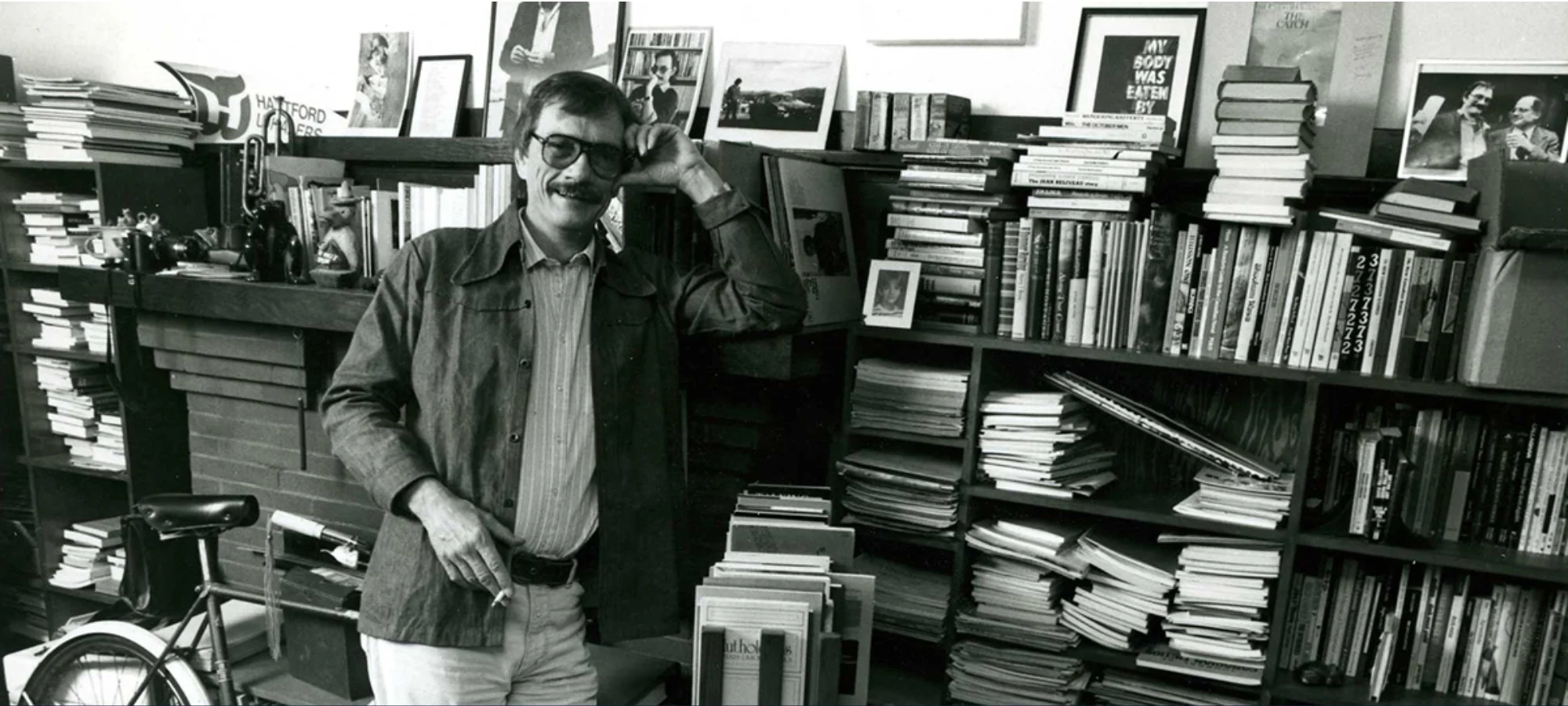
George Bowering among books in his home study at 2499 West 37th Ave., c. 1981.
Instead, Barefoot Gringo is a love note, not just for Mexico but also for his wife and helpmate, Jean Baird, “my sweetheart and the heroine of my mature books.” “[L]ove is greatest when you are old,” he says. We’ve already met Jean in a previous book. Bowering’s lifelong, international love affair with baseball in Baseball Love (Talonbooks, 2006) recounts their road-trip travels to various North American ballparks.
Bowering loves his pals, too. One of his more eloquent sentences describes their “comical talk, friendly mockery, complex falsehoods, and so on in our games, the usual camaraderie of folk who realize that they should feel a little…not guilty but at least thankful for being on a warm seaside with cold drinks while most people they knew were frowning in the rain up north, or even the piled-up snow back east.”
The latter chapters of Barefoot Gringo are pervaded with a sense of aging and mortality. These trips take place while Bowering is in his late seventies and eighties, and, combined with concurrent health crises, he mentions his inhalers, his cane, wheelchairs, failing eyesight, broken bones and hospital visits. He wonders “whether old guys like me should just stay home.” Though he says he is “an old gimpy half-blind heart-and-lung patient,” the allure of Mexican travel triumphs once again.
His writing formula now is this: “the older you get, the less time you have left, so the faster and longer you should be writing.”
Sitting on his balcony in Manzanilla, he relates, “I decided to tell God what I want to do in Heaven: I want to watch puppies playing on a beach, if they have beaches up there.” 9780774890786
Gene Homel has been a faculty member at universities, colleges and institutes since 1974 teaching history and politics.





Leave a Reply