

Land back
The Supreme Court has ruled consistently that Aboriginal title is a reality. It can't be wished away. George Abbott chronicles how and why we got to where we are.
July 20th, 2026
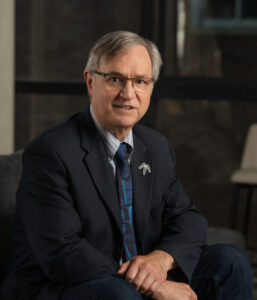
George Abbott is a former politician and cabinet minister for the Canadian province of B.C.
“We’re now having to deal in 2026 with issues that might have been remedied effectively 170 years ago, but were not.”
Review by Rod Mickleburgh
George Abbott’s illuminating account of the long, troubled history of British Columbia’s treatment of its original inhabitants could not be more pertinent, given two recent court decisions that have upset the apple cart on what had been a slow but steady path towards reconciliation.
Rulings that the Cowichan Nation’s Aboriginal title includes some fee simple property on the south arm of the Fraser and that BC’s longtime Mineral Tenure Act is inconsistent with the province’s Declaration on the Rights of Indigenous People Act set off a wave of angst.
Premier Dave Eby has vowed to appeal both decisions and make changes to DRIPA. BC Conservatives want the act repealed, while municipal politicians and residents have unleashed a torrent of alarmist rhetoric. An Angus Reid poll found, for the first time, a majority of British Columbians believe DRIPA “goes too far in limiting provincial authority.”
Abbott, twice a Liberal Minister of Aboriginal Affairs and now chief commissioner of the BC Treaty Commission, brings knowledge and empathy to the subject, and it’s heartening that Unceded: Understanding British Columbia’s Colonial Past and Why It Matters (UBC Press $29.95) has been a surprise best-seller.
Unceded is essentially two books in one. The latter half covers modern developments, including the historic Nisga’a Treaty, milestone rulings by Canada’s top court, and the varying approaches of different governments to reconciliation. Abbott doesn’t miss the chance to lob a few potshots at his former leaders Gordon Campbell and Christy Clark, as well as issue his own mea culpa for voting against the Nisga’a Treaty.
It’s the first half of Unceded that really hits home. In meticulous detail, Abbott documents the relentless injustices visited on BC’s Indigenous people in the 19th and early 20th century. Their rights were eroded, their land occupied, their ability to earn a living stymied.
Complaints about DRIPA overriding the right to stake claims on Indigenous land seem hollow, when First Nations, themselves, were denied mineral rights to land on their own reserves.
As for current cries over the sanctity of private property, Abbott notes that land First Nations had occupied for centuries was regularly sold off without consent. “Although our houses are on… old village sites,” protested Chief Owahagaleese of the Kwawkewlth, “the BC government seems to have been able to sell it from under us and we have to pay rent on the houses we are living in and the land we are living on, because it has been sold to white people.”
These are just some examples among a litany of wrongs that add real substance to Abbott’s book. It’s one thing to accept that First Nations were treated badly during BC’s colonial past, which few dispute. It’s yet another to view it up close in horrific detail. It makes for hard reading.
Most British Columbians know BC is the only Canadian province that did not bother to sign treaties, because its leaders believed there was no Aboriginal title to be extinguished. But how many know that, in addition, First Nations were shunted onto reserves that were then drastically cut back, until they were by far the smallest in Canada?
The initial wave of reductions was spearheaded by the notorious Joseph Trutch, BC’s first commissioner of lands, who considered Indigenous people “utter savages.” Confronted with the relatively generous, informal allotments advocated by BC’s far-sighted first Governor, James Douglas, Trutch had them slashed by 92 per cent, at a time when the Indian population outnumbered white settlers by four to one.
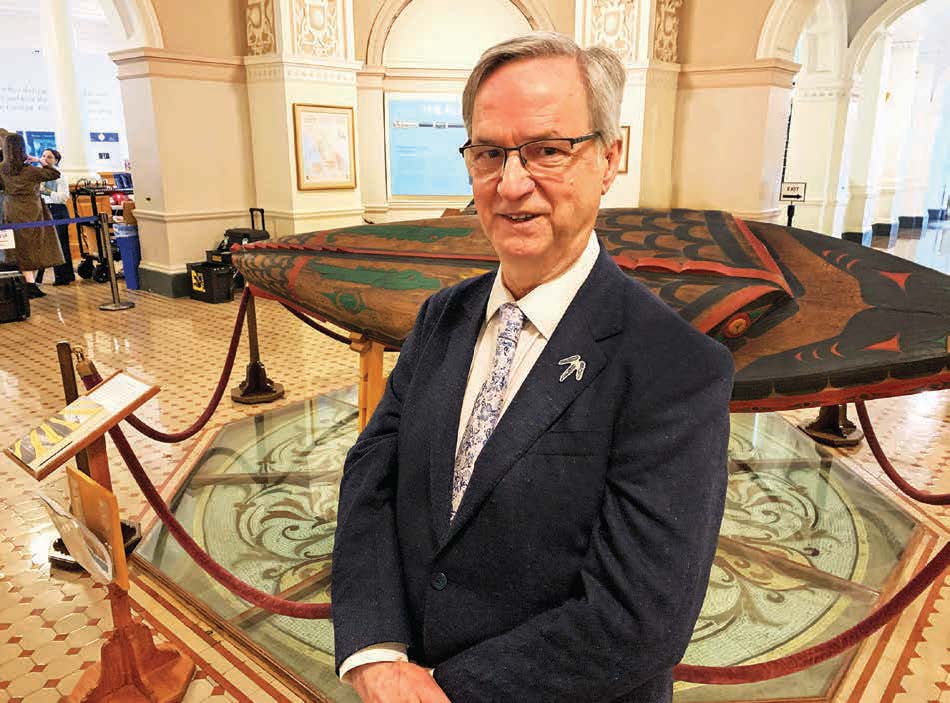
George Abbott, at the BC Parliament buildings, stands with Shxwtitostel, a traditional inland river canoe carved by Chief Tony Hunt, Hereditary Chief of the KwaGulth, and the Honourable Steven L. Point (Xwĕ lī qwĕl tĕl), 28th Lieutenant Governor of BC, who also wrote the Foreword to Unceded.
Even that proved too bountiful. As immigration boomed and First Nations continued to demand title to their unceded land, BC and Ottawa established the McKenna-McBride Royal Commission in 1912 to settle “the Indian land question” once and for all. They settled it with a second wave of reserve reductions.
Referencing the Commission’s extensive archives, Abbott is able to catalog the reductions, while highlighting often contemptible exchanges between commissioners and Indigenous witnesses pleading for retention of their surviving land and a return of their lost territory.
When Sam Pierre of the Splatsin Band near Enderby declined to provide information about his reserve without being told how it would be used, Commission Chair Edward Wetmore retorted: “We are not here to be examined by the Indians. We are here to examine the Indians… Do you know that we could place you in prison for not answering our questions?” The Commission subsequently slashed 1,600 acres from the Splatsin’s 5,625-acre reserve.
Virtually all decent agricultural land was stripped from existing reserves, because Commissioners believed only whites knew how to farm it. Overall, the Commission removed nearly 50,000 more acres from BC’s already stripped-back reserves. Observes Abbott: “Commission decisions were invariably guided by the presumption that five white men briefly visiting a region knew what was best for Indigenous peoples who had occupied those lands for so many hundreds of years.”
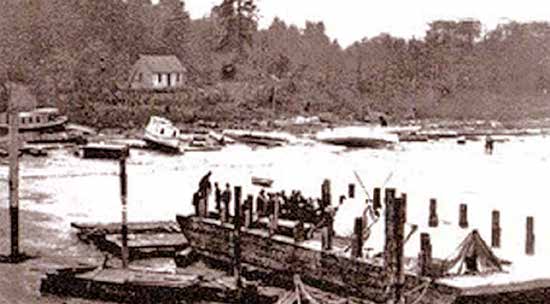
In 1913, with just two days’ notice, Squamish First Nations were forced to abandon their homes on Kits Point and pack up and head to the North Shore on this barge. The BC government under Conservative premier Richard McBride was forcing them to move so the city of Vancouver could expand.
Through all the setbacks, First Nations leaders kept pressing their land claims, arguing with eloquence and dignity that their territory had never been relinquished, hence the book’s pointed title, Unceded. They got nowhere. The long-ago assertion by Joseph Trutch that “Indians really have no right to the land they claim” was echoed by BC governments for the next 120 years. Premier Bill Bennett might have been Trutch, himself, when he proclaimed that “if any aboriginal title or interest may once have existed, that title was extinguished prior to the union of British Columbia with Canada in 1871.”
That was then. This is now. The Supreme Court has ruled consistently that Aboriginal title is a reality. It can’t be wished away. Those griping about Indigenous demands would be advised to read Abbott’s valuable book that spells out in clinical detail how and why we got to where we are today. It is not due to accidents of history, but rather deliberate government decisions to ignore First Nations and relegate them to a marginal existence. “We’re now having to deal in 2026 with issues that might have been remedied effectively 170 years ago, but were not,” Abbott has said.
The array of complex issues ahead is vast, but luckily for us who are non-Indigenous, BC’s First Nations appear more conciliatory than our ancestors. Amid all the hullabaloo stirred up by the Cowichan decision, they have professed no interest in claiming private property in their traditional territories. Said a Xeni Gwet’in elder: “We do not want to do to them, what was done to us.” 9780774881159
Rod Mickleburgh co-authored John Horgan: In His Own Words with John Horgan (Harbour, 2025), and co-authored with Geoff Meggs, The Art of the Impossible: Dave Barrett & the NDP in Power, 1972- 1975 (Harbour, 2012) that won the Hubert Evans Prize.




Leave a Reply