


A gay coach speaks up
Elite athlete and coach, Betty Baxter's memoir of battling homophobia in sports in the 1980s remains relevant today.
May 06th, 2026
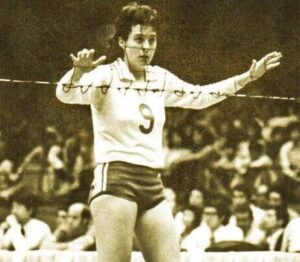
Betty Baxter in the 1970s during her years of international success as a volleyball player.
[Betty Baxter’s] dedication to making sports better for women athletes shines through on every page. She continues to respond to media requests for comment about LGBTQ+ representation in sport because, as one exasperated reporter said in 2010, no other lesbian coach, athlete or administrator was willing to publicly identify herself. “I realized then that the struggle for equality in sport was far from over,” says Baxter.
Review by Carellin Brooks
Former volleyball star Betty Baxter first became aware of the rumours in 1981. Hired just a year earlier as the first woman anywhere to coach a national sports team, Baxter weathered the media attention that followed. She never said anything about being a lesbian, not in 1980s Canada. Nobody asked and she had no plans to tell.
That all changed when the board of the Canadian Volleyball Association summoned her to a meeting. “There is a lot of talk about you being a lesbian—too much talk,” a colleague warned her, assuring her that he wasn’t homophobic himself. When Baxter asked him what the issue was with her sexuality, he responded, “Well, what parent would send their daughter to a program if they knew the coach was a lesbian?”
Despite having engaged in no inappropriate behaviour with anyone, the mere fact of her sexuality is a firing offense. Baxter consults a lawyer, who informs her that sexual orientation is not a protected ground of discrimination: in other words, the association has the legal right to fire her. “I assure you that I am the same person I’ve been as an elite athlete with this organization for over a decade,” she tells the president. After she refuses to deny her sexuality, her former coach stands up and punches the wall. “You’d never have been given this job if I’d known that!” he shouts.

Betty Baxter today
Why the ire? By her own account, Baxter is a good coach and a trustworthy mentor to the young women in her care. She figures out how to motivate them, enforces the rules and helps them find joy in the game even when playing a much better team.
Baxter doesn’t belabour the point, but long before stories of abusive behaviour in sport started making headlines, it was not the predatory lesbian a young female athlete had to avoid, but the male coach who invited her into his hotel room for special one-on-one sessions on team trips. When Baxter hears the athletes’ tearful stories about one such coach—whom the young female athletes are afraid will cut them from the team if they protest—she reports him. The mostly-male athletic establishment admits her complaint isn’t the first and quietly removes him from coaching the world juniors team.
There are no criminal charges, families aren’t warned and the coach himself isn’t fired or charged with any offense. He continues to coach university athletes for years to come. As Baxter discovers later, the norms of Canadian high-performance sport mean this behaviour is almost guaranteed to go unpunished: “The elite athletes we interviewed about how to improve their sport experience…had one thing in common. They were compliant. They had no criticism of their governing bodies, no criticism of the programs they were offered and no criticism of their coaches,” writes Baxter. “Non-compliance often leads to a career-ending moment for both athletes and coaches. The unspoken core requirement for success in sport in Canada was deference to the system…complete obedience…even if the coach’s demands were unreasonable, abusive or even illegal.”
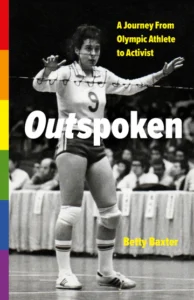 Outspoken: A Journey from Olympic Athlete to Activist by Betty Baxter (Nightwood Editions $23.95) is a story that needed to be told. Not everyone is aware of the bad old days when lesbians had to conduct their entirely unexceptional love lives undercover for fear of outsize repercussions: being blacklisted, losing jobs, being denied housing or having their children taken away by vengeful ex-husbands. Baxter’s humiliating firing—she’d been in the top spot for less than two years when she was let go—turned her away from sports entirely. The team she coached was told nothing. The girls assumed she’d simply abandoned them without a word of goodbye. It took years for Baxter to find her way back to sport, ironically through the first-ever Gay Games in San Francisco she attended with her girlfriend Anita. “In Ottawa and in Vancouver the gay bars had been in secret locations—often in dark alleys behind unmarked doorways, and when you rang a buzzer, a small slot opened to reveal an unrecognizable face behind a grate,” writes Baxter. By contrast, “hanging out in the Castro area watching the antics as women and men from cities across North America celebrated on the streets was both eye-opening and healing because everyone was out and proud and so clearly having a good time.”
This book could have benefitted from restructuring: the chronological progression ensures that the most significant moments in the narrative tend to sneak up on the reader. Whether visiting China when foreigners were largely barred, encountering farcical amounts of trouble crossing European borders or communicating with a Bulgarian master coach without a common language, Baxter shows herself to be resourceful, intelligent and highly adaptable, but such moments do little to advance her thesis. Baxter also provides almost no context for the homophobia she experienced. Was it rampant? Rare? Everyday? As a lesbian who came of age in the 1990s, I would love to know more about the clubs, relationships and lesbian world of a decade earlier. Girlfriends and partners are only briefly mentioned in this book: most merit less than a full sentence. While Baxter might simply be protective of these women’s privacy, readers of memoirs expect some revelations about the writer’s personal life or, if they are missing, an explanation why.
These are small quibbles about what is overall a compelling narrative. I learned about the mindset of athletes at the top of their respective sports, the hours and hours of training every day devoted to the pursuit of excellence and the pitfalls Baxter experienced personally. Her dedication to making sports better for women athletes shines through on every page. She continues to respond to media requests for comment about LGBTQ+ representation in sport because, as one exasperated reporter said in 2010, no other lesbian coach, athlete or administrator was willing to publicly identify herself. “I realized then that the struggle for equality in sport was far from over,” says Baxter. Indeed, as she notes in her epilogue, “there is still so much work to do.” Consider Outspoken a passing of the torch to the next generation of athletes cum advocates for equality on and off the court. 9780889715066
Carellin Brooks is a lifelong non-athlete and the author of books including Learned and Wreck Beach, now on sale at a Licorice Parlour near you.





Leave a Reply