


Living cheap, well
January 27th, 2026

Steve Burgess is a writer and broadcaster whose new book Cheapskate in Lotusland: The Philosophy and Practice of Living Well on a Small Budget (Douglas & McIntyre $26.95) explores how frugality can be a thoughtful, even joyful way of life. Set in one of North America’s most expensive cities, the book blends memoir, economic reflection and social observation, drawing on Burgess’s decades-long experience of living well without earning much. A two-time Canadian National Magazine Award winner and contributing editor at The Tyee, Burgess is also the author of Reservations: The Pleasures and Perils of Travel (Douglas & McIntyre, 2024), longlisted for the Leacock Medal.
*
Question: Most people who write books about saving money call themselves gurus or have a philosophy. You counter that with: “I’m not really a philosopher. I’m just someone who is trying to save money.” If your book is not a self-help book, what would you classify it as?
Steve Burgess: How about “a bargain at under thirty dollars?” I would say the book is an examination, rather than a handbook. It definitely contains personal tips on saving money. But throughout I remind the reader that my circumstances are not universal, so I am unable to offer universal prescriptions. Writing a book is an exploration—ideally, the author is learning as they go. I was surprised and delighted at how many aspects of frugality there were to explore. So I explored them, and hope people will join me.
Q: I love the reference to Vancouver as “Lotusland”. You describe it as “a backhanded compliment that combined a nod to the city’s physical beauty with a vague implication that this is not a serious place”. What made you decide to include Lotusland in the title?
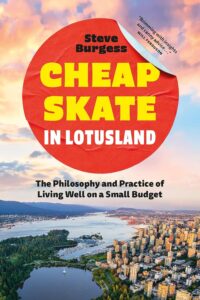 SB: The term was coined by former Maclean’s columnist Alan Fotheringham as a description of our city. I have become aware that very few young people are familiar with it. To a lot of readers, I think it will just be a mysterious reference. Hopefully an intriguing one.
Q: Your book covers some very depressing topics, like shrinkflation, economic impact, and the costs of food waste, yet you tackle it with classic humour (and copious Monty Python references). Did you find it difficult balancing out hard truths with humour, or was it necessary?
SB: That’s a bit like asking a frog if its long tongue is helpful in catching flies. Got to use the tools you have. As long as I have been writing I have at least tried to use humour. It’s my most reliable fly-catcher. Of course, the frog’s aim isn’t always on target. Hope I nailed a few.
Q: There is a link between living frugally and having a smaller footprint. Still, you write that: “A couple of studies have shown that if individuals did everything they could to reduce their footprints it might make a difference of between 2 and 10 percent. The heavy lifting has to be done by governments.” When you’re up against statistics like this, how do you combat the feeling that your choices don’t matter?
SB: Remember that voting is an action. You can help choose your government. And although I quote that opinion (from William Rees as I recall), I would like to push back against it a little. A pile of pebbles can become a mountain. Let’s all do what we can.
Q: You speak often of your routines and natural obsessiveness as things that end up saving you money. Is being frugal pre-ingrained in some people more than others? Is it a matter of nature vs. nurture?
SB: Very interesting question, and a slippery one. The stereotype of the Depression child who lived through the 1930s and never got over the fear of scarcity suggests that nurture, or experience, plays a big role. Certainly when I was very young our family had little to spare—five young kids on a United Church fieldworker’s salary. Getting a dime to spend was a big deal. But I also know that my obsessive nature, which I was certainly born with, has always played a big role in my tight-fistedness. How about my Scottish heritage? Are Scots naturally cheap, as the stereotype suggests? It’s a topic I explore in the book but of course it’s rather dangerous to start suggesting personal traits are bred in the bone.
Q: “The amount of food waste in Canada is staggering. According to Second Harvest, 41 percent of Canadian food production goes to waste—enough to provide three meals for 17 million people every day of the year.” Another depressing statistic! Do you ever marvel at how we live in a world with so many people living in food insecurity, and also so much waste?
SB: Sure, but that’s always been the case. Arguments about capitalism always get down to the unequal distribution of resources vs. the question of whether other systems would be an improvement. What that statistic suggests to me is that if attitudes change—and I include personal attitudes about what is waste and what is not—and distribution systems are supported, we can go a long way toward battling food insecurity.
Q: “Once upon a time, Safeway would give you a solid discount on a mouldy block of cheese—I used to scour the dairy case looking for compromised packages—but unfortunately they discontinued that policy in favour of simply removing such items and disposing of them. Phoo.” It’s hard to imagine seeing moldy cheese on sale at a store today—almost as hard as it is to imagine getting rid of best before dates! Have grocery stores changed so much so fast? Is there anything else you’d bring back to grocery stores today?
SB: Best before dates are being re-thought—the British company that invented them, Marks & Spencer, is now moving away from best-before dates because they are so often misinterpreted and cause so much needless waste and expense. Post Banana Nut Crunch Cereal. That’s what I would bring back. It’s not sold in Canada anymore. Sometimes I think there’s a spy who follows me around, sees my favourite products, and discontinues them. That’s not clinical paranoia, is it?
Q: “One major international discount chain did make an attempt to invade Canada. It went about as well as Napoleon’s march on Moscow. Target Canada launched in 2013, opened 133 Canadian locations, and by April 2015 was a heap of smouldering rubble.” Is there any civic pride in Canada’s resistance to international discount chains?
SB: In retrospect, we can take pride in repelling Target, although at the time Canadians could hardly have foreseen the reasons why. After Trump took office and discouraged DEI (Diversity, Equity, Inclusion) hiring policies, Target caved in. Costco did not. Costco sales went up, Target sales went down. Deservedly.
Q: You have a beautiful section on misers (and all of their synonyms). Do you have anyone in your life that would consider you a miser? How thin is the line between frugal and miserly?
SB: I’d say the people who might consider me a miser include anybody who’s known me longer than a week. I am a cheapskate. I sort of wear it on my sleeve.
Historically, the difference between a wise and frugal person and a wicked miser has been wealth. People of modest means, especially those with children, have always been praised for their frugality. Wealthy people who are also cheap become the butt of terrible stories in which they get their come-uppance. There’s a great one in the book about the old skinflint who pretended to be dead so he wouldn’t have to feed his servants. It doesn’t end well for him.
Q: “A writer can only hope that reading their book will prove educational.” What do you hope people learn from reading your book?
SB: I hope people will see how the topic of frugality has so many aspects and so many consequences. I felt like I could keep adding chapters ad infinitum but I hope what I did include will feel relevant to people. One question that I really struggled with is balancing the advantages of frugality with the need to support local business. How do we try to spend wisely without allowing Walmart to gobble up the entire retail environment?
Q: Have you gotten any really, really good deals recently?
SB: Sure but another recent moment comes to mind more readily. A couple of years ago I was at a grocery store and saw packages of shredded coconut priced at three cents each. I notified an employee that there was a mistake in pricing. Nope, I was told, that’s the price—three cents a package. I was so excited I ran around alerting strangers to the deal. What would I do with shredded coconut? No idea but I grabbed a bunch of them. Three cents each!
A couple of weeks ago I was cleaning out a cupboard. Way in the back, several packages of shredded and very stale coconut. Emptied them into the compost. That’s nine cents I will never see again. 9781771624633





Leave a Reply